














































By Fadel Lo
Senegalese music is assimilated to its most-known genre, Mbalax, to the point that all musical genres coming from Senegal are mistakenly named Mbalax.
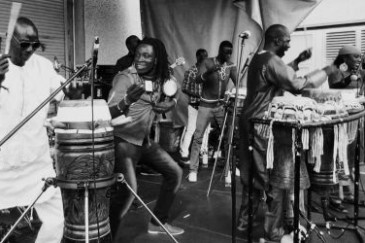
Senegalese music has long been associated with the genre called Mbalax and this name is now associated with all music genres from this country. The term has been made famous around the world thanks to artists like Youssou N'Dour. Mbalax’s particular rhythm is obtained from a local instrument called sabar and has become the trademark of Senegalese music. Mbalax has completely overshadowed every other genre. Its local supremacy has prompted the creation of derivative genres such as ‘rock mbalax’, ‘zouk mbalax’ or even ‘salsa mbalax’. But its long march towards recognition wasn’t easy on the local scene. Mbalax music had to go through several stages and transformations before reaching its current status. While it is undeniable that Mbalax has become a major genre on the local music scene, we have to admit that it has failed to do so on the international scene.
The rise of Mbalax
According to the legendary drum maestro Doudou Ndiaye Rose, whose opinion can be considered authoritative, Mbalax is played with the sabar, a small instrument used by percussionists from the Wolof ethnic group. Ndiaye Rose, a respected musician who has imposed his style and class around the world, explains that Mbalax is actually the background instrumentation played by a band of percussionists. In time, the term came to be associated with any music coming from Senegal. This association is understandable because the Mbalax is a rhythm that belongs to the Wolof people, the major ethnic group in Senegal. Wolof is commonly spoken across major cities. Although Senegalese people are music lovers and appreciate different musical genres, Mbalax has indeed become their most appreciated musical genre, with Youssou N'Dour considered the king of the genre. Many Mbalax drummers have managed to launch successful careers, such as Mbaye Dieye Faye, Salam Diallo and Pape Ndiaye Thiopéte. It is therefore interesting to look at the long road that has shaped Mbalax into the most popular genre in Senegal today.
It should be noted that Senegal has a long tradition of hospitality. As a result, different bands and orchestras traveled throughout Dakar and the rest of the country. But it was not until the end of WWII that orchestras bloomed everywhere in Dakar. At that time, the Senegalese, who were still part of the French colony, liked to party. Bands and orchestras needed to be present in order to have a successful party. These bands liked to do renditions of European and American classics.
During the independence era, veteran artist and saxophone player Bira Guéye tried to innovate and promote a new musical genre. He started to feature on stage female singers like Mada Thiam who were singing in Wolof. Their repertoire was inspired by local folklore. During that time, other local artists were simply singing international classics of tango, waltz, biguine and other international genres.
This era lasted until the arrival of Ibra Kassé on the local scene. Kassé, a native of Kaolack, opened a night-club called “Le Miami” upon his return from France at the end of the WWII. The Star Band, the night-club’s resident orchestra was entertaining the public and thus Kassé started to redefine and shape Senegalese music by giving it its own identity. He began by introducing local languages in songs, then the use of the tama, a local drum held under the armpit. Artists like Doudou Sow and Mamane Fall played a leading role in the Star Band. In the late 1970s and following the departure of Pape Seck (who went on to create his own band, Star Band Number One), Kassé gave a young musician named Youssou N'Dour the opportunity to join the band. N'Dour was patiently ‘readying his weapons’ and began timidly introducing tunes from local folklore. Songs like ‘Guédj’ and ‘Faye Birame Penda Wagane’ started to steal the limelight from N'Dour’s friend Assane Thiam’s well-loved tama compositions. But it took decades before these musical innovations became completely accepted by music lovers.
Other groups had also been trying to establish themselves, including Orchestras such as Baobab and Number One. In the early 1970s the group Sahel from Dakar timidly had tried to shake things up. Artists like Cheikh Tidiane Tall, Idrissa Diop and the late Seydina Wade tried to innovate by singing in Wolof over sabar rhythms. But the experiment was not conclusive because the band broke up after only three years of existence
Ultimately it was the Super Diamono of Dakar who initiated a real revolution. Beside tama they introduced real Wolof drums percussion with the contribution of Aziz Seck (son of Aly Guéye Seck) of Kaolack. Seck possessed a real mastery of his art and had no difficulty blending in with this new band. Omar Pene, Bailo Diagne Faye and Adama, along with the rest of group, completely broke away from what was happening on the musical scene. Pene, who sang only in Wolof, successfully lent his great voice to the sophisticated sounds of Super Diamono. The group walked in the footsteps of Ifang Bondi of Banjul, Gambia and managed to forge a new genre that would later be emulated by many. Orchestras such as Étoile de Dakar, Canari de Kaolack and the Royal Band of Thiès were trying to keep up with this new pace while remaining faithful to the Afro-Cuban music that had prevailed for so many years.
Mbalax in the mainstream
It was not until the beginning of the 1980s with the rise of the Super Étoile of Youssou N'Dour that Mbalax finally managed to dominate the local scene. A child of Medina, one of the oldest and most populous areas of Dakar, N'Dour had left L’Étoile de Dakar to create Super Étoile and managed to quickly captivate the crowds. He made a dramatic shift from the Afro-Cuban style that had prevailed for decades. At the beginning of his solo career, Youssou N'Dour had often been compared to his former bandmate El Hadji Faye, but he quickly stood out. As the sole leader of the newly formed band, he took some risks like singing in Wolof and showcasing his peers such as Assane Thiam, Mbaye Faye Dieye and Alla Seck. Seck excelled in Tassou, the Wolof musical art consisting of rapping at a fast pace. N'Dour continuously innovated by creating new rhythms and dance styles like the famous ‘ventilateur’ (meaning ventilator or fan). He thus put in place a new combination that won the hearts of music lovers.
The beginning of the 1980s also saw the launch of careers of new Senegalese artists. Thione Seck left Baobab to set up the Raam Daan and came up with his own style. Relying on a frenzied pace with more than three percussionists, his hardcore Mbalax dance music style made him popular in Dakar’s nightclubs such as le Sahel and Orca. Ismaël Lô, a talented guitarist nicknamed the ‘one-man-orchestra’, also created his own band after leaving Super Diamono. Baaba Maal launched a new sound called Yéla and quickly established his style of world music sounds mixed with mbalax. This prolific period lasted for more than two decades. Lamine Faye, who formed his band Lemzo Diamono in the early 1990s, also brought in a new twist. A talented guitarist and arranger, he created a new fast-paced sound that gave the keyboard a major role, along with instruments like the kora or balafon. Lemzo Diamono seriously disrupted the existing hierarchy and quickly became a regular feature on the local music scene. Unfortunately the adventure did not last long and the group broke up later in the decade, disappointing many fans.
Defectors of the band like Alioune Mbaye Nder and Fallou Dieng enjoyed limited success after leaving the group. Younger artists like Alioune Kassé, Boy Marone, Coumba Gawlo and Abdou Guitté Seck also managed to launch their own careers. Cheikh Tidiane Tall experimented with different styles in a “tradi-modern” fusion and helped launch the careers of many females artists, such as
Kiné Lam and her band, Kagou the mid-90s. Many would follow in her footsteps, like Dial Mbaye, Soda Mama, Daro Mbaye, Madiodio Gning, Fatou Guewël, and the late Aby Ngana Diop, among others.
At the same time some artists, aware of the dominant role of Mbalax, tried to innovate by creating derived genres. Examples include the late Demba Dia with his rock- mbalax, Ndjolor of Castors with his zouk-mbalax, Black Mbolo with his rap-mbalax and Super Cayor with its salsa-mbalax. It was the golden age of the genre and the market was swamped with any kind of productions. This prolific period ended at the beginning of the 1990s with newcomers struggling to ensure the continuity of the mbalax musical genre. Artists like Pape Diouf, Viviane N'Dour, Mada Ba, Amy Mbengue, Daba Seye, Titi, Waly Seck and Abou Thioubalo all tried to launch their careers around that time, some more successfully than others.
A few drummers, already recognized masters in the art of producing rhythms, tried to launch singing careers and enjoyed some success. These include artists like Mbaye Dieye Faye, Salam Diallo, Pape Ndiaye Thiopéte, Secka, Bada Seck and Bakane Seck, among others. Some of these upcoming artists stood out, but they never managed to overshadow established household names such as Youssou N'Dour, Thione Seck, Baaba Maal and Ismaël Lô.
Despite its success on the local scene, Mbalax has failed to establish itself on the international scene. Veteran musician Vieux Mac Faye puts this failure down to the fact that Mbalakh is based on ternary rhythms that are largely unknown to western audiences. In his opinion, this is a great disadvantage. This seems to be the reasonable explanation because most artists who have managed to achieve international recognition have had to diversify their sound and venture beyond Mbalax, such as the late Gambian-born musician Laba Sosseh, Youssou N'Dour (with his 1994 hit ‘7 Seconds’), Coumba Gawlo (with ‘Pata Pata’ in 1998) and the band Touré Kunda, who have enjoyed huge popularity in Europe since the 1980s with their reggae- and salsa-influenced fusion inspired by the Senegalese coming-of-age ceremony known as Djamba Dong. There is an urgent need to find the right combination that will make Mbalax explode internationally, a long-term endeavor that will probably be led by young talents.


Most popular
Call For Applications : ACCES seeks a UK-based performer
10 Sep 2026

Top amapiano songs of 2026
16 Feb 2026

Top Afrobeats songs of 2026
19 Mar 2026
Open call: FAME Week Africa, Pressure Cooker Studios songwriting camp
09 Sep 2026
Open call: Ernst von Siemens Music Foundation 2026 funding programmes
04 Sep 2026
Open call: Goethe-Institut grants for Southern African creatives
08 Sep 2026
AFRIMA 2026: All the winners
12 Jan 2026
Disclaimer: Music In Africa provides a platform for musicians and contributors to embed music and videos solely for promotional purposes. If any track or video embedded on this platform violates any copyrights please inform us immediately and we will take it down. Please read our Terms of Use for more.

Subscribe to our monthly Newsletter
Follow us on social media


Please log in to post a comment.