


















































In Swaziland, music making is centred around the urban hubs of Mbabane, Manzini and Matsapha, with small venues and bars hosting occasional live music events. Numerous churches in these areas have live bands and singers, and provide much needed regular employment for musicians. Near Matsapha, the arts centre House On Fire hosts the annual Bushfire music festival, which draws local and international musicians together every year and provides local artists with a platform to perform.
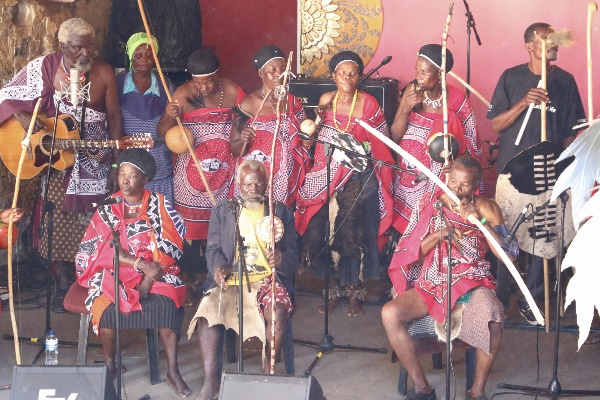
In the rural areas, radio is still the most important form of cultural mediation, with few remaining performing traditional musicians spread across the countryside. The remaining traditional musicians are enthusiastic about sharing their skills. Slowly, young, urban musicians are engaging with what is often still seen as music of the past. This text provides an overview of traditional music in Swaziland.
Umhlanga, Incwala and Swazi vocal performance
Swaziland has an extensive annual calendar of cultural events, with numerous mass national celebrations. The two most notable events are the incwala kingship ceremony and the umhlanga reed dance, both of which bring people together from across regions to sing and dance in their assigned regiments or age-groups.
The Incwala, the annual kingship rite, involves a sequence of different performed rituals by the young male regiments over a period of a month. The Umhlanga is an eight-day ceremony where all the young women of the nation cut reeds and present these to the Queen Mother or indlovukati. During the festivities, groups of young women, divided according to their region, dance and sing acapella call-and-response vocal songs. In both ceremonies, sacred and secular historic vocal music is used to demarcate rite and accompany processions.
Swazi vocal music, like other southern African singing, is marked by its call-and-response structure, and what David Rycroft (1967 & 1976) called ‘phrase shifts’ (when call-and-response start and end points are moved during a song’s performance).
Beyond the repertory of umhlanga and incwala regimental songs, vocal music accompanies wedding celebrations, manual work, and all types of worship. Aside from these mass-participatory cultural events, much traditional Swazi music is played in smaller gatherings or when musicians are on their own. Much of the instrumental music of the country was and continues to be played while the musician walks from one destination to another, works, or rests at home.
Traditional instruments and players
The most prominent local instruments are the voice, the makhoyane (bow) and the isitolotolo (mouth harp). Players and makers of the makhoyane, isitolotolo and other traditional instruments are largely based in the middle and lowveld rural areas of Swaziland.
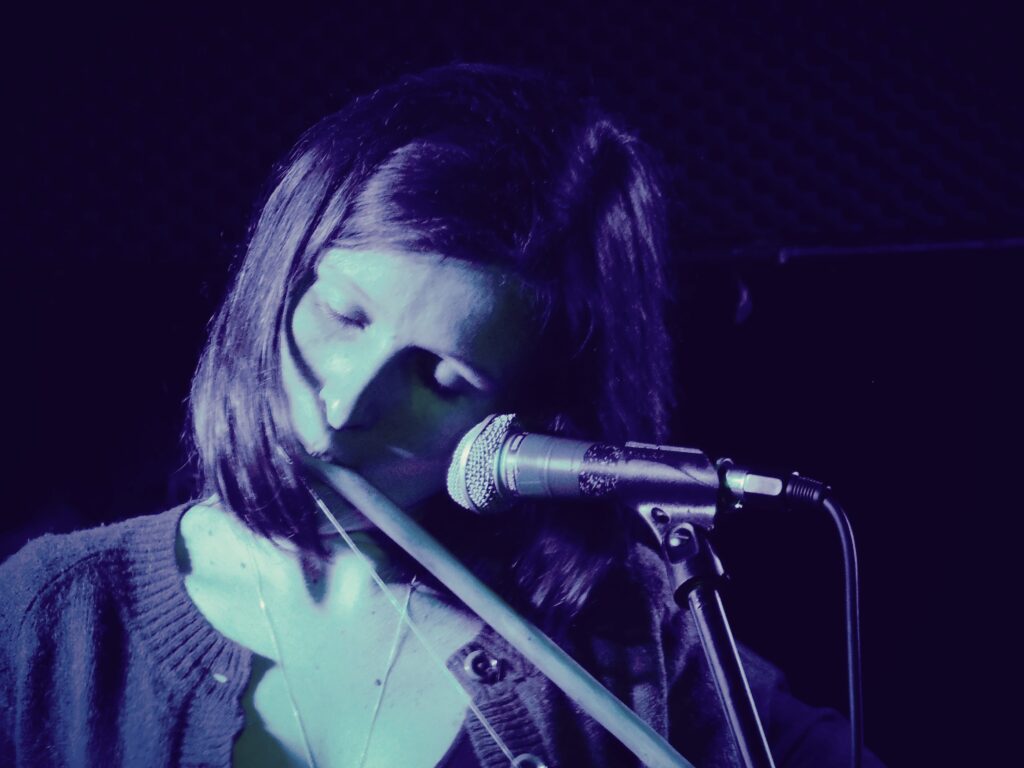
The makhoyane is a tall, gourd-resonated braced musical bow. It is largely considered the national instrument of Swaziland and a recording of it heralds in the hourly news broadcasts on local Siswati radio. Despite this, there are few remaining players of the makhoyane and those who still perform are now elderly. Notable performers on the makhoyane include Bhemani Magagula, Khokhiwe Mphila, Sonile Sifundza, Katherine Magagula, Tfobi Shongwe and Cecilia Mdluli. Though there are numerous male performers, the makhoyane is traditionally considered a woman’s instrument, with young women learning to play before marriage.
The makhoyane is similar to a hunting bow with a long wooden stave that acts as a frame for a long wire, drawn in and braced to create two different string-lengths and notes. When the makhoyane is performed, the player holds the calabash opening to his or her chest and strikes the taut wire with a dried stick or piece of hard grass to create a rhythmic pattern. The player typically sings narrative songs about early courtship, local stories, or the struggles of life, whilst playing along on the musical bow.
Other traditional instruments played in Swaziland are the isitontolo (mouth-resonated bow), the isitolotolo (mouth harp), the umtshingosi (bark flute) and the inkhositina (concertina). The isitontolo or mouth harp is a common instrument in Swaziland due to its size and price. Local players are able to buy cheap, imported (usually Austrian-made) instruments at general dealer stores, although historically many players forged their own instruments from recycled metal. Notable performers on the isitolotolo include Khokhiwe Mphila, Katherine Magagula, Tfobi Shongwe and Bhemani Magagula (the only remaining local maker of this instrument).
The single-string fiddle, known locally as the sikhelekehle, is now considered a vulnerable (possibly extinct) instrument since its main performer, Elias Matsenjwa, passed away in recent years.
Various flutes and whistles can be heard across the country, usually played by young men while they take care of livestock. Moses Phayinaphu Mcina is an example of an older man who has continued to play his umtshingosi (flute). Mcina and Khokhiwe Mphila, both based in the Nsanwgini region, have recently created a duo where they merge makhoyane and umtshingosi music.
Since 2014, a larger ensemble of traditional musicians has emerged, known as Bashayi Bengoma (“the song beaters”). This group performed together in Mbabane in 2014 and at Bushfire in 2015.
Musicians and migrancy: Then and now
Swaziland is a small, land-locked kingdom located surrounded by South Africa and Mozambique. Being a small nation, it has benefited from cultural exchange with both countries. Throughout the 20th century, many Swazi men travelled to South Africa to work on the country’s mines. It is this intermingling with South Africans (and other young men from throughout the southern African region) that has led to the importation of musical styles and instruments into Swaziland.
Vocal styles such as umbholoho (the equivalent of Zulu isichathamiya), sibhaca dancing and instruments like the retuned inkhositina or concertina (also commonly used in traditional Zulu and Sotho music) have all been imported into Swaziland from elsewhere over the past century. These styles and sounds have been successfully integrated into what is now considered Swazi music.
This cultural and economic exchange continues today, with young artists such as the group Spirits Indigenous, Thobile Makhoyane, Sibusiso Nkambule, Ralph Smit and Bholoj, travelling to Mozambique, South Africa and even further abroad to create, record and perform their music.
Through the efforts of these artists and their predecessors, traditional music still holds an important place in Swazi culture.
References and further reading
- Kuper, Hilda. 1963. The Swazi: A South African Kingdom. 1st ed. Case Studies in Cultural Anthropology. New York: Holt, Rinehart and Winston Inc.
- Rycroft, David. 1967. “Nguni Vocal Polyphony”. Journal of the International Folk Music Council, Vol. 19: 88-103.
- Rycroft, David. 1976. Say It In siSwati = Shóno ǹgesíSwati. London: SOAS.


Most popular

Top Naija songs of 2026
31 Mar 2026

Top amapiano songs of 2026
16 Feb 2026

Top Afrobeats songs of 2026
19 Mar 2026

Call for applications: ACCES 2026 Emerging Artist Spotlight Competition
01 Oct 2026
AFRIMA 2026: All the winners
12 Jan 2026
CAPASSO backs global principles for fair generative AI music licensing
06 Oct 2026
Disclaimer: Music In Africa provides a platform for musicians and contributors to embed music and videos solely for promotional purposes. If any track or video embedded on this platform violates any copyrights please inform us immediately and we will take it down. Please read our Terms of Use for more.

Subscribe to our monthly Newsletter
Follow us on social media


Please log in to post a comment.