






























































By James Kinyanjui
Although largely perceived as Western music, classical music is intertwined with the history of Kenya in many ways and continues to influence the country’s musical culture.
The origins of classical music in Kenya can be traced to the advent of colonialism. The building of the Kenya-Uganda Railway (dubbed the ‘Lunatic Express’) opened up the interior and led to the founding of a humble town on the vast central plain that would become the administrative capital of the new colony. The town’s ramshackle beginnings did not deter efforts to put a civilized veneer among the conglomeration of tin and wooden shacks that was then Nairobi. The earliest reference to an orchestral event dates to September 7, 1914 when Nairobi’s Theatre Royal (now known as Cameo Cinema) was packed out for what the newspapers of the day described as ‘the greatest meeting in the history of British East Africa’. An audience of 1500 gathered to listen to Colonel Ewart Grogan exhort all present to fulfil their patriotic duty in confronting the enemy across the border in German East Africa. There was an orchestra at hand to stir up the audience with patriotic songs.
The Nairobi Musical Society (NMS) was founded in the 1930s. It comprised an orchestra which performed mainly choral and theatre music. At the time a lot of chamber music was performed in private homes and at venues like Government House and the Theatre Royal. However, ironically, it is the Second World War that provided the fillip for more serious music-making. The attack on Kenya’s northern frontier by Italian forces in July 1949 led to a massive mobilization and deployment of troops to counter the threat. Accompanying the soldiers was a band of musicians to provide entertainment. By late 1940 the conquest of Ethiopia was complete, Addis Ababa occupied in April 1941. Many captive Italian soldiers were interned as prisoners of war in camps in Nairobi, Central Province and Rift Valley. It seems music offered an escape from the harsh conditions in these camps. The most important ensemble to emerge from these camps was the Central Italian Orchestra, which gave its first concert in November 1943. In its two years of existence the orchestra had performed at an impressive 200 concerts.
The departure of the Italians after the end the war provided the impetus for the formation of a new orchestra that would satisfy the demand for quality music in the colony. In 1945 the Musical Society appointed a sub-committee to revive its orchestra, which had been visible during the war. The arrival in Kenya of the itinerant piano virtuoso Jean de Middelier in 1946 was a boon for the newly-revived ensemble. The Nairobi Musical Society was quick to recruit de Middelier and in January 1947 he was appointed the director of the East African Conservatoire of Music, which had been formed in 1944 and had up to that time been headed by a Polish refugee, Bronislaw Fryling. The ensemble was called the Nairobi Orchestra, and it gave its first concert in December 1947.
Other than Nairobi the Kericho Music Ensemble kept the light of classical music burning in Kericho town from 1963 to 1978. More than 60 years after it was founded the Nairobi Orchestra is still going strong, presenting at least three concerts a year and accompanying the NMS in its choral concerts.
The oldest music education institution in the country is the Kenya Conservatoire of Music, founded in 1944 as the East Africa Conservatoire of Music. From a purely expatriate teaching staff and clientele at its inception, the Conservatoire has grown to include students from all ages and backgrounds and has a teaching staff of 35, almost all of them Kenyan. The institution currently offers lessons to 400 students and enrollment has been going up by about 10% per year for the past decade. The most popular instruments are violin, guitar, voice and piano.
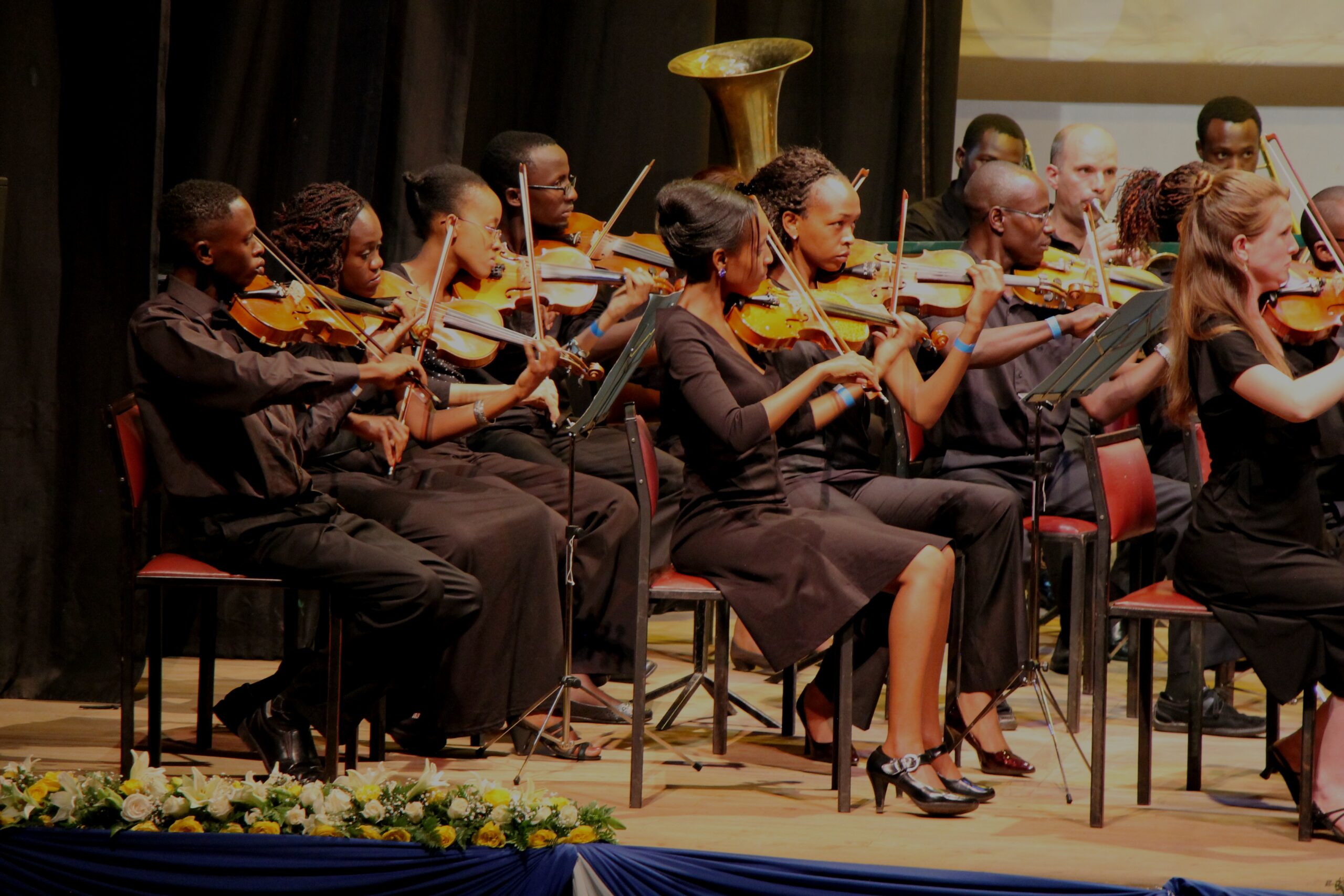
In 2003, the then-director, Atigala Luvai, founded the Conservatoire Orchestra to provide teachers and students an avenue to hone their musical skills. Since then the orchestra has performed at many concerts. It performed in Kampala in 2007 and Dar es Salaam in 2008.
The stature of classical music had grown to the extent that in 2009 Safaricom Limited, the leading mobile service provider, sponsored and promoted The Safaricom Kenyan Classical Fusion Concert, a grand extravaganza meant to bring together Kenya’s classical music community on one stage together with other local and international artistes from other genres of music. Soweto String Quartet, Ladysmith Black Mambazo, Eric Wainana, Kiggundu Musoke, Sauti Sol, Rhoda Ondeng and Voces8 are just a few of the big names that graced the event during its three-year run.
Critics are always quick to point out that classical music is foreign and elitist, a mzungu (white man) imposition. Music teacher and former host of a classical music programme on Radio 316, Lola Akwabi, thinks the presence of Western classical music in Kenya does not detract from the country's homegrown music. Akwabi believes there is room for both, given music is universal.
Despite the criticism the future of classical music in Kenya seems secure, given classical music is touching lives in the most unlikely of places. Art of Music, a non-profit foundation that promotes the performance and appreciation of music in Kenya, runs a community-based programme called Ghetto Classics in Korogocho, one of Nairobi’s slums. The foundation also runs the Kenya National Youth Orchestra, a music ensemble that brings together young musicians from all walks of life.
The founder of Art of Music, Elizabeth Njoroge, believes there is a rebirth of the arts fuelled by the growing middle class which has enough money to patronize the arts.
Supporters of classical music say it can be used to compliment traditional African music. Composers such as Njane Mugambi and Nancy Day are taking up the challenge, combining the Western idiom with native rhythms and folk songs to produce ‘fusion’ music that has wide appeal.
More young Kenyans are taking up rare orchestral instruments such as the oboe, bassoon, French horn and viola. Victoria Nduta, who has recently taken up the oboe after playing the violin for seven years, says it is a challenging instrument in ways other than playing. She cites the lack of quality reeds locally as one of the challenges, together with places where a student can learn the instrument. She says she takes her lessons on Skype from a teacher in London.
Music teacher and conductor Levi Wataka is encouraged by the fact that more young Kenyans are taking up music but says it isn’t enough to just learn to play an instrument.
According to Wataka, music cannot be viewed in isolation. It must be rooted in the communities in which the players come from. He cites his trip to Venezuela as an eye-opener. In Venezuela he discovered that if a musician can play three notes they are expected to teach another who can only play two notes. A former bass player with the Simon Bolivar Youth Orchestra, Edicson Ruiz, who now plays for the Berlin Philharmonic gives his time to teaching when he returns home to Venezuela. Over there no player is too big for the community. That is why El Sistema has been such a success. It is about sharing, community and uplifting each other.


Most popular

Top Naija songs of 2026
31 Mar 2026

Top Afrobeats songs of 2026
19 Mar 2026
Ghana: Mr Eazi and MOLIY’s ‘Comfort’ earns Urban Music Awards nomination
21 Oct 2026

Top amapiano songs of 2026
16 Feb 2026

Open call: CANEX Music Business Lab and Songwriting Camp
15 Oct 2026
Nigeria: CANEX WKND unveils 2026 programme
21 Oct 2026
Disclaimer: Music In Africa provides a platform for musicians and contributors to embed music and videos solely for promotional purposes. If any track or video embedded on this platform violates any copyrights please inform us immediately and we will take it down. Please read our Terms of Use for more.

Subscribe to our monthly Newsletter
Follow us on social media


Please log in to post a comment.