
NEFCISA
NEFCISA

The Music In Africa Foundation (MIAF) is proud of its partnership with the Industrial Development Corporation (IDC) as a Strategic Implementing Partner (SIP) for its Social Employment Fund (SEF). Through this collaboration, MIAF is running a national programme that is creating jobs, addressing skills gaps, and strengthening South Africa's creative industries — in line with the SEF's overarching goal to generate work for the common good and build community value through employment, social contribution, and inclusive economic participation. Operating under the banner NEFCISA (National Employment Facility for Creative Industries in South Africa), the initiative is recruiting and training participants, matching them with host organisations, and has already placed 1 500 workers across the country — surpassing its original target of 1 000. NEFCISA is delivered through a network of 20 host organisations spanning five provinces, who are actively hosting participants and contributing to work for the common good across South Africa's creative and cultural industries. Key Objectives: Support employment and entrepreneurship in the creative industries. Offer skills development and training programmes. Foster partnerships between public and private creative sectors. Promote South African creativity at both provincial and national levels Foster community development through social contribution.

ACCES
ACCES

ACCES Conference and Showcase Festival is Africa's leading music industry gathering, bringing together the people shaping the future of the continent's music business. Artists, entrepreneurs, executives, investors, policymakers and cultural leaders from across Africa and around the world come to ACCES to build partnerships, exchange ideas, discover talent and create new business opportunities. Since its launch in 2017, ACCES has become the continent's premier platform for professional exchange and music market development. Combining a high-level conference with a curated showcase festival, networking, exhibitions and industry programmes, ACCES offers a unique space where creativity meets business and where African music connects with the global industry.

Gender@Work
Gender@Work

Music In Africa Gender @ Work is a three-year training programme aimed at upskilling and increasing the participation of female professionals in the African music sector. Launched by the Music In Africa Foundation (MIAF) in April 2019, the programme is connected to the MIAF’s ACCES music conference – a pan-African event held in a different African country every year. This connection enables the programme to reach new participants in a different African country every year. The programme marks the beginning of a more concerted effort by the Foundation to support the participation and inclusion of women in all facets of its programmes and the music sector in Africa as a whole. Over the three years, the programme will aim to address gender imbalances in the sector through training, lobbying, facilitating knowledge exchange and dialogues that foster the interest of women. The broader objectives of the programme are to: Provide industry training for women on critical music industry skills, focusing on: Stage management Electronic music production and recording Music business management Technical knowledge Provide an opportunity for both professional and aspiring women to benefit from the Music In Africa network and its broad range of activities in 2019, 2020 and 2021. Provide a solution-based platform in the form of a round table at ACCES with a view to identify challenges, discuss opportunities and lobby for the interests of female practitioners. Offer participants the opportunity to benefit from programmes offered by MIAF’s partners. Increase access to educational materials. Integrate participants in the broader ACCES programme to maximise experience and exposure to the industry. Record and present training materials on the www.musicinafrica.net, including but not limited to tutorials, templates and other best-practice materials. Communicate women-based themes that support the initiatives and messages of the programme. MAIN TRAINING ACTIVITIES Training in first country (Ghana): In the first year, participants will be trained on all aspects of stage management by a team of experienced stage managers from 10 to 17 November 2019. The programme will offer robust classroom training as well as practical, hands-on training in which participants will also be given the opportunity to manage various aspects of the ACCES performance programme. Training in second country: The second training iteration will take place at ACCES 2020 when the programme will diversify its course to include music production lessons and training on other music business topics. A round-table platform will also be introduced to coincide with the ACCES programme. Training in third country: The third training iteration will take place at ACCES 2021 in a different country, offering an advanced course. HOW DO YOU GET INVOLVED?  As a participant, facilitator or trainer: The programme enrolls up to 12 trainees every year. All opportunities are advertised publicly on this website, and will be added to this page. Please keep checking this page for new calls (below under UPDATES & CURRENT OPPORTUNITIES). As a partner Please contact Claire Metais at [email protected]. APPLY The call for applications for 2020 will be announced soon. The Music In Africa Gender @ Work programme is made possible with the support of the Prince Claus Fund, Siemens Stiftung and Goethe-Institut.

Sound Connects Fund
Sound Connects Fund

For cultural and creative practitioners and organisations operating in southern Africa, access to funding remains a major challenge. The COVID-19 pandemic has also had a massive impact on government policy, spending and the economy in general, and has seen spending on culture being moved further down the list of priorities. Further, the cultural and creative industries repeatedly cite four main areas where investment is needed for growth, which are increased visibility, mobility including access to new markets, finance and support structures.

Instrument Building And Repair Project

Experience the Vibrations African Instruments Exhibition online in 3D

Features

Ghana-based artist Hym talks trap music

22 Feb 2016 - 11:07

cc-img flag-img

'Trippy trap' connoisseur and Davido collaborator Hym recently dropped a neo-soul, deep synth, Afro-trap single called 'Sober'. The song takes listeners on a smooth 1990s R&B ride infused with a perfect sample and pumping groove pattern.
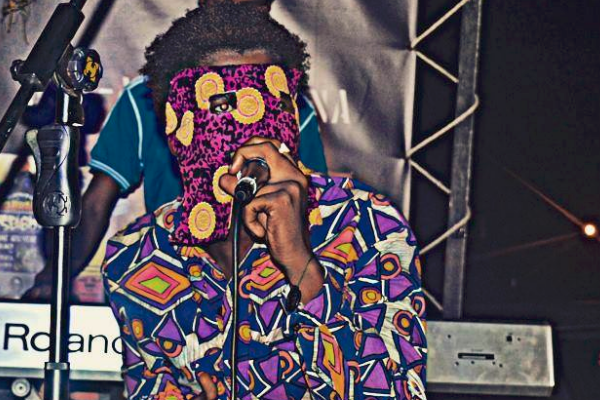
Trap artist Hym performs with mask. Photo: Facebook

“It all started with curiosity,” says Hym about his beginnings. “Your experiences dictate what you put out. If you want to live a lifestyle different from the message in your music, there will be a resulting identity crisis. The industry is filled with a lot of people who don’t want to figure out things for themselves. It is filled with a lot of people who are dependent on others, expecting them to do something for them.

Born Mohammed Nasir to a Hausa family, Hym grew up in a large household in Lagos among individuals with varied tastes in music. “My dad could be playing country music. On my way home from school, the driver may choose to play reggae music. And Michael Jackson was everybody’s favourite at the time.”

His first recording was in a small studio in popstar Davido‘s house. “We were in high school then,” he says. We had the passion. We saw the picture. We wanted to make music. Davido bought the mic. He knew how to connect it to the computer so the sound was always good."

“I learned a lot from how he operated the software. I was lucky enough to start with and learn from somebody who had a lot of vim. I started writing music for the girls then. I got to see every sign of the perks in high school. One way or the other, everybody who was popular was exposed to the girls and also because you wouldn’t even have to spend your own money anymore because there was so much support.”

[audio:https://soundcloud.com/hymssongs/in-a-garden autoplay:0]

While Davido has gone on to be a pop star, Hym cuts the picture of the true independent artist. What with his peculiar genre and public image which sees him perform with a mask, usually made of cloth, covering his face. “An independent artiste for some reason has more clarity than the guy who is signed onto a label,” he says. “The independent artiste intuitively knows what to do with a beat as soon as they get the chance while the signed artiste has to go through all that tiring process of thinking about his contract, the content that the masses are used to or whether it would be a hit song or not.”

For Hym, music is not ‘work’ because that word “has certain formalities to it.” Access to space for music production and productivity are linked in Ghana. So that in Accra, several musicians end up sharing a common music recording studio at a time, and the realities of joining queues and distractions are frustrating facts that hinder inspiration.

“Inspiration comes to me in the form of a conversation or when I hear something interesting,” says Hym. “The process becomes more realistic too because we have a studio in the same apartment we live in, so it’s more like go in there and make a hit. With the labels, the creative process is usually dragged. Also when one visits the studio, there’s always a queue and you’d hardly be the most important person in there even if it’s your own session.”

About what artistry really means for the society, Hym says: “I feel that being a musician is a social responsibility and could be used to open minds about what could help the people. I don’t want people to think that I am all God with my music. I make music for club-goers too. It’s all about the feeling. I grew up in Lagos with the plan to go all out with the music.

“Along the way, people gave up, some even died. That meant I had to move and take the message elsewhere. People that know me back in Lagos have seen my music channel from party-type to conscious music. I’ve realized that it’s best for musicians to keep pushing. Even if it’s two radio stations for promo. Even with videos, over there (in the West), some people shoot with their phones. But we are socialized to think that we only need the red camera to make it because we saw Jay-Z and co. use it.

Hym calls trippy trap “the dope cousin” of Afro-trap. One Afro-trap rapper worth mentioning here is Dex Kwasi, who plots stories and sound moods about experiences, struggle, culture, drug politics etc. over afro-trap beats. The rhythm is not too far from an afro hip-hop and trap hybrid. Dex Kwasi first got a strong response when he dropped a satirical trap anthem and video “Africa (Trappin’)” featuring Wanlov.

Trippy trap, says Hym, “is the genre I mostly easily connect to. I used to call it Afro trap. My music is for people who have not figured life out yet. Almost every black man feels the need to cut his hair once it gets to the afro level. The afro signifies blackness or black mentality.

“The best part of the creative process is when I’m listening to the piece recorded," he adds. "I like to take the music from a different angle.”

[audio:https://soundcloud.com/hymssongs/sober-mixedbyshiqee autoplay:0]


Originally published on 13 February 2016 on the Kwamewrite blog.

Please log in to post a comment.

Most popular

Disclaimer: Music In Africa provides a platform for musicians and contributors to embed music and videos solely for promotional purposes. If any track or video embedded on this platform violates any copyrights please inform us immediately and we will take it down. Please read our Terms of Use for more.

newsletter banner

Subscribe to our monthly Newsletter

Follow us on social media