






























































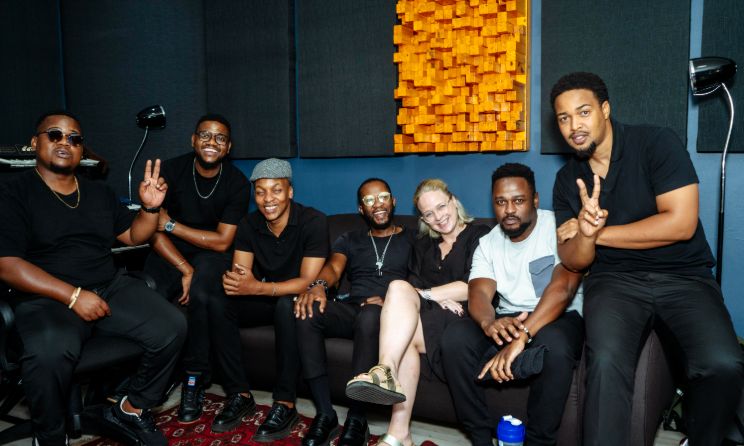
Let’s talk about your Grammy nomination. How has that changed things for you, both locally and internationally?
Kwande: First off—the love from my friends! None of them can say “Just 6” without adding “Grammy-nominated!” Laughs. That kind of support from home is priceless to me.
Nkosie: I agree. There’s something really special about being appreciated at home. One of the biggest shifts for us has been learning how to balance our careers locally and internationally. We started touring overseas within a year or two of launching—but then COVID hit and threw everything off course. The Grammy nomination helped us regroup and become more intentional about our presence at home. And the best part? We were the only group in our Grammy category whose project was fully recorded and arranged in South Africa.
Smokes: Plus, we weren’t nominated in that generic “African category” laughs—we were up against major names, the kind of artists who score Marvel films, Oppenheimer, and other blockbusters. And there we were: Just 6, from South Africa! It was surreal—and suddenly, people at home started paying attention in a whole new way.
Nkosie: So to answer your question directly: yes, the Grammy nod made a real impact. People now see we’re not just a group that tours overseas—we’re creating art that resonates globally. For us, it’s never been about fame; it’s always been about impact. This nomination proved that what we’re doing has value.
Shakes: We’re also living proof that dreams really do come true. Growing up, being part of a Grammy conversation felt like the ultimate goal. From day one, we envisioned this—and now we’ve been nominated twice! That’s powerful. If you believe in your craft and stay consistent, anything is possible. Third time lucky, right? Laughs.
What’s been the most memorable performance for you so far?
Mtha: Locally, it has to be the concert we did with Samthing Soweto. We’d been talking about collaborating for a while, and when he finally called us up, I couldn’t believe it. I actually forgot some of my lines on stage!
Shakes: There are a few moments I’ll never forget. Music has placed us in rooms we never imagined. Like shaking hands with President Ramaphosa—we’ve performed for him twice. Once, he even came over to chat and told us he could sing too! Laughs.
Fez: For me, it was the Beethoven Festival in Germany. We performed alongside six top German vocalists at a nationally televised event. Afterward, at the gala, the response was overwhelming. Ambassadors and high-profile guests all wanted to meet us. It was phenomenal.
Smokes: December was a huge milestone. We performed at the Christmas Carols concert at SunBet Arena—our biggest crowd yet: 9,000 people! And what’s amazing is that the gig came from someone who’d seen us at a much smaller show just months earlier. Turns out, he was a concert promoter. That moment reminded us: even if a show isn’t packed or doesn’t go your way, you never know who’s in the room. Big shout-out to Adrian!
Nkosie: Another special one was a private show at Serengeti National Park in Tanzania. We performed The Circle of Life from The Lion King—I know it can feel cliché, but in that setting, it was magical. It truly felt like The Lion King come to life.
Kwande: Same here. That Tanzania show was next-level—so exclusive, so unreal. And honestly, I was shocked to find out how expensive that place is! Laughs. Music has taken us to places we only dreamed of as kids. That’s priceless.
The Gwiio vocal style has gone viral on social media. Do you have any advice for vocally talented young people hoping to break into the industry?
Shakes: Social media is a powerful launchpad. Use it wisely to catch the attention of the right people. It’s a tool—learn to make it work for you.
Nkosie: And take it further—record your music professionally and get it out there. If people are willing to spend money on your sound, the decision-makers will notice. That’s the real test: turning attention into support.
Smokes: Don’t chase fame. Align yourself with excellence, and success will follow. The industry sells this idea of overnight fame and viral moments, but real longevity comes from consistency and craft. Young people need to know: you don’t have to be famous to make money in this business.
Kwande: Be humble. Be someone people want to work with. The industry is small, and people remember your energy. Good energy opens doors.
Georgia: And never stop learning. Growth comes through collaboration. You become a better artist—and a better person—when you stay open and willing to evolve.
What’s next for Just 6? Any upcoming projects, collaborations, or tours we should know about?
Nkosie: Fingers crossed, our new album drops in April! We’re excited to take it on tour. We’re also planning to release original music—Afrobeats, Afropop, reggae… a mix of styles. We’ve got a gig coming up in eSwatini that includes a workshop. We want to do more of those—visit schools, share our journey, and inspire the next generation. It’s not about teaching technical skills, but showing young people what’s possible with passion and consistency. We’re putting that out into the universe—if any partners are interested in supporting this, let’s talk!
Kwande: For me, it’s all about legacy. We want to be a group that future artists reference—like people talk about Ladysmith Black Mambazo. One of our dreams is to open an academy to teach our Afro-Vocal-Play style. We want to make sure a cappella lives on, just like jazz and hip-hop.
Nkosie: Just to add—we haven’t really explained how the term Afro-Vocal-Play came about. “Vocal Play” was originally coined by Quincy Jones to describe the sound of Naturally 7, a groundbreaking American a cappella group. In 2018, while touring in Germany, we met them and had some deep conversations about genre, identity, and finding our unique voice. That moment was a turning point—they encouraged us to embrace our African roots and fuse them with the Vocal Play concept. It felt like they were passing the baton. From that moment, Afro-Vocal-Play was born—and we’ve been proudly flying that flag ever since.


Most popular

Top Naija songs of 2026
31 Mar 2026

Top Afrobeats songs of 2026
19 Mar 2026

Ghana: Mr Eazi and MOLIY’s ‘Comfort’ earns Urban Music Awards nomination
21 Oct 2026

Top amapiano songs of 2026
16 Feb 2026

Open call: CANEX Music Business Lab and Songwriting Camp
15 Oct 2026

Nigeria: CANEX WKND unveils 2026 programme
21 Oct 2026
Disclaimer: Music In Africa provides a platform for musicians and contributors to embed music and videos solely for promotional purposes. If any track or video embedded on this platform violates any copyrights please inform us immediately and we will take it down. Please read our Terms of Use for more.

Subscribe to our monthly Newsletter
Follow us on social media


Please log in to post a comment.