
















































Andrew Hoole and Conrad Asman were big winners at the 2018 Southern African Music Right Organisation (SAMRO) Overseas Scholarships Competition for Composers at the Linder Auditorium in Johannesburg on Saturday.
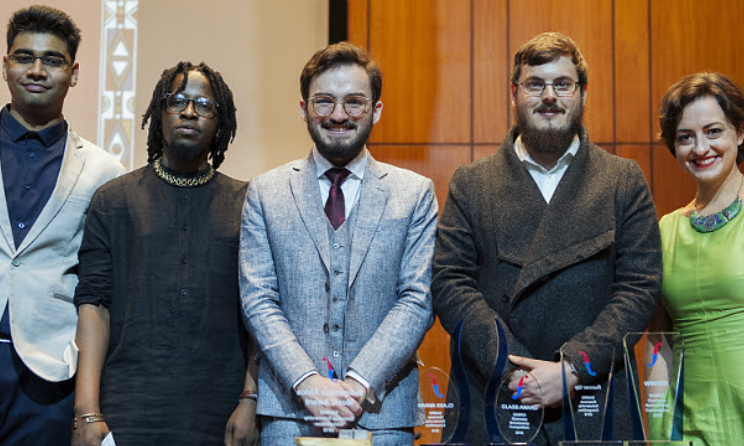
University of Cape Town graduate Hoole emerged triumphant in the Jazz category while Johannesburg-based University of Cape Town student Asman was the winner in the Western Art Music category. Hoole and Asman received R200 000 (about $14 000) to further their postgraduate studies or professional development abroad.
"Winning the SAMRO main and clazz awards has been a personal goal of mine, for which I have been striving ever since starting my university degree in composition," Asman said. "This experience offered me a platform on which my compositions could be performed and evaluated on a professional level, for which I am most grateful.
"The SAMRO scholarship will enable me to take my craft to the next level, as I plan to use the prize money to apply for festivals and postgraduate courses overseas – particularly in the UK, Europe and the US."
The two runners-up, University of KwaZulu-Natal (UKZN) alumnus Riley Giandhari and Stellenbosch University graduate Lise Morrison received R70 000 each. Giandhari and Morrison competed in the Jazz and Western Art Music categories respectively. Morrison also walked away with the R30 000 Indigenous African Music Award.
Asman and Giandhari also received the Surendran Reddy Clazz Award in the Western Art Music and Jazz categories respectively, for their ability to expertly combine elements of different musical styles. Both prizes are worth R10 000.
Reddy, who passed away in 2010 aged 47, devised the term 'clazz' to describe his crossover musical style and his concept of composition and improvisation – a fusion of classical, jazz, traditional African and various styles of world music.
"Saturday was an amazing evening. The wonderful artists from the Johannesburg Philharmonic Orchestra (JPO) and the ZAR Big Band brought new works to life," SAMRO managing director André le Roux said after the event. "The works literally jumped off the pages of their scores and into our ears like little earworms."
Speaking to Music In Africa after the big event, Andrew Hoole said: “I am very grateful and honoured to have been selected as the jazz category winner and I want to congratulate my fellow composers and musicians on a phenomenal evening of original South African music.
"A special thanks to the organisers of the event at SAMRO, who poured so much time, effort and money into an event that highlighted and rewarded local music in this country.”
Giandhari said: “I took the runner-up award of R70 000 and I also won the clazz award of R10 000. I am so grateful for the opportunity to get my music performed and I'm also very thankful to SAMRO for recognising me as a composer. I felt that everyone who received an award deserved it, due to all the hard work that was put in.”
Out of this world performances
Saturday night saw the five young composers' works brought to life by some of South Africa's most accomplished classical and jazz musicians, including Bokani Dyer, Marcus Wyatt, Ziza Muftic and Romy Brauteseth, among others. The composers' live renditions were witnessed by their families, friends, music professionals and fans who braved the chilly Johannesburg weather to experience the eclectic programme.
Trumpeter and bandleader Marcus Wyatt and the ZAR Jazz Orchestra performed Hoole’s winning compositions ‘Bombero Suite’ and ‘Kind of Cool’. Asman’s composition ‘Shisa Nyama' was put to action by JPO musicians under the conductorship of Kutlwano Masote.
Asman said he was inspired to write the "party piece" after thinking about how a South African braai, or barbeque, brings people together.
Giandhari’s piece ‘Answer the Call’ was also performed by Wyatt and the ZAR Jazz Orchestra. The composer said the composition was partly inspired after he heard a cellphone ringing constantly in a restaurant, prompting him to take his feelings of annoyance to the world of music.
Morrison’s work ‘Dololo’ (for flute, guitar, percussion and string trio) was composed with the mbira in mind, using the rhythm of the word 'dololo' (nothing) as a starting point. In addition, her 'Trio in Five Movements' was inspired by the contrasts between the different landscapes and soundscapes she has experienced during her travels. Both works were played by JPO musicians.
In addition to showcasing the works of these four finalists, the gala concert also offered another young composer, Ndabo Zulu, a platform to shine. His work ‘Umgidi’, dedicated to the Nguni nation, was performed by Wyatt and the ZAR Orchestra. Ndabo, a UKZN graduate who is completing his master’s degree at the Norwegian Music Academy in Oslo, received the R30 000 Indigenous African Music Award for jazz. ‘Umgidi’ was arguably the best-received composition on the night, with Zulu encouraging the participation of the crowd.
"Sitting back and listening to the indigenous African sounds through all the compositions, I get the sense that these young composers are creating a new soundtrack for South Africa by disregarding the rules and boundaries of jazz, western art and indigenous music," Le Roux saud.
"By mixing the sounds together they created a potjiekos or Shisa Nyama (braai) of sound. My team and I witnessed as these young people cultivated our tastes. The music was really Kind of Cool, the celebration a proper Umgidi and we tasted the Shisa Nyama. None of the candidates left with Dololo (nothing). Apart from their awards, they left with professional photographs, audio and video, and having been acknowledged by their peers as the top composers of their generation in the country."
As part of a special focus to honour Nelson Mandela, two tracks – ‘An Ideal to Die For’ and ‘Time to Build’ – by bass player Concord Nkabinde were performed on the night. The two songs were drawn from Mandela’s speeches and carefully sampled the late statesman’s wise words throughout the recital. Former SAMRO scholarship winner Darren English also paid homage to the late leader with his song ‘Pledge For Peace’.


Most popular

Top Naija songs of 2026
31 Mar 2026

Ghana: Mr Eazi and MOLIY’s ‘Comfort’ earns Urban Music Awards nomination
21 Oct 2026

Top Afrobeats songs of 2026
19 Mar 2026

Top amapiano songs of 2026
16 Feb 2026
Open call: CANEX Music Business Lab and Songwriting Camp
15 Oct 2026
Nigeria: CANEX WKND unveils 2026 programme
21 Oct 2026
Disclaimer: Music In Africa provides a platform for musicians and contributors to embed music and videos solely for promotional purposes. If any track or video embedded on this platform violates any copyrights please inform us immediately and we will take it down. Please read our Terms of Use for more.

Subscribe to our monthly Newsletter
Follow us on social media


Please log in to post a comment.