


















NEFCISA
NEFCISA

The Music In Africa Foundation (MIAF) is proud to announce its partnership with the Industrial Development Corporation (IDC) as a Strategic Implementing Partner (SIP) for its Social Employment Fund (SEF). Through this collaboration, MIAF is launching a new national programme designed to create jobs, address skills gaps, and strengthen South Africa’s creative industries — in line with the SEF’s overarching goal to generate work for the common good and build community value through employment, social contribution, and inclusive economic participation. Operating under the banner NEFCISA (National Employment Facility for Creative Industries in South Africa), the initiative will recruit and train participants, match them with host organisations, and place a minimum of 1 000 workers across the country. Key Objectives: Support employment and entrepreneurship in the creative industries. Offer skills development and training programmes. Foster partnerships between public and private creative sectors. Promote South African creativity at both provincial and national levels Foster community development through social contribution.

ACCES
ACCES

Chaque année, nous fournissons des informations générales afin de guider les participants dans la préparation de leur voyage. En plus de ce site, des mises à jour importantes seront envoyées par e-mail à tous les délégués inscrits. Assurez-vous de vous inscrire dès que possible. Pour plus d'informations, veuillez contacter [email protected] Continuez à consulter cette page pour plus d'information.  

Gender@Work
Gender@Work

Music In Africa Gender @ Work is a three-year training programme aimed at upskilling and increasing the participation of female professionals in the African music sector. Launched by the Music In Africa Foundation (MIAF) in April 2019, the programme is connected to the MIAF’s ACCES music conference – a pan-African event held in a different African country every year. This connection enables the programme to reach new participants in a different African country every year. The programme marks the beginning of a more concerted effort by the Foundation to support the participation and inclusion of women in all facets of its programmes and the music sector in Africa as a whole. Over the three years, the programme will aim to address gender imbalances in the sector through training, lobbying, facilitating knowledge exchange and dialogues that foster the interest of women. The broader objectives of the programme are to: Provide industry training for women on critical music industry skills, focusing on: Stage management Electronic music production and recording Music business management Technical knowledge Provide an opportunity for both professional and aspiring women to benefit from the Music In Africa network and its broad range of activities in 2019, 2020 and 2021. Provide a solution-based platform in the form of a round table at ACCES with a view to identify challenges, discuss opportunities and lobby for the interests of female practitioners. Offer participants the opportunity to benefit from programmes offered by MIAF’s partners. Increase access to educational materials. Integrate participants in the broader ACCES programme to maximise experience and exposure to the industry. Record and present training materials on the www.musicinafrica.net, including but not limited to tutorials, templates and other best-practice materials. Communicate women-based themes that support the initiatives and messages of the programme. MAIN TRAINING ACTIVITIES Training in first country (Ghana): In the first year, participants will be trained on all aspects of stage management by a team of experienced stage managers from 10 to 17 November 2019. The programme will offer robust classroom training as well as practical, hands-on training in which participants will also be given the opportunity to manage various aspects of the ACCES performance programme. Training in second country: The second training iteration will take place at ACCES 2020 when the programme will diversify its course to include music production lessons and training on other music business topics. A round-table platform will also be introduced to coincide with the ACCES programme. Training in third country: The third training iteration will take place at ACCES 2021 in a different country, offering an advanced course. HOW DO YOU GET INVOLVED?  As a participant, facilitator or trainer: The programme enrolls up to 12 trainees every year. All opportunities are advertised publicly on this website, and will be added to this page. Please keep checking this page for new calls (below under UPDATES & CURRENT OPPORTUNITIES). As a partner Please contact Claire Metais at [email protected]. APPLY The call for applications for 2020 will be announced soon. The Music In Africa Gender @ Work programme is made possible with the support of the Prince Claus Fund, Siemens Stiftung and Goethe-Institut.

Sound Connects Fund
Sound Connects Fund

Pour les praticiens et les organisations culturels et créatifs opérant en Afrique australe, l’accès au financement reste un défi majeur. La pandémie de COVID-19 a également eu un impact massif sur les politiques gouvernementales, les dépenses et l’économie en général, et a vu les dépenses consacrées à la culture reléguées plus bas dans la liste des priorités. De plus, les industries culturelles et créatives citent régulièrement quatre domaines principaux où l’investissement est nécessaire pour la croissance : une visibilité accrue, la mobilité incluant l’accès à de nouveaux marchés, le financement et les structures de soutien.

Music In Africa Live

MUSIC IN AFRICA LIVE Lancé en 2020 pour une durée de 3 ans, Music In Africa Live est une initiative visant à soutenir l'écosystème de la musique africaine face aux contraintes imposées par la pandémie de COVID-19 ; le projet a été lancé par la Fondation Music In Africa (MIAF) en partenariat avec le ministère fédéral allemand des Affaires étrangères, Siemens Stiftung et le Goethe Institut. Plus de 30 aides sont disponibles dans le cadre de la troisième édition de Music In Africa Live, dans 3 catégories :  showcases, renforcement des compétences et plaidoyer, en conformité avec les modalités énoncées.

Instrument Building And Repair Project

The overarching objective of Music In Africa Foundation’s Instrument Building and Repair (IBR) project is to encourage the formalisation and professionalisation of instrument-making and repair in Africa, especially in relation to indigenous African instruments. Background In 2014, the Music In Africa Foundation (MIAF) identified as one of its focus areas for development the need to encourage young people from music and music-related sectors to consider instrument-making as a career. This need extended itself from the recognition that the making of traditional African instruments is not a widely practiced skill and seems to be limited to the older generation. Traditional African instrument makers are also few and far between, making communication and logistics between teachers and learners an obstacle. When instrument building workshops take place, budgetary constraints do not allow teachers or learners the time to explore the finer details of an instrument. Based on these observations, the MIAF designed and piloted the first IBR workshop at the Dhow Countries Music Academy (DCMA) in Zanzibar in February 2015. In 2016, the foundation received funding from the South African National Lotteries Commission to implement a much bigger version of the project in Johannesburg. The project drew participants from five African countries. 25 students from South Africa, Ghana, Senegal, Kenya and Ethiopia were trained on how to build and repair musical instruments. The instruments that they made were: Traditional Instruments: Umakhweyana and Marimba Conventional Instrument: Dulcimer guitar The workshop culminated in a traditional instruments concert at the Wits Theatre in Johannesburg. It is the MIAF’s aim to roll out similar workshops in as many African countries as possible over the next few years. Objectives Developing awareness of musical instrument makers in Africa with a view to promote their work to a wider global audience. Facilitating the sharing and transfer of skills in indigenous instruments between countries on the continent. Encouraging the formalisation and professionalisation of instrument-making and repair in Africa, especially in relation to indigenous instruments. Helping instrument makers develop their careers. Fostering the rapid monetisation and sustainable development of instrument-making and repair in Africa. Promoting constant exchange of ideas, expertise, experiences and know-how among instrument makers in Africa. Facilitating the identification of existing gaps in the field with a view to contribute new solutions. Facilitating the transfer of knowledge and skills of indigenous instruments between younger and older generations. 2020 edition The MIAF has also announced that multi-instrumentalist and instrument maker Joe Makhanza will facilitate one of the workshops on the building of the kamale ngoni instrument. Kamale ngoni is a kora-like, stringed instrument that originated in West Africa. The instrument contributed to the rise of Wassoulou music in the 1970s and 1990s. Makhanza was born in Giyani in South Africa's Limpopo province. He completed a bachelor of music degree and a post-graduate diploma in arts marketing from Wits University. He is currently completing his masters in ethnomusicology and is a part-time lecturer in African music studies at Rhodes University. He plays the kora, mbira, valiha, masenqo, xiwewe, ngoni ba and xizambi, among others. He also manufactures the aforementioned instruments. The MIAF will confirm more trainers who will join the workshops as well as the other instruments that will be featured in the 2020 IBR programme.  Apply to participate here. Connect with us on Twitter, Instagram and Facebook, and subscribe to our monthly newsletter. The Music In Africa Instrument Building and Repair project is funded by the National Lotteries Commission. It is implemented in partnership with Siemens Stiftung, Goethe-Institut, Wits Theatre and Kaya FM.

banner image

Street King uses taxis as musical canvas

Accueil/Non classé/Street King uses taxis as musical canvas

Nairobi has many peculiarities. It is the only Kenyan city with a game park right next to it, and possibly the only city with public service vehicles that have redefined popular culture. They are called matutus – 15- or 24-seater vans that transport 70% of Nairobi’s workforce. In Lagos, they are called danfos and painted in bright yellow. In Addis Ababa they are known as “blue donkeys”.

In Kenya, however, these vans are a form of self-expression, coloured and decorated with messages, slogans and portraits of popular people. Inside is where the real party goes on. Many of them have loudspeakers, disco lights, screens and all manner of interior decoration. At the very top of the matatu hierarchy are the nganyas – the ‘Lamborghinis’ of the matatus – which are often fitted with state-of-the-art sound systems and customised with outrageous designs.

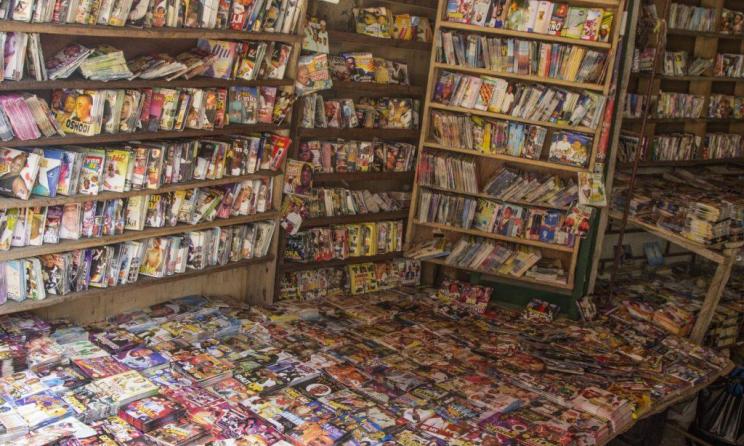
Because most matatus’ play music all the time, the drivers have become influential in the Kenyan music marketing chain. The average Kenyan spends between one and four hours a day in a matatu, listening to whatever the driver decides to play. With time, DJs realised that the drivers needed a decent selection of music so they started making mixes for the drivers with references to their stage names. The DJs would give their mixes to the drivers for free in exchange for free marketing. With time, middlemen with extensive networks of matatu drivers emerged, dealing in DJ mixes and selling them to the drivers.

These middlemen also distribute mixes to shop owners who utilise loudspeakers to attract business on the streets. The net effect is a unique form of music distribution where Kenyans discover new music in matatus or while walking down the street. As a result street DJs have become more influential than their radio counterparts. The rationale is simple: in order to listen to a radio DJ, one has to tune in and stay tuned, but a street DJ’s mix will get to you whether you like it or not. Numerous hitmakers in Kenya have made a name on the streets, with radio and mainstream media often playing catch-up.

Though DJs like Bunduki, Lyta and Mantix were trailblazers in this sector, DJ Demakufu is the undisputed king of the streets. Drivers all over the city anticipate his latest mixes with bated breath, and several commuters have missed their stops while listening to them.

“In the morning the drivers want R&B, then around lunchtime most of them want reggae or [Tanzanian] bongo,” Demakufu tells Music In Africa. “Of course in the evening people are tired so most drivers prefer to play cool music. Kenyans also love new music so I always throw in a new song in every new mix. Before I do a mix, I always do my research – I watch crowd reactions in clubs and try and figure out what people will groove to. That is why my mixes give people – a club experience on their way to work.”

The success of Demakufu’s mixes can be attributed largely to his taste, and at one time media outlets were scrambling to reveal his identity because no one knew what he looked like. Demakufu has noticed that residents in every neighborhood in Nairobi prefer a specific genre, which lets him tailor his mixes accordingly.

“People from Westlands and Rongai like Afrobeat and hip hop, Buru Buru listens to a lot of hip hop but reggae also works,” he says. “In Kitengela people like bongo, reggae and a little bit of hip hop while those from Madaraka are big reggae fans. Umoja people are extremely eclectic and in Dandora they’re into reggae with a little bit of hip hop. In Kasarani hip hop works best while reggae is big in Kikuyu.”

Demakufu’s journey began in 2012 when he joined a DJ academy on a one-year course. Paying school fees was a struggle but he pushed through. After graduating, prospects for a stable DJ job were low and his father got him a low-wage job in Nairobi’s industrial area, which he pursued until 2014. When his contracted ended, his father offered to buy DJ equipment but realised it was above his budget.

About the same time a friend of his had bought decks but didn’t have a mixer, so Demakufu asked his father to put up money for the mixer, which he did. With the decks in place and a partnership with his new colleague, Demakufu began his deejaying career. His first order of business was to market himself by releasing street mixes with “drops” of his name. Soon his entire neighbourhood of Kayole knew his name. His next move was to expand to other areas in Nairobi. Soon he made connections with all the middlemen from across the city and began spreading his mixes all over town.

“As a DJ it’s very hard to get direct access to drivers, so these middlemen act as our distributors,” he said. “We give them our mixes for free and they sell them to drivers for about 200 Kenyan shillings [$2]. These guys work in shifts distributing our mixes day and night. Some sell to as many as 50 matatus a day.”

The frequency of purchase usually depends on the class of the matatu. Those who drive the top-end nganyas change their mixes every week while regular matatus can use a single mix for a whole month. For this reason, nganyas are a major component of pop music marketing in Kenya; everything that is hot is played in an ngaya first.

To commercialise his brand, Demakufu has now come up with a unique product: Demakufu Free WiFi.

“I am installing free WiFi in every ngaya in Nairobi. My fans have supported me from day one so I want to give back to them. So far we have 20 matatus but we are working to increase that number. Once we have increased our reach we will be selling adverts to corporate partners to make the project sustainable.”

Demakufu has shaped the musical landscape of Nairobi one mix at a time. By simply tapping into the unique realities of Nairobi and its music culture, it seems there’s no stopping The Street King of Nairobi just yet. 

newsletter banner

Abonnez-vous à notre newsletter

Retrouvez-nous sur les réseaux sociaux