






























































By Ts’eliso Monaheng
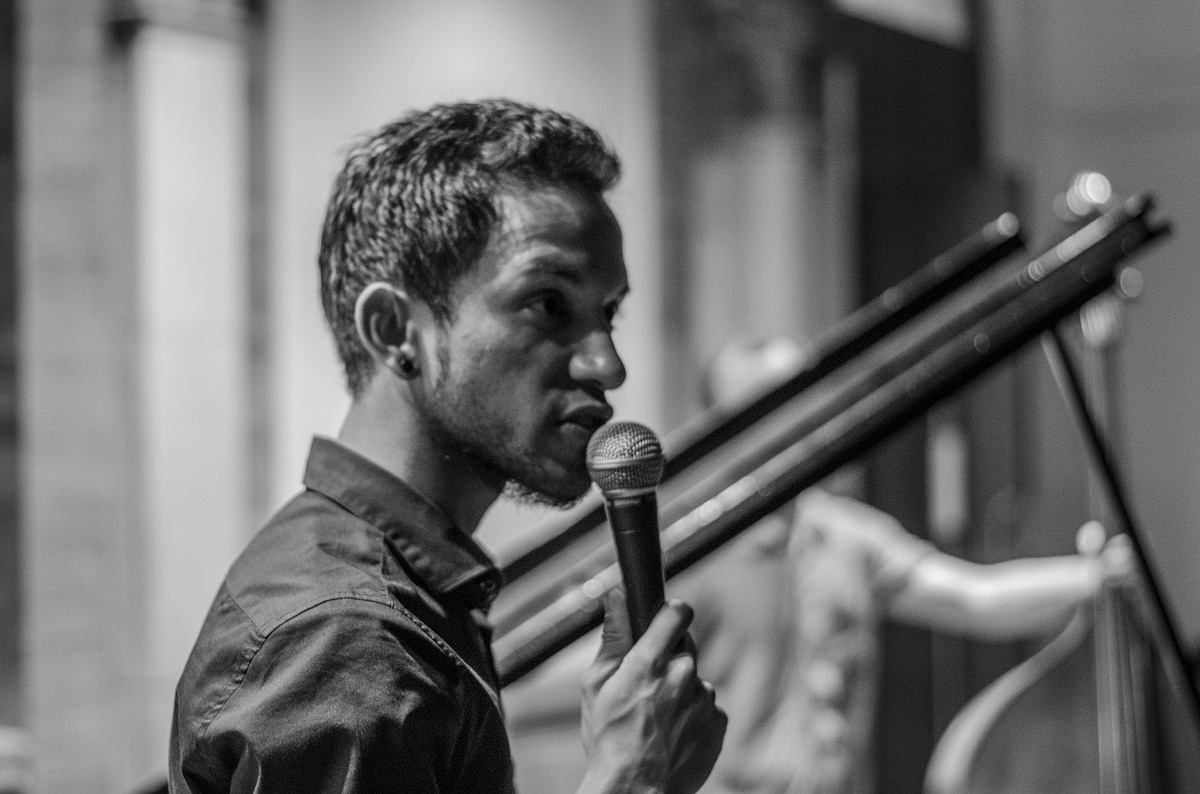
At 21 years old, Kyle Shepherd burst into the South African jazz conscience without prior warning. Following in the footsteps of heavyweights such as Marcus Wyatt, Andile Yenana and Zim Ngqawana (with whom he would later collaborate), Shepherd proved that he is a presence worthy of reckoning. A couple of years down the line, coupled with culturally-fulfilling work and collaborative social exploits with the likes of filmmaker Dylan Valley (Afrikaaps), as well as Aryan Kaganof and the late Zim Ngqawana on Exhibition of Vandalism, we sat down to discuss identity, journeying through sound, culture and survival in contemporary South African society…
Can you explore the concept of music as a process of healing, especially after being involved in bra Zim Ngqawana's Exhibition of Vandalism project? What did you learn from that experience?
Zim was – it sounds like a paradox – but he was a warrior of healing. Everything he did was in line with that. A jazz musician who is dedicated to true creativity and to depth in music, and to spirituality in music, finds it very hard to function in this world of ours. So whenever we play, it is an attempt at healing, for ourselves firstly. If that is achieved in the self, then for the people listening as well. So the Exhibition of Vandalism, although it was a very painful experience... I mean, I spent some months at this Institute of Zimology that they vandalised, and it was so painful to see the place in tatters. I credit it to Zim's creative genius that he came up with the performance art piece that we did, and used what happened to create something. He could have sat back and did quite a few interviews on TV; he could have spoken about the problems in South Africa, complained, and attacked people. But instead he understood the process, and he created something.
So out of the pain...
...comes creation, yes. And it shows you what his dedication was, his dedication was to creativity.
Now, take us through the experiences you had working with Dylan Valley on the Afrikaaps project. What types of experiences did you have, and how was it touring with that outfit? Did you feel that people ‘got it’?
I think in Cape Town people definitely got it, and I got to see how people were moved by it, and also how people were liberated by that information. Because here in Cape Town you have this group of people who speak Afrikaans, but for such a long time were made to think that they were instrumental in Apartheid because they speak Afrikaans. And that was the misconception of Afrikaans, that it was a tool of Apartheid – and it eventually was because the National Party used it. But in Afrikaaps we trace the history and we realise that it’s actually a language of the people. I know in the rest of the country there’s still this negative outlook on the language, but I found that Capetonians who speak the language and watched the show were incredibly liberated. Because here we were saying 'listen, it's okay', and we backed it up with historical accounts and with facts, and you can’t argue with facts. And for me too, it was a spiritual liberation also; we are a valid people, we are fine, and what we do is valid. And the reason why I participated in Afrikaaps was solely because of the message, solely. I think the message now lives on beyond the show, the show’s maybe twenty percent of the bigger picture.
The Goema/Cape Malay beat informs some of the songs on your previous albums, but it has been employed extensively on this project. Why?
Well, why not? It's a thing that I grew up with culturally. I saw those things in the communities that I lived in. It's strange when you enter into jazz and you go to University, and I left University for this reason, because it's not celebrated among jazz musicians. And it’s a strange thing, because it's such a valid music. And also, besides it being a Capetonian thing, it's our link to the rest of Africa and the East. Because if you go around the coast of Africa, East and West, it's the same beat. And if you even go to South America, it's the same beat, of course evolved in different ways. You go up to parts of northern Africa, it's the same thing. For me, it’s probably the most universal rhythm, and we of course have our own way of articulating it. And so it's our link to everything.
Don't you worry that by embracing the Cape beat and Cape tradition, that you are being myopic in a way, in much the same manner that people from elsewhere in South Africa view the 'coloured' community in Cape Town?
That's why I never go out and say 'I only play Cape music'. It's one aspect to my music-making, and an important aspect. And in many ways it’s also important for me to break that 'coloured' stereotype. If you think of someone like Biko who embodies an African man with great intelligence, then I think it's very important as well for Capetonians to present themselves in that way. It's unfortunate that in every other artistic sector, whether it be dance, drama, or comedy, Coloureds are always portrayed in that (demeaning) way. I'm tired of that, because there's so much more, so much nuance to the people. It’s so sad that people limit us in that way, in the same way that anyone would limit a black man or a white man. Stereotypes are unfortunately around, but we have to break through that.
How are you breaking down those stereotypes? Are you maybe involved in projects or workshops to combat that mentality?
Not in that form, but I really do feel that my job as a musician is to keep playing music on a certain level, and keep making albums. That’s my way of saying things. The best way of saying things for me is unfortunately not in a workshop situation; for me the best way is to play, because in that way then people can make up their own minds, interpret, and be fulfilled or not.
You left varsity due to the lack of acknowledgement that you saw for South African jazz as a whole; there's no emphasis on learning South African jazz standards, for example. Do you think there is a chance, especially with the cats coming up now who are becoming teachers, to break that mould?
It's unfortunate that the cats taking on those roles are already bred by the University. So I'm not seeing a drastic change; perhaps the change is slow, but I'm not seeing it. And it's unfortunate because there are generations of young people who come out of high school and into University, and they go through the same thing. And the sadness is that they don't know themselves, the emphasis is not on self- discovery. For me, if your roots are European-African, and you discover yourself as someone that's meant to play Western classical music, then for me that's honest. At least you went through the process of self-discovery. At University, there isn't an encouragement for that. The modules are already set, you are forced into a traditional way – which is great – but I think as a lecturer, the responsibility is to open the mind of the student, and let the student decide. Maybe you're a free jazz pianist, or maybe you're a traditional pianist in the style of Budd Powell or whatever; you should be allowed to study that, but that's not the case.
Would you at some point take it upon yourself to rectify that?
Up till this point, I think that my stand against it is my work and me leaving, and me also openly speaking about my feelings about the Institution as a whole – and I do speak about it quite often. I'm not sure what more I can do right now, but I think in the future, I would like to teach a few students and impart the knowledge that I have gained from other great masters; people like Zim, people like Abdullah.
Jazz is big in South Africa, and one only needs to go to the townships in order to fully grasp that. But it is not very easy to sustain one’s livelihood purely from shows. How do you find your way around that?
This is the thing, whenever I travel to Europe or Japan, I get a sense that the people over there have hundreds of years’ head start in terms of concert-going. In African traditions, the function of music was different. It was never the performer there, the audience here; it was integrated, and everybody took part. And also dance, music, and poetry were never separated, they were a communal thing. That's why we haven’t gotten to where Europe is in terms of concert-going. If you think of classical music, it's already so deeply engrained in the public’s mind that they will pay to go and see somebody perform. We are slowly getting there now. But I also think it's a beautiful thing that we have, because I think the moment you separate the audience from the performer, it then becomes like a group of people watching a race- horse, and seeing how fast it can run. I think true music-making is beyond concertizing – that's only one part of it. True music-making is beyond that - it's personal.
The above is an extract from a longer interview originally published at: http://ntsoana.wordpress.com/2012/12/31/interview-with-kyle-shepherd/


Most popular

Top Naija songs of 2026
31 Mar 2026

Top Afrobeats songs of 2026
19 Mar 2026

Ghana: Mr Eazi and MOLIY’s ‘Comfort’ earns Urban Music Awards nomination
21 Oct 2026

Top amapiano songs of 2026
16 Feb 2026

Open call: CANEX Music Business Lab and Songwriting Camp
15 Oct 2026

Nigeria: CANEX WKND unveils 2026 programme
21 Oct 2026
Disclaimer: Music In Africa provides a platform for musicians and contributors to embed music and videos solely for promotional purposes. If any track or video embedded on this platform violates any copyrights please inform us immediately and we will take it down. Please read our Terms of Use for more.

Subscribe to our monthly Newsletter
Follow us on social media


Please log in to post a comment.