












NEFCISA
NEFCISA

The Music In Africa Foundation (MIAF) is proud to announce its partnership with the Industrial Development Corporation (IDC) as a Strategic Implementing Partner (SIP) for its Social Employment Fund (SEF). Through this collaboration, MIAF is launching a new national programme designed to create jobs, address skills gaps, and strengthen South Africa’s creative industries — in line with the SEF’s overarching goal to generate work for the common good and build community value through employment, social contribution, and inclusive economic participation. Operating under the banner NEFCISA (National Employment Facility for Creative Industries in South Africa), the initiative will recruit and train participants, match them with host organisations, and place a minimum of 1 000 workers across the country. Key Objectives: Support employment and entrepreneurship in the creative industries. Offer skills development and training programmes. Foster partnerships between public and private creative sectors. Promote South African creativity at both provincial and national levels Foster community development through social contribution.

ACCES
ACCES

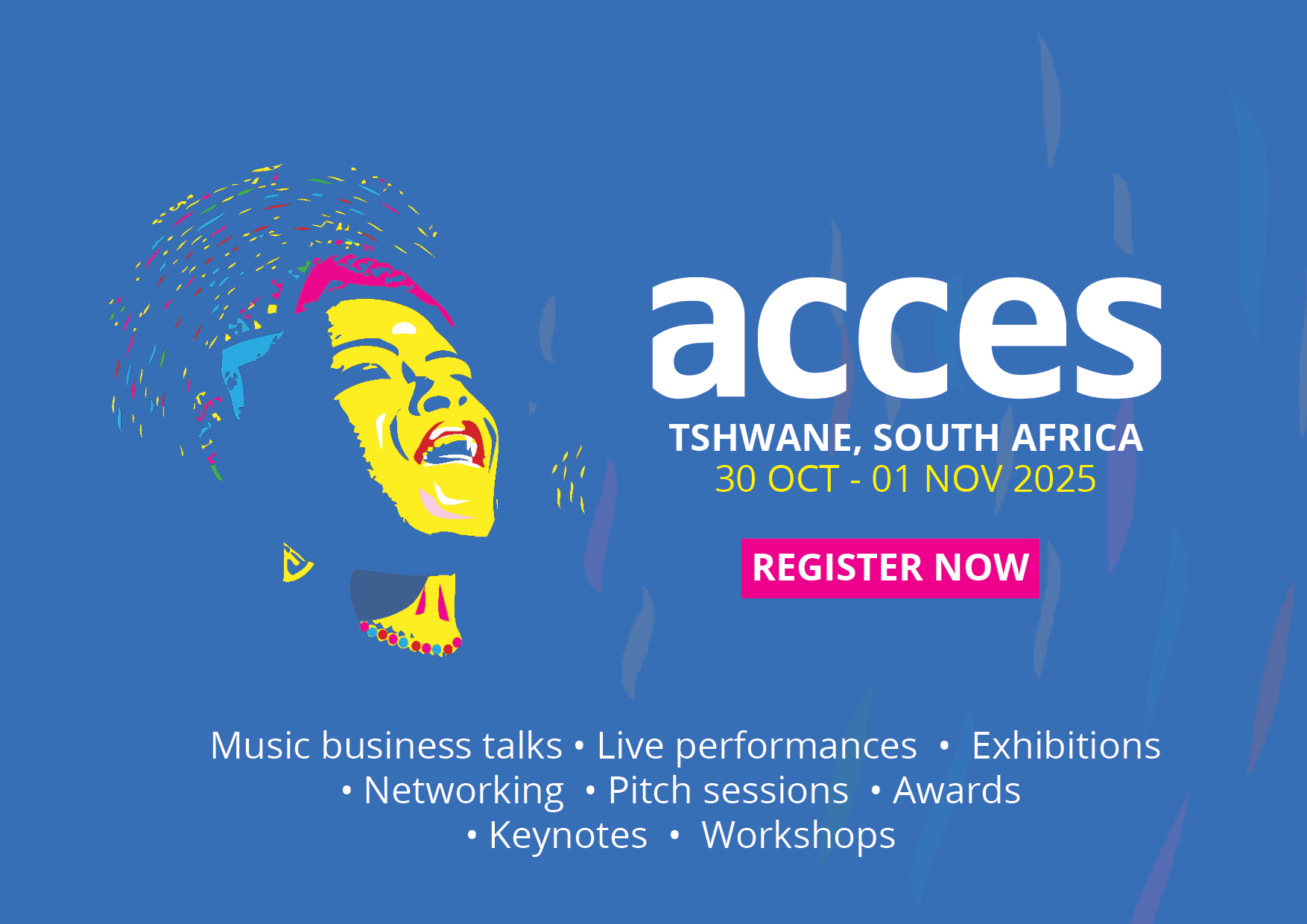
Chaque année, nous fournissons des informations générales afin de guider les participants dans la préparation de leur voyage. En plus de ce site, des mises à jour importantes seront envoyées par e-mail à tous les délégués inscrits. Assurez-vous de vous inscrire dès que possible. Pour plus d'informations, veuillez contacter [email protected] Continuez à consulter cette page pour plus d'information.  

Gender@Work
Gender@Work

Music In Africa Gender @ Work is a three-year training programme aimed at upskilling and increasing the participation of female professionals in the African music sector. Launched by the Music In Africa Foundation (MIAF) in April 2019, the programme is connected to the MIAF’s ACCES music conference – a pan-African event held in a different African country every year. This connection enables the programme to reach new participants in a different African country every year. The programme marks the beginning of a more concerted effort by the Foundation to support the participation and inclusion of women in all facets of its programmes and the music sector in Africa as a whole. Over the three years, the programme will aim to address gender imbalances in the sector through training, lobbying, facilitating knowledge exchange and dialogues that foster the interest of women. The broader objectives of the programme are to: Provide industry training for women on critical music industry skills, focusing on: Stage management Electronic music production and recording Music business management Technical knowledge Provide an opportunity for both professional and aspiring women to benefit from the Music In Africa network and its broad range of activities in 2019, 2020 and 2021. Provide a solution-based platform in the form of a round table at ACCES with a view to identify challenges, discuss opportunities and lobby for the interests of female practitioners. Offer participants the opportunity to benefit from programmes offered by MIAF’s partners. Increase access to educational materials. Integrate participants in the broader ACCES programme to maximise experience and exposure to the industry. Record and present training materials on the www.musicinafrica.net, including but not limited to tutorials, templates and other best-practice materials. Communicate women-based themes that support the initiatives and messages of the programme. MAIN TRAINING ACTIVITIES Training in first country (Ghana): In the first year, participants will be trained on all aspects of stage management by a team of experienced stage managers from 10 to 17 November 2019. The programme will offer robust classroom training as well as practical, hands-on training in which participants will also be given the opportunity to manage various aspects of the ACCES performance programme. Training in second country: The second training iteration will take place at ACCES 2020 when the programme will diversify its course to include music production lessons and training on other music business topics. A round-table platform will also be introduced to coincide with the ACCES programme. Training in third country: The third training iteration will take place at ACCES 2021 in a different country, offering an advanced course. HOW DO YOU GET INVOLVED?  As a participant, facilitator or trainer: The programme enrolls up to 12 trainees every year. All opportunities are advertised publicly on this website, and will be added to this page. Please keep checking this page for new calls (below under UPDATES & CURRENT OPPORTUNITIES). As a partner Please contact Claire Metais at [email protected]. APPLY The call for applications for 2020 will be announced soon. The Music In Africa Gender @ Work programme is made possible with the support of the Prince Claus Fund, Siemens Stiftung and Goethe-Institut.

Sound Connects Fund
Sound Connects Fund

Pour les praticiens et les organisations culturels et créatifs opérant en Afrique australe, l’accès au financement reste un défi majeur. La pandémie de COVID-19 a également eu un impact massif sur les politiques gouvernementales, les dépenses et l’économie en général, et a vu les dépenses consacrées à la culture reléguées plus bas dans la liste des priorités. De plus, les industries culturelles et créatives citent régulièrement quatre domaines principaux où l’investissement est nécessaire pour la croissance : une visibilité accrue, la mobilité incluant l’accès à de nouveaux marchés, le financement et les structures de soutien.

Music In Africa Live

MUSIC IN AFRICA LIVE Lancé en 2020 pour une durée de 3 ans, Music In Africa Live est une initiative visant à soutenir l'écosystème de la musique africaine face aux contraintes imposées par la pandémie de COVID-19 ; le projet a été lancé par la Fondation Music In Africa (MIAF) en partenariat avec le ministère fédéral allemand des Affaires étrangères, Siemens Stiftung et le Goethe Institut. Plus de 30 aides sont disponibles dans le cadre de la troisième édition de Music In Africa Live, dans 3 catégories :  showcases, renforcement des compétences et plaidoyer, en conformité avec les modalités énoncées.

Instrument Building And Repair Project

The overarching objective of Music In Africa Foundation’s Instrument Building and Repair (IBR) project is to encourage the formalisation and professionalisation of instrument-making and repair in Africa, especially in relation to indigenous African instruments. Background In 2014, the Music In Africa Foundation (MIAF) identified as one of its focus areas for development the need to encourage young people from music and music-related sectors to consider instrument-making as a career. This need extended itself from the recognition that the making of traditional African instruments is not a widely practiced skill and seems to be limited to the older generation. Traditional African instrument makers are also few and far between, making communication and logistics between teachers and learners an obstacle. When instrument building workshops take place, budgetary constraints do not allow teachers or learners the time to explore the finer details of an instrument. Based on these observations, the MIAF designed and piloted the first IBR workshop at the Dhow Countries Music Academy (DCMA) in Zanzibar in February 2015. In 2016, the foundation received funding from the South African National Lotteries Commission to implement a much bigger version of the project in Johannesburg. The project drew participants from five African countries. 25 students from South Africa, Ghana, Senegal, Kenya and Ethiopia were trained on how to build and repair musical instruments. The instruments that they made were: Traditional Instruments: Umakhweyana and Marimba Conventional Instrument: Dulcimer guitar The workshop culminated in a traditional instruments concert at the Wits Theatre in Johannesburg. It is the MIAF’s aim to roll out similar workshops in as many African countries as possible over the next few years. Objectives Developing awareness of musical instrument makers in Africa with a view to promote their work to a wider global audience. Facilitating the sharing and transfer of skills in indigenous instruments between countries on the continent. Encouraging the formalisation and professionalisation of instrument-making and repair in Africa, especially in relation to indigenous instruments. Helping instrument makers develop their careers. Fostering the rapid monetisation and sustainable development of instrument-making and repair in Africa. Promoting constant exchange of ideas, expertise, experiences and know-how among instrument makers in Africa. Facilitating the identification of existing gaps in the field with a view to contribute new solutions. Facilitating the transfer of knowledge and skills of indigenous instruments between younger and older generations. 2020 edition The MIAF has also announced that multi-instrumentalist and instrument maker Joe Makhanza will facilitate one of the workshops on the building of the kamale ngoni instrument. Kamale ngoni is a kora-like, stringed instrument that originated in West Africa. The instrument contributed to the rise of Wassoulou music in the 1970s and 1990s. Makhanza was born in Giyani in South Africa's Limpopo province. He completed a bachelor of music degree and a post-graduate diploma in arts marketing from Wits University. He is currently completing his masters in ethnomusicology and is a part-time lecturer in African music studies at Rhodes University. He plays the kora, mbira, valiha, masenqo, xiwewe, ngoni ba and xizambi, among others. He also manufactures the aforementioned instruments. The MIAF will confirm more trainers who will join the workshops as well as the other instruments that will be featured in the 2020 IBR programme.  Apply to participate here. Connect with us on Twitter, Instagram and Facebook, and subscribe to our monthly newsletter. The Music In Africa Instrument Building and Repair project is funded by the National Lotteries Commission. It is implemented in partnership with Siemens Stiftung, Goethe-Institut, Wits Theatre and Kaya FM.

banner image

Hundred years of pop music in Nigeria: what shaped four eras

Accueil/Non classé/Hundred years of pop music in Nigeria: what shaped four eras

In Nigeria, the shutdown of concerts and public music performances was swift. Not even the Nigerian-Biafran War of 1967 to 1970 could shut down all of Nigeria. In fact, popular music activities boomed in Lagos as bombs rained on Biafra.

The pandemic was a watershed moment and offers a compelling reason to trace the trajectory and evolution of popular music in Nigeria 100 years ago since the birth of the modern state.

In a study I surveyed the various political, economic and social events, trends and choices that characterised the 98 years between 1922 and 2020, giving consideration to how they shaped popular music practices and experiences in and of Nigeria.

Nigeria became a modern state in 1914 when British colonial powers amalgamated the northern and southern protectorates into one unit. A music recording in London in 1922 by Rev Josiah Ransome-Kuti (grandfather of music icon Fela Kuti) is regarded as the first formal effort at commercialising and “popularising” Nigerian music.

From that beginning, four periods emerged from the study: I called them the foggy years, the interactive-budding period, the liberal period and the mononationalist period.

1922-1944: juju and palm-wine music

For the first 22 years, there was a foggy or unclear direction in the emergence of popular music practices in urban Nigeria. In this short time, two world wars and internal economic and sociopolitical tensions interfered with and delayed the growth of popular music. They limited social life among the youth, calling young men to enrol into the West African Frontier Force that fought for Britain.

These years witnessed early recordings by musician Domingo Justus and political activist Ladipo Solanke. The early recorded music was sung in the style of a hymn in a Yoruba church, accompanied by plucked string instruments like the banjo.

[video:https://youtu.be/1NNBv8W2uBI autoplay:0]

The arrival of the guitar was followed by the rise of the Jùjú music style in Lagos. Jùjú was basically a modern Yoruba-language reinterpretation of its traditional, precolonial Àsìkò music with the principal instrument known as jùjú (the tambourine). It was led by such artists as Tunde King, whose song Aronke Macaulay was produced in 1937.

Palm-wine music emerged, expressing a combination of styles but mostly accompanied by guitars and banjos and performed at palm wine drinking bars in the emerging urban areas. It was championed by Israel Nwaoba, G.T. Ọnwụka and others. Also notable is the appearance of the Ọnịcha Native Orchestra, which combined only musical instruments of the Igbo people while exploring various social themes and trends in their native singing style.

The church, the guitar and the tavern all influenced early popular music in Nigeria.

1945-1969: highlife and civil war

The next 24 years saw interaction and budding among Nigerians as a new sociopolitical order emerged from the ashes of the Second World War. A wave of decolonisation and talk of independence spread throughout colonial Africa. There was increased participation of Nigerians in mainstream social and political affairs.

With this, a new generation of musicians emerged who would – through extensive interactions across nations and personalities – forge a decolonised popular music culture. They moved from the colonial influences they had been subjected to from birth.

It was at this time that Nigerian highlife music and the highlife music of Ghana and other nations evolved. It spread along the West African coast, essentially from increased cultural interactions between Africa and the West. “High” was in the name because highlife was reserved for “highly” placed Africans resident in urban centres.

It mostly adopted simple Western tonality, chords and instruments (like guitars, brass horns and bands) to perform popular themes (like love, mourning and joy), either in local languages, pidgin or English. The marching bands of the colonial military formations were a major influence in the emergence of highlife. A few of the early notable exponents were Bobby Benson, Victor Olaiya, Stephen Amaechi, Samuel Akpabot and Rex Lawson.

During this period, female artists joined the popular music industry for the first time, among them Foyeke Ajangila and Comfort Omoge. And while US-influenced jazz and twist styles were introduced in Nigeria, Jùjú was also being championed. 

The Nigerian–Biafran War brought the era to an end by 1969.

1970-1999: Afrobeat and oil

The liberal period marked the most diverse and expansive moment of popular music practices in Nigeria so far. After the war, regional popular music styles and practices came to the fore. And new influences came with imports of foreign popular music such as pop (Michael Jackson), rock (Beatles), marabi (Miriam Makeba) and others.

As influences mixed, new Afro-based music genres rose. Most celebrated of these was Afrobeat (Fela Kuti). Afrobeat is a fusion of rich African polyrhythms and Afro-American forms like jazz and reggae. It was influenced by local political struggles and the US civil rights movement.

[video:https://youtu.be/E0BhNPiq78k autoplay:0]

But there was also Afro-reggae (Sonny Okosun), Afro-jùjú (Shina Peters) and Afro-pop (Dora Ifudu). There was increased participation of women in the industry (Onyeka OnwenuSalawa Abeni and others).

Middle-class income grew as a result of the first oil boom in Nigeria. Added to this was the rise of pentecostal Christianity among young people as well as the rise of sophisticated Lagos nightclubs. The likes of Ron Ekundayo and Benson Idonije would foreground the explosion of Nigerian deejays from the 2000s. In this period popular music styles were often adapted to gospel themes.

2000-2022: Naija hip hop and Afrobeats

With the start of a new century came a seismic shift from a diverse to a singular focus in Nigerian popular music. The new government of Olusegun Obasanjo decided to pursue a local content policy. This meant that local music was foregrounded in media and broadcast. This would help form the “Naija hip hop” scene.

Naija hip hop is a profusion of US/global hip hop, Afrobeat, highlife and other Nigerian/African styles mediated through computer-aided technology. It boasts local rhythms, languages and dance styles. A remarkable feature of the Naija hip hop movement is its branching out into Afrobeats – an interlinked fusion of various Afro-based genres that has given Nigeria the greatest global fame and acceptance since its emergence as a modern nation-state in 1914.

[video:https://www.youtube.com/watch?v=hO6W74zindM autoplay:0]

Just a few of the notable artists of this period include Plantashun Boiz, Lagbaja, 2Face Idibia/2BabaFlavourAṣaDavidoWizkidTems and Burna Boy.

I characterise this period as mononationalist because of the one-dimensional focus on a particular nationalist musical movement (Naija hip hop) that has dominated.

Today

The global COVID-19 pandemic’s shutdown of public life boosted online music structures and opportunities while helping to contain the unchecked powers of music pirates. This allowed many more talented and younger artists to emerge independently. But COVID-19 brought heavy economic losses to artists and music industry workers.

In 2022, the Naija hip hop phenomenon, whose child is Afrobeats, is surging on with hit songs tearing competitively into the global soundscape. As Nigeria marks a century of popular music practices and experiences, it appears that the mononationalist era may last for a full generation (three decades) or more before another episode emerges.

Chijioke Ngobili is a music lecturer at the University of Nigeria. This article first appeared on The Conversation.

newsletter banner

Abonnez-vous à notre newsletter

Retrouvez-nous sur les réseaux sociaux