





















































By Abiodun Adebiyi
This text provides a look at the teaching of music in Nigeria.
Music education in primary and secondary schools
Historically, music as a subject of study in Nigeria has existed since 1842, marked by the introduction of mission schools that created an atmosphere for teaching and practice of European music in Nigeria (Adegbite, 2001:77 and Omojola, 1994:534). The current form of music education, however, takes off from the Nigerian National Policy on Education [1981], which states that “the Federal Government, realizing the importance of arts and culture in the development of science and technology, has given Arts and Cultural Education their legitimate right in the nation's educational system from the primary, post-primary and post-secondary institutions with their educational goals clearly stipulated."
Hence, the subject Cultural and Creative Arts, which comprised, arts & crafts, music, and drama was properly enshrined in both the Junior and Senior Secondary Schools’ curriculum by the National Education Research Council . The music curriculum, which is available only at the JSS 1 and 2 levels, focuses on harmony and counterpoint, aural training, history and literature of music, and performance.
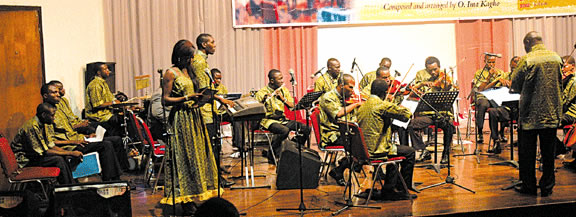
In primary schools, teaching of music is limited to nursery rhymes and singing, with only a few private schools teaching the playing of musical instruments. Some organizations such as the Musical Society of Nigeria's School of Music at Onikan, The Ademiluyi Music Foundation at Surulere, Ten Strings Music Academy also at Surulere, Parara Music School at Egbeda and Masha Music Academy at Victoria Island, all in Lagos, teach children how to play musical instruments and prepare them for formal examinations such as the Associated Board of Royal School of Music, Trinity College in Music, and also the MUSON Theory and Practical music examinations. These institutions have children choirs and orchestras that hold seasonal concerts.
There are also scores of private music teachers offering home teaching services in piano, trumpet, saxophone, singing, and the strings. Youths organizations and para-military outfits such as the Boys’ Brigade, the African Lass & Lasses Brigade, the Salvation Army, and the National Civil Defence Corps organize music and band-training workshops for their members.
Music educaton in tertiary schools
In 1960, the University of Nigeria, Nsukka in Enugu state established the first college of music in the country. Initially named Fela Sowande’s School of Music, it was later renamed the Department of Music. The department runs a bi-cultural musical curriculum - combining Western and African Traditional music courses. The earliest graduates from the University of Nigeria later went on to establish music departments at Obafemi Awolowo University in Ife; Lagos State University; University of Ilorin; University of Lagos; The Polytechnic (Ibadan); Nnamdi Azikiwe University, Awka; and Colleges of Education in Ilesha, Ijanikin, Osiele, Oyo and elsewhere.
Standardization of the basic music course modules ensued as a result of the growth of centers of music education. Such courses include: History of Western Music [from Renaissance to 20th Century]; Theory of Music, Tonal Harmony, Counterpoint, Orchestration, Ear-Training and Keyboard Harmony; African Music (Theoretical Studies & Appreciation); Foundation of Musicianship, Conducting & Performance Management; Music and Society; African Music: Historiography, Theoretical Issues and Contemporary Development; Introduction to Musical Instruments; Technology, Structure and History of Contemporary Music in Nigeria; Performance Workshop/Choral & Orchestral Studies (typically requiring every student to sing in the choir and also play in an ensemble); Basic Composition; and Applied Music (where every student must choose major and minor instruments, one of which must be the Piano).
Studies have shown that a substantial number of music graduates did not initially set out to study music, but ended up doing so as a result of the comparatively liberal admission policies in Nigerian universities regarding Music as a course. Music is thus sometimes seen as a ‘soft’ or easy option to gain a tertiary qualification. For instance, some years back, with just two West African Examination Council (WAEC) credit passes, the Obafemi Awolowo University in Ife would admit candidates into some of its certificate courses, such as Drama, Physical & Health Education and Music, the completion of two of these certificate courses then qualifies candidates to be admitted into a Baccalaureate programme in Music or Drama.
Aside from universities and polytechnics, another route to obtaining a music qualification in Nigeria is via the conservatory. The two most prominent conservatories are the Musical Society of Nigeria (MUSON) School of Music and the Peter King College of Music. The church Mountain of Fire Ministries [MFM] has the ‘Mountain Top Music Academy’; the Nigerian Baptist Convention also has the ‘Annual Baptist Music Workshop’ for their members. These conservatories and workshops have less stringent entry requirements, but still provide a practical course of study with very high standards required for qualification for either a Diploma or a certificate in Music. A university qualification however remains the preferred option for a candidate requiring more formal theoretical grounding and wider career options, especially in the academia.
Conclusiom
Music as a course of study is primarily a skills-based, professional venture, but it is domiciled in an academic environment. Higher institutions in Nigeria require fine-tuning of their courses and staff to provide greater value to students. To quote the distinguished academic, Dr. Femi Fasheun, university don and former Head of the Music Department, Lagos State University, “Since the inclusion of the subject (music) in Nigerian curriculum, students’ lack of interest in music as a school subject has been of great concern to music educators. The failure of music as a course of study to compete favorably with other courses of study needs to be vividly examined and rectified”. [Fasheun 2001]
On a positive note, it must be highlighted that the study of music is now daily embraced by very brilliant and intelligent young Nigerians, including graduates from other disciplines, combining their training in other fields with music. For example; Department of Creative Arts, University of Lagos has a Post-graduate Diploma program in Music, which is designed to train graduates from other disciplines that are also musically inclined to study music formally. The department has produced several virtuoso instrumentalists on this program.
Also, graduates of the conservatories in Nigeria are pursuing very successful musical careers both in performance and in the academia in schools such as University of Cape Town, South Africa, Berkelee College of Music, Boston, USA and Trinity College of Music, London. Many are also running a Baccalaureate in Music in several Universities in Nigeria. This can only be an indicator of positive outcomes in the future.
Disclaimer: Music In Africa's Overviews provide broad information about the music scenes in African countries. Music In Africa understands that the information in some of these texts could become outdated with time. If you would like to provide updated information or corrections to any of our Overview texts, please contact us at [email protected].


Most popular

Top Naija songs of 2026
31 Mar 2026

Top Afrobeats songs of 2026
19 Mar 2026

Top amapiano songs of 2026
16 Feb 2026
AFRIMA 2026: All the winners
12 Jan 2026
Open call: 2026 Gender@Work music industry training in Johannesburg
03 Oct 2026
NAAK and Vumaala to take SA electronic sounds to Amsterdam
02 Oct 2026
Disclaimer: Music In Africa provides a platform for musicians and contributors to embed music and videos solely for promotional purposes. If any track or video embedded on this platform violates any copyrights please inform us immediately and we will take it down. Please read our Terms of Use for more.

Subscribe to our monthly Newsletter
Follow us on social media


Please log in to post a comment.