






























































By Simon Doniol
Malian musical culture is amongst the richest on the continent - but behind the international success of some artists, the local music industry has never been able to support their professional careers. The text provides a brief overview at the history of the country's recording industry.
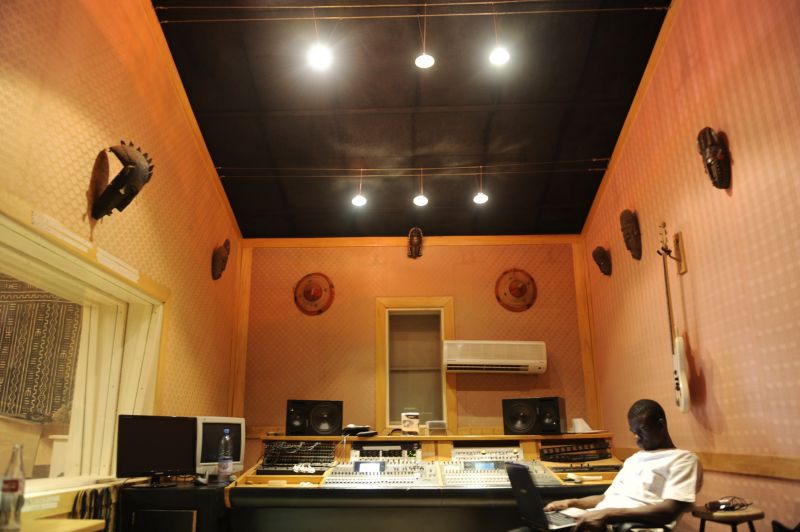
Independence to the late 1970s: A state-owned industry
From independence in 1960 until the late 1970s, all music produced in Mali belonged to the state. It was all about glorifying the country and independence, drawing on the cultural policy of authenticity of Guinean President Sékou Touré. Artists competed during national youth week under Modibo Keita’s rule or during the biennial sporting, artistic and cultural events under Moussa Traoré.
The legendary national and regional orchestras were then discovered. The Radio and Television Office of Mali (L’Office de Radiodiffusion Télévision du Mali – ORTM ) recorded groups and artists at Radio Mali , the only professional studio at that time, run by sound engineer Boubacar Traoré[i]. The famous 16-track compilation released by Mali Music in 1970 and the 11-disc recording of Mali Kunkan released in 1977 are part of Malian music heritage. However, these vinyl records, widely played on Mali’s radio waves, were manufactured in Europe.
Late 1970s - 80s: World-renowned Malian artists produced in Abidjan or Paris
The musicians of the Rail Band of the Buffet Hotel de la Gare in Bamako, for example, were employed as officials by Mali 's railway company (La Régie des chemins de fer du Mali (RCFM)) and their instruments were property of the state. Salif Keita, the lead singer of the Rail Band, was already thinking about royalties. He later joined the Ambassadeurs du Motel before leaving for Ivory Coast with some members of the group.
Artists outside of government circles and non-griots without sponsors were seldom recorded. Many Malian artists decided to try their luck in Abidjan in Ivory Coast, the musical capital of West Africa in the 1970s and 1980s, just like Boncana Maïga (the conductor of the Maravillas du Mali orchestra).
It was not until 1977 that the first intellectual property rights agreement was signed in Mali. The Malian Intellectual Property Rights Office (Le Bureau Malien des Droits d’Auteurs – BuMDA ) was created in 1978. However, artists pursuing an international career were already settled abroad, namely in France during the 1980s, a period when world music took off. During this time, Salif Keita met the famous producer Ibrahima Sylla and signed a deal in 1987 with Syllart Productions (now known as Syllart Records) to release his album Soro. In 1986, Ibrahima Sylla also bought out the forgotten music catalogue issued by Mali Music and Mali Kunkan.
Late 1980s – early 2000s: Mali K7 undermined by piracy and state inertia
In 1988, Frenchman Philippe Berthier opened the first multi-track recording studio in the country. In 1989, he founded Mali K7 SA, which became the leading Malian label during the 1990s. Originally associated with the major label EMI, the studio lasted until 1995, when EMI decided to leave the African continent. Philippe Berthier then partnered with Ali Farka Touré to reform Mali K7.
Ali Farka Touré founded Studio Bogolan at the same time in Bamako and enabled many Malian and international artists to record their albums.
Mali K7 could sell, in good times, 10 000 copies of audio cassettes in three months. Today, a successful artist only sells 3000 copies over the same period. Failure to enforce Intellectual Property Rights and piracy undermines the industry. Artists sought to alert the authorities. Rokia Traoré launched a citizens' march in 2000 which brought together the key players of the music industry and the state[ii]. The music industry is still struggling in Mali, even with the success of Tinariwen’s ‘desert blues’ and the international recognition of Amadou & Mariam .
Mali K7 closed permanently in 2005[iii], unprofitable and plagued by government inertia on the issue of piracy. Piracy now affects almost 98% of national production[iv]. Music transfer via bluetooth and illegal downloading prevails over traditional music piracy. Orange Mali and Malitel, the two largest operators, are criticized but they ignore the issue.
2000s - present: Professional studios and trained technicians suffer from lack of recognition
Other studios emerged, mainly in Bamako, such as the Moffou studio founded by Salif Keita in 2001 after the establisment of Wanda Records label, The Yellen studio, Maestro Sound founded by Boncana Maïga in 2004, Teriya Mali studio founded in 2007 by Berthin Coulibaly, Patrice Lumumba studio incorporated to Tiken Jah Fakoly’s club Radio Libre, the Humble Ark studio and Studio Mali[v].
After the death of Ali Farka Touré in 2006, Syllart Records took over Studio Bogolan. Moffou studio (with the support of the Vivendi Foundation) offers sound engineering training courses since 2006. Among the trainees, three young technicians are now well-established in the music industry in Mali: Abdallah Ag Amano, Abou Cissé and Sidi Mohamed Dicko. According to Dicko, “We suffer from a lack of trust from Malian artists, who sometimes prefer to spend more money working with Ivorian and European engineers. The state does not support artists. The budget allocated to BuMDA is insignificant. Foreign technicians operate the sound systems of most festivals held in Mali - this is absurd as there are qualified and competent technicians here.”
Post-crisis opportunities and initiatives of the new generation
The 2012/2013 political crisis, which shut down the activity of studios, did not improve the situation. Binetou Sylla, head of Syllart Records, explains: “The lack of a formal structure in Mali has also created opportunities, especially among the young, who are bold. Resourcefulness allows for a new dynamic.”
Today, the most popular music in Mali is not from national orchestras, famous divas or internationally recognized Malian artists. Hip-hop artists are the ones who fill the stadiums. The live stage is the only way for artists to survive. Clubs play Naija and new fusion music. Self-produced albums are becoming the norm. Artists like Sidiki Diabaté, Toumani Diabaté’s son, websites like Badama City and Rhhm.net, music streaming platforms offering videos and info on Malian rap, as well as home studios such as Buba’s recording studio Maliba Production are the new trends to follow.
- Bensignor François, « Hommage à Ibrahima Sylla », Hommes et migrations [Online], 1305 | 2014, posted January 1, 2014, accessed April 27, 2015. http://hommesmigrations.revues.org/2769
- Berger Virginie, « l’Afrique, nouvel eldorado de l’industrie musicale et des technologies? », 2014. http://blog.dbth.fr/2014/04/lafrique-nouvel-eldorado-de-lindustrie-musicale-des-technologies/
- Da Lage Emilie & Debruyne François, Chapter 8 « Les formes de la mobilisation contre le piratage au Mali: quand les artistes de la diaspora expérimentent leurs tactiques locales » in « Piratages Audiovisuels », De Boek Supérieur – 2011.
- Sidiki Dembele Y., Les Echoes article, 2005: http://www.malikounda.com/Art-Culture/MUSIQUEMali-K7-et-Seydoni-production-ressuscites.html
- Dicko, Sidi Mohamed, personal interview, Bamako, 2015.
- DVD Mali All Stars, Bogolan Music- Metisrecords & Universal Music France, 2013 - Excerpt Mali K7: https://vimeo.com/91297310
- Koné, Assane, “Culture malienne / Les artistes ont décidé de renforcer leur cohésion pour mieux défendre leurs intérêts », le Républicain Mali – 2013. http://www.diasporaction.com/culture/33-culture/8344-culture-malienne-les-artistes-ont-decide-de-renforcer-leur-cohesion-pour-mieux-defendre
- Sound engineering training in Moffou: http://cultureswithvivendi.com/dialogue-interculturel/formation-des-ingenieurs-du-son-au-moffou/
- Lee, Helen, les tribulations de la musique Malienne, RFI, 2005. http://www.rfimusique.com/musiquefr/articles/070/article_15766.asp
- Mazzoleni, Florent: « Musiques modernes et traditionnelles du Mali » – Le castor astral – 2011
- Mazzoleni, Florent: « Africa 100, la traversée sonore d’un continent » – Le mot et le reste – 2012
- Oublié, Jessica, interview with Cheick O. Traoré from Wanda Records, 2007. http://www.africultures.com/php/?nav=article&no=5847
- Richard, Florence, Slate Africa, 2013: http://www.slateafrique.com/102949/mali-bamako-la-musique-album-made-in-bamako
- Sidibé, Amadou, Philippe Berthier interview for Les Échos, 2005: http://www.malikounda.com/Art-Culture/PHILIPPE-BERTHIER-A-PROPOS-DE-LA-FERMETURE-DE-MALI-K7-Les-autorites-sont-complices-des-pirates.html
- Website of La Fondation Passerelle, a Rokia Traoré project: http://www.fondationpasserelle.com/
- Skinner, Ryan Thomas, « Money Trouble in African art world: Copyright, Piracy, and the Politics of Culture in Postcolonial Mali “– www.iaspmournal.net - http://www.academia.edu/6755425/Money_Trouble_in_an_African_Art_World_Copyright_Piracy_and_the_Politics_of_Culture_in_Postcolonial_Mali
- Sylla, Binetou, personal interview, Paris - 2015


Most popular

Call For Applications : ACCES seeks a UK-based performer
10 Sep 2026

Top amapiano songs of 2026
16 Feb 2026

Top Afrobeats songs of 2026
19 Mar 2026

Open call: Goethe-Institut grants for Southern African creatives
08 Sep 2026

AFRIMA 2026: All the winners
12 Jan 2026

Open call: Ernst von Siemens Music Foundation 2026 funding programmes
04 Sep 2026

Open call: FAME Week Africa, Pressure Cooker Studios songwriting camp
09 Sep 2026
Disclaimer: Music In Africa provides a platform for musicians and contributors to embed music and videos solely for promotional purposes. If any track or video embedded on this platform violates any copyrights please inform us immediately and we will take it down. Please read our Terms of Use for more.

Subscribe to our monthly Newsletter
Follow us on social media


Please log in to post a comment.