


























































South Sudan gained independence from Sudan in 2011, making it the world’s newest nation. Before then, there had been decades of conflict between Sudan's predominantly Arabic population in the north, which practices Islam, and the black population in the south, which practices Christianity and various African religions.
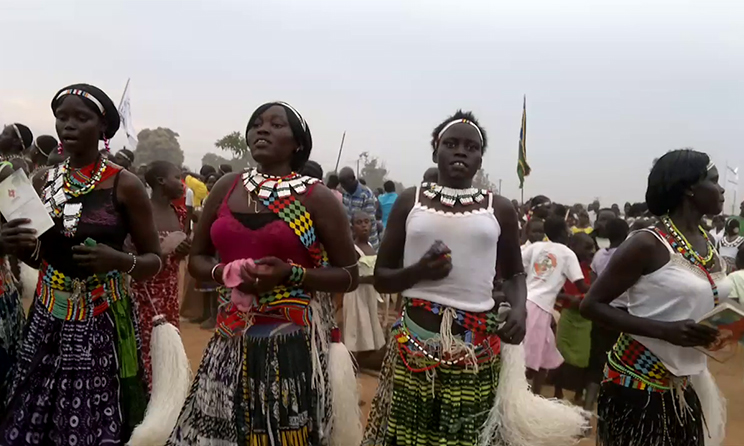
South Sudan has a rich tradition of folk music that reflects the diverse cultures of the region. For example, folk music of the Dinka people includes poetry, while the Azande are known, apart from the many other traditions and beliefs, for storytelling that often features a figure of a good wizard.
South Sudanese music draws on sub-Saharan rhythms – often six-beat, three-against-two patterns – and modal or pentatonic melodies, along with the gleaming lines of Congolese-style electric guitars. Vocal styles arrived from two directions, namely Arabic-style glides and quavers, echoed by the strings, or African leaps and exhortations.
Countries neighbouring South Sudan heavily influenced the country's culture. This is due to years of civil war that led to the flight of many South Sudanese to Ethiopia, Kenya and Uganda, where they interacted with the locals and learnt their languages and culture. However, those who remained in the country, or went north to Sudan and Egypt, assimilated the Arabic culture.
The influence of Islam on music in South Sudan
In the early 1990s, the Sudanese government destroyed recordings of important cultural artefacts to create space for propaganda. This included the destruction of unique tapes by Southern Sudanese artists such as Yousif Fataki. During this period only Islamic songs were played legally, which resulted in the exclusion of secular and gospel music.
Many secular South Sudanese musicians such as hip hop artist Mangar Azuma, who is popularly known as Lawless YB, used to attend church and listen to Christian songs. Azuma also used to read literature about Islamic faith. Artists like Azuma were therefore influenced simultaneously by Islam and Christianity. Azuma also claims to be inspired by American rappers Ice Cube and Tupac Shakur who professed the Muslim faith.
Gospel music in South Sudan
The development of gospel music in South Sudan is not really clear. However, it can be said with certainty that Christianity was introduced to South Sudan (then Sudan) around the 2nd century BC when Coptic Christianity reached ancient Nubia. Southern Sudan (now South Sudan) remained long dominated by traditional religions of the Nilotic peoples and was largely converted into Anglicanism (Episcopal Church of Sudan) during the 19th and 20th centuries.
Following the destruction of important cultural artefacts, including gospel music in the early 1990s, Christians compiled the popular text Shukuru Yesu (Thank You Jesus) in the late 1990s. Shukuru Yesu is a hymnbook comprising Juba Arabic and English songs. It is popularly used at student and youth conferences in South Sudan. The 89-page book comprises 181 hymns in Arabic and 141 hymns in English, and includes indexes and copyright information. These hymns have been translated into local languages and are well known by young and old Christians.
The influence of Christianity on music in South Sudan
South Sudan remained predominantly Christian through the years of conflict and artists in the country, whether secular or gospel, have been inspired by gospel songs.
South Sudanese Afrobeats musician Silver X, reggae legend Emmanuel Kembe, and hip hop star Emmanuel Jal all participated in church choirs early on in their careers. Award-winning Afrobeats musician Wonlok James, popularly known as WJ De King, developed his music from a local church in the town of Yei—some 100km from the South Sudanese capital Juba—and in Torit. Soul artist Winnie Lado also learnt to sing in her local church, as did gospel artist Denaya Dennis (aka Ambassador), a member of the Star Eagles band.
Some artists, however, believe the church's input in the growth of artists has not been enough. Churches are said to restrict artists from showcasing original songs within their walls, thereby discouraging them. This has seen the movement of artists from gospel to secular music in search of more support. In spite of all this, gospel concerts in the country still attract multitudes of music lovers.
Gospel artists in South Sudan
Most gospel musicians sing about salvation, forgiveness and faithfulness to God, as well as unity and reconciliation. For instance, Mary Butol’s song ‘Zol Batal’ is a call for repentance. In the song, Butol, who is one of the most prominent gospel artists in South Sudan, says God loves bad people regardless of their iniquities.
Daniel Lasuba, another gospel artist, sings about repentance and social activism. Mbaraza Emmanuel, a gospel music singer and composer, is known for songs like ‘Afa al Asil’ (Forgiveness), while popular gospel artist Manasseh Mathiang is a peace activist. David Dedi is well known for his song Weledu Yesuwa (Jesus Is Born) while Stella Martin is popular for ‘Mafi Zol ze Inta’ (There Is No One like You).
The tone and message of their songs suggest an attempt to send messages of forgiveness and reconciliation in a country where many killings have taken place.
Promotion and distribution of gospel music in South Sudan
There is limited media freedom in South Sudan. The nation is now ranked 145th in the world according to the 2017 World Press Freedom Index. Thus South Sudanese media face immense logistical, economic, social and political challenges. Newsgathering can be difficult and the communications infrastructure is poor. There are, however, about a dozen radio stations in the country (radio being the most popular medium of information dissemination). There is a state-run network, and each of South Sudan's 10 states has its own radio station.
These radio stations are the main outlet for the promotion of gospel music in the country, with most featuring gospel shows especially om Sundays . For example, Classic FM, one of the most listened-to FM stations in Juba, has a show called Morning Glory, which plays gospel exclusively and takes requests from listeners.
The South Sudan Broadcasting Corporation, the national broadcaster and only TV station, also airs gospel songs.
YouTube has become a platform for South Sudanese artists to share and promote their songs, with Facebook the primary medium for promotion. Many artists have personal Facebook accounts and fan pages through which they find an audience. There is also a dedicated Facebook page called South Sudan Gospel Music. It has a vision that reads: “Uniting to reach the unreached through music."
References:
- https://en.wikipedia.org/wiki/Music_of_Sudan#cite_note-roughguide-1
- http://www.nytimes.com/2007/07/23/arts/music/23cent.html
- http://www.worldmusic.net/guide/musi
- http://www.nytimes.com/2007/07/23/arts/music/23cent.html
- http://www.worldmusic.net/guide/music-of-sudan-south-sudan-divided-together
- http://www.thenationmirror.com/news/south-sudan-news/190-gospels-songs-unite-multitudes-of-believers-in-juba-gospel-album-launch-attracted-christian-masses
- https://rsf.org/en/south-sudan.
- http://www.bbc.com/news/world-africa-14019206
This article is part of the Music In Africa Connects project, a multifaceted development initiative aiming to support the music sectors of African countries affected by conflict. To find out more about Music In Africa Connects, click here.


Most popular

Top amapiano songs of 2026
16 Feb 2026

Top Naija songs of 2026
31 Mar 2026

Call for applications: ACCES 2026 Emerging Artist Spotlight Competition
01 Oct 2026

Top Afrobeats songs of 2026
19 Mar 2026

AFRIMA 2026: All the winners
12 Jan 2026

Open call: 2026 Gender@Work music industry training in Johannesburg
03 Oct 2026
Disclaimer: Music In Africa provides a platform for musicians and contributors to embed music and videos solely for promotional purposes. If any track or video embedded on this platform violates any copyrights please inform us immediately and we will take it down. Please read our Terms of Use for more.

Subscribe to our monthly Newsletter
Follow us on social media


Please log in to post a comment.