




























































A brief feature on the life and work of Etubom Rex Williams, one of Nigeria's finest Highlife Trumpeters and bandleaders. This was based on an exclusive interview granted Music in Africa by the legend himself.
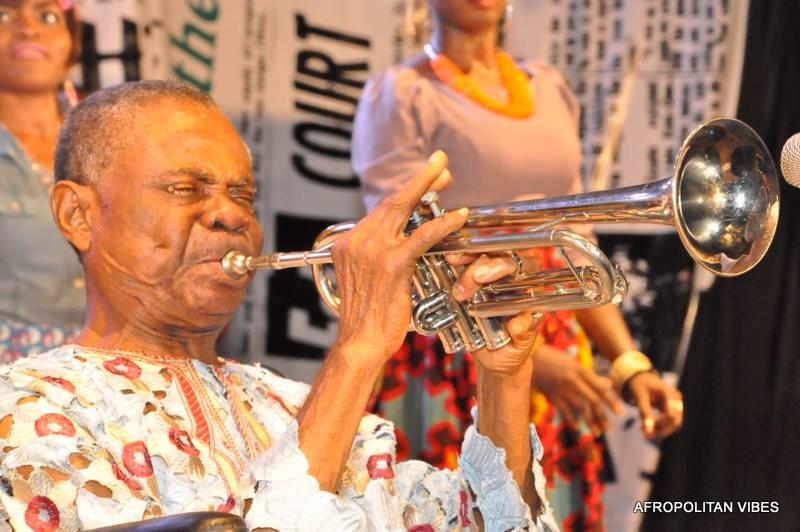
Lagos, 1976: I am not quite sure which variety programme I was watching then on the old Nigerian Television Authority, Lagos TV Channel (there was just one Lagos Channel then), but then the band playing was special. A fairly large Highlife ensemble, led by a stocky, dark-complexioned Trumpeter, at least I assume he was dark complexioned as it was Black and White TV after all. The Trumpeter was special though, near tonal perfection, a strong gravelly, masculine voice and some truly sweet tunes, straddling what clearly was a Highlife base, with unapologetic flirtation with Funk, Afrobeat and even Reggae. What signed me up to the man, was his infectious, joyous charm. He genuinely seemed like a man living his dream as a performer, and clearly on top of his game professionally. The clincher for me was when he recounted -to the interviewer- his interaction with the legendary Louis Armstrong (Satchmo), during his tour of Nigeria in 1963. In response to the not unexpected next question “What did you think of Satchmo?” his answer was simply the stuff of legend, “Ooh It was fantabulous!!” That was it for me, if this man was going to contest in any election, I was going to vote for him. That in a very large nutshell, was my introduction to the greatness of Etubom Rex Williams.
I followed his artistic trail for over 30 years, consisting by the way, of snapping up compilations in Europe that only needed to have artistes, with even a passing similarity to his name (and deeply regretting some bad misses). Proof that there is a supreme deity in the universe however emerged, when I received an email from the uber-cool Ade Bantu, inviting me to Interview Afropolitan’s next guest artiste, with permission to reproduce on the Music in Africa platform. When I was told the name of the said artiste, my first reaction was sheer disbelief. I briefly recovered my composure though and coolly responded that I would be glad to do it -whilst simultaneously dancing around my living room. Finally my search for the “Fantabulous man” was over. By the way, the obvious play on a recent documentary is clearly intended.
In summary though, Etubom Rex Williams occupies the genuine space of legend of Nigerian Highlife. His incredible professionalism, vast body of work and huge personality, established him as a veritable force of the genre quite early in his career. A case quite similar to another teenage prodigy of Highlife Music, Sir Victor Uwaifo. However any accolades he earned were well deserved and based on a platform of hard graft and genuine love for his art. He like Uwaifo, straddles the Inter-generational gap between the old masters of Highlife such as Bobby Benson, E.C.Arinze, Inyang Henshaw, Dr Victor Olaiya etc and the latter generation of Eddy Okweddy, Orlando Owoh, Tunji Oyelana, Eric Akaeze, Osayomore Joseph et al. Whilst his fortunes sadly waned in the course of decline of the genre in the post Oil boom 1980’s, today’s generation was left with an aide memoire of the invaluable bequeath of him and his generation in the form of compilation albums, released in the course of the decade long “World Music” revolution of the late 90’s on to the late noughties. Embarrassingly Nigerians were reminded of what they had nearly lost in these musical treasures. However we are fortunate that some of these great creators are still with us and in some cases, barely so. Etubom Rex Williams is one of such. The present generation still has the facility of a part of our incredible Musical heritage in him, still vibrant and strong, in spite of the passing years.
The story of Etubom Rex Williams, is however best expressed in his own words and the text of his interview is published below.
Early life: “I was born in Etinan, in Akwa Ibom State in the 1930’s. My father was a teacher and the founder of the Salvation Army in our town. I started out in Music in the 1950’s, playing in the Salvation Army Band, on the encouragement of my elder brother Nsifon William Nsemin.. It was through the Salvation Army Band that I learnt the Trumpet and the proper structure of Music. I attended Primary School up to Standard Six then, after that I went to Teacher Training College for One year.
I was afterwards employed at the Radio Station at Enugu, where I worked for a while. I was at Enugu when E.T Mensah came to perform. I was so excite, because he was playing my favourite Instrument- the Trumpet.”
Early musical career
“After seeing E.T.Mensah, I decided to become a professional Musician. So I resigned my job and went to Lagos. I was staying at Empire Hotel, where there was a Highlife Band playing, when I was approached to perform at a Hotel called Welfarers (Wayfarers) Hotel owned by a lady and I began to perform there leading the Highlife Band. I soon became very popular, everyone was talking about this Rex Williams. One day Sir Victor Olaiya, came to the Hotel and asked me to join his band as the leader, this was in 1960. Victor Uwaifo was one of the musicians in the band then, while he was at St Gregory’s College.. I was playing with Victor Olaiya’s band when Louis Armstrong visited Nigeria in 1961. I performed and represented Nigeria very well. In fact Satchmo congratulated me after I finished playing and told me I was going to be great. I was so happy, he was a great man. I also played with other great musicians like Eddy Okonta and E.C.Arinze.
In 1966, I got a contract to play at the Kainji Dam, which was being built then. We were entertaining the staff. When the problems started, I had to flee to the East. I then started playing at Onitsha in 1967 with the Army Band. When the war got to Onitsha, I eventually moved back to Etinan my home-town. From there I moved to Calabar where I started performing with my brother Nsifon William Nsemin.
After the war ended, we played at venues in Calabar like Cool Cats Inn, Dayspring Hotel and many others. We really entertained people then. We toured all over the country, Ibadan, Lagos, Enugu, we even toured Cameroun. We were invited by the East Central Government to play when General Gowon came to Enugu (in 1971).
I settled in Calabar and have been playing since then, at Concerts and other engagements. I enjoy my music and still perform at engagements”.
His legacy.
“I have released many albums, many albums like, ‘Juliana’, ‘Kudara Ererimbot’ and many others. My music has a message for people to try and do good and avoid evil. My music is about love, peace and happiness. My personal favourite out of my songs include ‘Satan ke mbiet owo’ and ‘Let us be happy’
I thank God my music is popular abroad and has been released again in albums. I am grateful to God for that. My message to our people is to be happy. I am a happy man and that is what I play in my music.”
Nothing sums up the legend that is Etubom Rex Williams, other than the last sentence. Long live the fantabulous man!


Most popular

Open call: 2026 Gender@Work music industry training in Johannesburg
03 Oct 2026

Call for applications: ACCES 2026 Emerging Artist Spotlight Competition
01 Oct 2026

Top amapiano songs of 2026
16 Feb 2026

Top Naija songs of 2026
31 Mar 2026

Top Afrobeats songs of 2026
19 Mar 2026

AFRIMA 2026: All the winners
12 Jan 2026
Disclaimer: Music In Africa provides a platform for musicians and contributors to embed music and videos solely for promotional purposes. If any track or video embedded on this platform violates any copyrights please inform us immediately and we will take it down. Please read our Terms of Use for more.

Subscribe to our monthly Newsletter
Follow us on social media


Please log in to post a comment.