






















































The Fingo Festival revolution in South Africa’s Eastern Cape
11 Jan 2016 - 12:41


“You’ve got a car? It’s less than two hours from here” says a Rasta woman I’ve known for a total of ten minutes. In that time, she’s managed to convince me to travel with her to a town nearby (or was it me trying to convince her?) on a hunt for medicinal herbs. The ganja in these here parts is strong. Mango, I’m told, is this season’s flavour. It can be found in Port Alfred, the town in question. I didn’t have a car in any case and had to forego the offer, unfortunately.
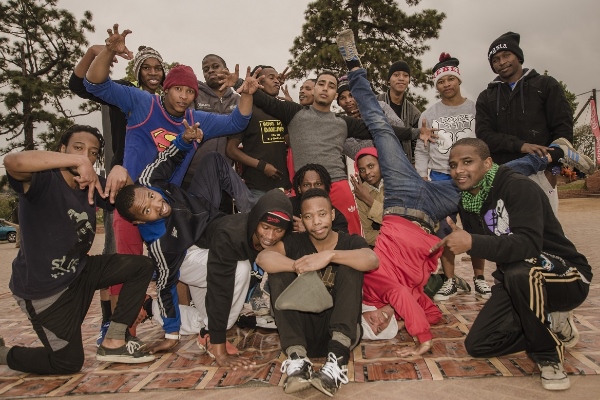
I’d landed here, in Fingo township, after being fetched from Grahamstown’s city centre by Xolile Madinda (or X), one of the main organizers of the Fingo Festival – an annual, independently-run series of events founded in 2011.
After a brief back-and-forth over text messages, X and myself agreed to meet in front of the Pick ‘n Pay off of Africa Street. It’s mind-morning during Winter; the air is crisp and fresh, and nippy in that special Easter Cape kind of way which leaves you with the perpetual feeling that you’re a clothing layer too short to be warm. X emerges from behind me and is every bit the nineties hip-hop renaissance man with his hooded jacket and Timbaland boots, plus a gray-coloured beanie wrestled onto his head to drive the whole idea home. He’s also well-versed in the history of Grahamstown – a story of displacement, deceit, and, ultimately, ownership–of land, of an entire nation’s memory. We spend the next 20 minutes shop-hopping, hunting for mats on which the b-boys will flex during the breakdancing battle later. We then leave the hungover, fest-frenzied streets of Grahamstown to cross the invisible line into Fingo, the township five minutes’ drive away.
Fingo Festival was established as an intervention during the Grahamstown National Arts Festival. The aim was to make art accessible to the Fingo township and its surrounds through a seven-day programme which has grown to include activities such as children’s workshops, open-ended dialogues, and musical performances. “There’s a lot of cry that the [Grahamstown Arts Festival] is for the elite, that the art is expensive, and all these questions. So, as artists we figured out [that] there’s a deeper question that is not being addressed right here,” says X.
This deeper question, he figures, is that we as black people aren’t taught to prioritise art from an early age. To redress this, X and his partners decided to demonstrate that art has value beyond being an extra-mural activity. “It’s a job for other people,” he says.
It was imperative for them as artists to set a standard so that people of Fingo and neighbouring townships understand that “during the festival, it’s not just them getting a job to clean the street. It’s for them to go and enjoy the arts – go and watch a drama performance, go and watch a music performance.”
We stop at the traffic lights where Dr Jacob Zuma Drive and Albert Street intersect, indicating to the right. A mural painted in red against a white backdrop lies to my left hand side; across from it is the open area paved in orange brick where the b-boy battles and live performances are held every the afternoon for the festival’s duration.
When we arrive at the community centre, a Rhodes University drama student is animatedly reading to a group of children gathered in one of the rooms. The workshops are hosted in the library at one end of the building. In session is someone from UCT’s Computer Science Department, who has developed an App to help bedroom producers determine the quality of their recording. It’s production 101 as heads listen intently and share their expertise on topics ranging from recording techniques, to treating a room for vocal recording.
The morning chill has started to wane, but there’s still a biting undercurrent which even the b-boys who’ve just arrived outside are keen to fight off. They stretch, they jump, and they clown around and take pictures for Instagram. I, on the other hand, develop this strong urge for medicinal herbs, which leads to me being introduced to the Rasta referenced above.
Fingo Festival is not without its own set of problems. According to X, they’re running on practically no funding this year. The little they received went towards hiring the sound, feeding the children, buying paint for the wall, and buying mats for the b-boys (we eventually got two when we found them). It would seem that while people in positions of power have been vocal in their support of Fingo Fest, lending muscle to ensure that it continues to exist doesn’t come as easy as the praises they’re so quick to dish out.
“We don’t want to be treated as special, but we want people to [take note] that after 20 years of democracy, these young men and women started something in their own community to reflect that there is change in the society we are living in,” says X. “It doesn’t have to be money. It can be making things happen,” he tells me. “The difficulties are there, but they could be solved if we also put ourselves out there, like now.”
It ultimately ends up sounding like a wishy-washy dream: a bunch of hippie-leaning bohemian intellectuals with deep socio-political grounding, a love for the freedom that comes with embracing art and letting it flourish, and a preference for more alternative forms of learning. It seems foolish, doesn’t it? A grassroots festival. Hosted in the outskirts of a frontier town. Over a seven-day period!
But without grassroots initiatives such as Fingo and its ilk, people in the community have no other means of accessing at least some of what’s on offer at the more polished, high-end, two-week festival just 20 minutes’ walk away. And sure enough on the Monday following fest, the street poles had newspaper headlines praising the “record attendance numbers” at the Grahamstown Arts Festival. The numbers, and not the art, were the main concern. We can argue until daybreak about the representation of black, mostly working-class people in spaces like the Arts Festival; about the festival’s steady movement away from townships such as Joza; about the Village Green’s policies (which have been deemed exclusionary to the immediate community countless times, yet nothing seems to be done about it).
Instead of talk, it’d help if initiatives like Fingo were championed more by the mainstream. I may have missed a few great showcases at the festival itself: Tumi Mogorosi, Kyle Shepherd, Msaki, and countless other musicians who dedicated themselves to a gruelling schedule of shows; the numerous actors who fought hangovers to give repeated performances which oftentimes cast them in emotionally-demanding roles; the film directors who availed themselves for QnAs after screenings; the seemingly-enriching discussions at Think Fest (X himself gave a talk). But as the sun hovered on the horizon on Saturday, the last day of the festival, and people sang along to a reggae band’s rally that “Better must come…”, I knew that no other gathering could, at that very moment in time, top the feeling of euphoria which overcame me.
Originally published on 30 September 2014 in Africa Is A Country.


Most popular
Open call: 2026 Gender@Work music industry training in Johannesburg
09 Oct 2026

Top amapiano songs of 2026
16 Feb 2026

Top Naija songs of 2026
31 Mar 2026

Top Afrobeats songs of 2026
19 Mar 2026
Gambia: Suntou Susso announce UK tour for ‘The Path of a Griot’
09 Oct 2026

Call for applications: ACCES 2026 Emerging Artist Spotlight Competition
01 Oct 2026
Disclaimer: Music In Africa provides a platform for musicians and contributors to embed music and videos solely for promotional purposes. If any track or video embedded on this platform violates any copyrights please inform us immediately and we will take it down. Please read our Terms of Use for more.

Subscribe to our monthly Newsletter
Follow us on social media


Please log in to post a comment.