































































Salsa is an integral part of the DNA of Benin from Gnonnas Pedro to Jospinto. This text explores the salsa culture and its African and Caribbean influences...
Benin rooted in Voodoo and Cuban Santeria
Salsa has always had a special place in Benin, a country wedged between Togo and the almighty Nigeria. In Senegal, Guinea Conakry and Ivory Coast, salsa is not as popular and considered ‘old music’ for many young people.
In Benin,however, salsa is profoundly rooted and linked to the history of the cradle of voodoo culture. “Salsa is a mix between the rhythms of the Orishas from the Yoruba and Western music,” says the Benin salsero, Michel Pinheiro. “We have added the piano and brass instruments to the Yoruba drum. This is what gave the salsa. I am an African so I figured it out!”
Voodoo ceremonies are characterized by the polyrhythmic sounds of the drum, bells, and rattles to make contact with the spirits of the dead. These are elements found in the Cuban sound, related to the Santeria i.e. the worship of the Orishas or the demigod-men mentioned in the Yoruba culture, and brought into the Caribbean through the period of slavery.
"Voodoo is our identity," says Vincent Ahehehinnou, the lead singer of Poly-rythmo orchestra. "Voodoo has contributed so much to music all around the world. Bells, castanets, tam tams, tumbas were created in convents.Salsa music has since evolved.”
The Caliente years 60-70
In 1960, the Republic of Dahomey gained Independence followed by a number of coups d’état. In 1975, Matthieu Kerekou established the People's Republic of Benin. Like Mali, Angola or Congo Brazzaville, his regime was based–and taken to the extreme – by Soviet Marxism. Porto- Novo became the capital and Fidel Castro, who danced to the sound of guaracha, the model.
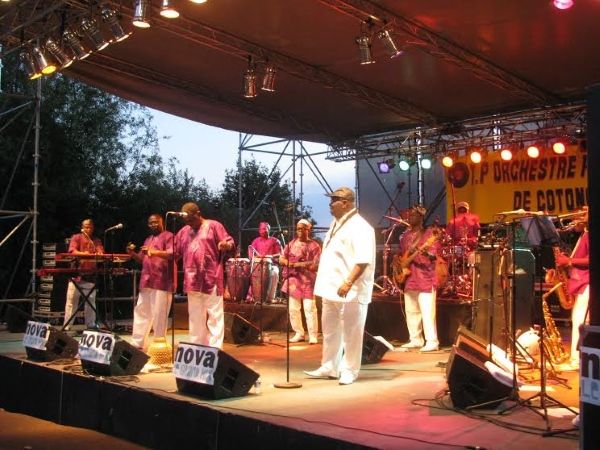
In the 70s, Beninese groups like the Tout Puissant Orchestre Poly-rythmo from Cotonou performed afro-Latin tunes with panache. The late Gnonnas Pedro, who passed away in 2004, was one of the pioneers of the genre and played with the legendary orchestra.
In the 60s, the rumba, salsa, and pachanga filled the streets of Cotonou and Porto Novo with groups with well-chosen names like El El Rego y sus commandos, Ignacio Blazio osho y orchestra Las Ondas and, of course,Gnonnas Pedro y sus Panchos.
Meanwhile, salsa celebrities like the Dominican Johnny Pacheco and the Cubans from the Orquesta Aragon toured, selling out theatres throughout the region. Together with afrobeat and funk, salsa was also part of the repertoire of the Tout-Puissant orchestra Poly-rythmo. Vincent Ahehehinnou, the lead singer, recalls: "We did not expect to become musicians. We were all passionate college students. We played in inter-college competitions. We were fascinated by the yéyé wave and singers like Johnny Halliday, Françoise Hardy, Jacques Dutronc, Richard Anthony ... We started to sing their songs which inspired us to create our own music. We adapted local rhythms to funk music and created something special: Our music, called Voodoo Funk."
The band, founded by the late Clement Mélomé, is today revered by collectors of vinyl records and the Scottish rock band Franz Ferdinand, who played with them. "Our adventure began in 1966, among many bands of the era," explains Ahehehinnou. "Ten years later, we had recorded more than four hundred singles! The demand was high. In 1969, we had our first hit with ‘Gbeti my Djro’ which toured the world. The radio show, Voice of America, was relayed around the world. We were on a lucky streak. That meant that we were on the right path! So we kept on going. We had good and bad times and today we are thankful!”
With the help of Elodie Maillot, a young French journalist, the orchestra toured around the world with the album Cotonou Club (2011) from Strut Records,featuring their “little sister” Angélique Kidjo.
Gnonnas’s Gimbo-Salsa
Gnonnas Pedro, whose real name is Pierre Kwasivi Gnonnas Sousou, is a child of Independence and artistic freedom of the time. The Cuban ‘son’ (pronounced sonne in Spanish) swept across the continent. Gnonnas proved himself with two hits namely, ‘Von von o no’ and ‘Yriyri boom’, a cover of a Cuban hit popularized by Beny Moré and Celia Cruz.
Pedro Gnonnas fused the agbadja style of the Lokossa region toLatin rhythms to create "gumbo-salsa"! In 1996, after the death of Pape Serigne Seck, Gnonnas Pedro joined Africando, a pan African orchestra created by Boncana Maiga.
The Haitian Shoubou, the Burkinabe Amadou Ballaké, the Guinean Sékouba Bambino, the Senegalese Diallo Médoune from the Orchestra Baobab and Ronnie Baro from the Broadway Orchestra were the popular voices of the genre. Africando’s last album, Viva Africando (Syllart productions / Sterns music) was released in 2013.
The 90s and 2000
Beninese salsa tradition is still present today. Founded in 1994, the Gangbe brass band is an extension of the Poly-rythmo orchestra. The band joyfully mixes funk, afro beat and salsa to create a cheerful genre. In 2015, this fantastic band released the album Go slow to Lagos (Buda musiques).
Jospinto, singer and founder of the Agogbe association for salsa lovers, declared how difficult it was to replace Gnonnas Pedro. His track "Esparati Gnonnas” from the Viva Africando album is a tribute to him. Jospinto sings in Fon, Yoruba, Mina and Goun, the major languages of the country.
Michel Pinheiro, former trombonist of Tiken Jah Fakoly, comes from Pobé, a city in the Louémé plateau. He founded the African salsa orchestra in 2014. Michel was trained in hotels of Abidjan in the 90s,and recalls: " Our repertoire was varied: Chocolate, Papaito, Coupé Cloué d'Haiti, Kassav, Moni Bilé, Hotel California...”
He toured with Tiken Jah Fakoly, without neglecting salsa music: “I danced the salsa in parties. It was as if I was entering a trance.” In 2009,he released ‘Bénin’ singing about the gate of no return of Cotonou and the lakeside village of Ganvié. Voyage, his lastself-produced albumwas released in 2013.
The future
Despite its musical dynamism, Benin is not immune to the global phenomenon of decreased orchestras in favour of DJs. "Young people are influenced by music programmed on machines,” says Pinheiro. “This goes with the current trend of pre- manufactured artists. Prior to recording an album, artists used to give concerts and perform at balls. Today, anyone can release an album. The career usually follows. Salsa is a very complex music and not everyone gets it! And then, there is the issue of the lack of producers.
“When I presented the first drafts of my songs in Abidjan, I was told: ‘This is old music! You must zouglou!’ We must encourage young people to play salsa.Young and old get up to dance when you play salsa in Benin. When an artist releases an album, there is always one salsa track. People like salsa. Boldness is lacking!”
Michel’s dream for the future is a salsa festival in Africa that would bring together Latin America and Africa…
Few links:
Jospinto Simedjito
https://www.youtube.com/watch?v=8KiEVHXewVM7
Michel Pinheiro Bénin
https://www.youtube.com/watch?v=4mcXlz8gAdg
Gangbe Brass Band live Ermitage 2015
https://www.youtube.com/watch?v=_5DkVe0h3_I
Interview conducted by the author in 2012 et 2013 in Paris


Most popular
Gambia: Suntou Susso announce UK tour for ‘The Path of a Griot’
09 Oct 2026

Top amapiano songs of 2026
16 Feb 2026
Open call: 2026 Gender@Work music industry training in Johannesburg
09 Oct 2026

Top Afrobeats songs of 2026
19 Mar 2026

Top Naija songs of 2026
31 Mar 2026

Call for applications: ACCES 2026 Emerging Artist Spotlight Competition
01 Oct 2026
Disclaimer: Music In Africa provides a platform for musicians and contributors to embed music and videos solely for promotional purposes. If any track or video embedded on this platform violates any copyrights please inform us immediately and we will take it down. Please read our Terms of Use for more.

Subscribe to our monthly Newsletter
Follow us on social media


Please log in to post a comment.