















































Interview: Jojo Abot talks about new ‘psychedelic gqom’ track

19 Feb 2018 - 13:10


Jojo Abot dropped yet another eccentric video last week and Music In Africa was quick off the blocks to talk to the artist about the inspiration behind the release. The New York-based Ghanaian singer has been making an impression with her fashion-heavy videos for some time now, and her latest visuals for the song ‘Alime’, theatrically shot among rural communities and amid urban landscapes in South Africa, are no exception.
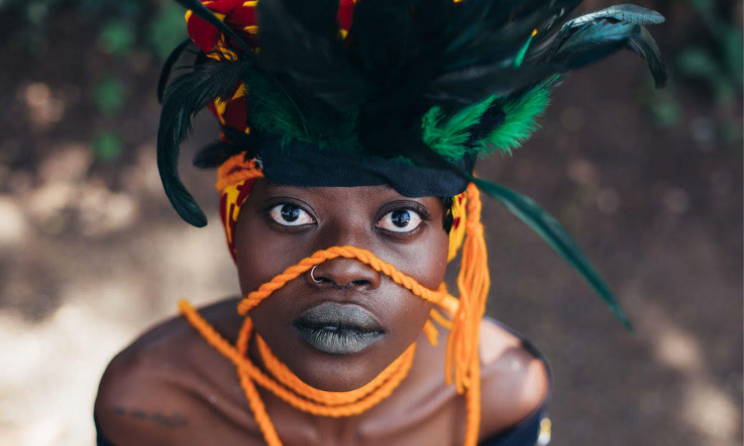
This is not the first time Abot has made a video in Mzansi. Last year she shot ‘Ngiwunkulunkulu’ in downtown Johannesburg where the multi-talented artist also played a couple of shows, most notably at the South African version of Afropunk Festival over New Year’s Weekend.
Although Abot’s music and persona might be seen as somewhat over-the-top by traditionalists, her constant craving to redefine cultural norms seems to be getting the desired reaction. And even though it may at first seem like Abot’s music might be more about fashion, visual art and expression than musical content, one has to delve deep into her body of work, the best part of which is arguably her live performances. The artist – who dabbles in dub, electronica, Afro-soul, Afrobeat, synth pop and now gqom – has performed at Times Square in New York, recorded live performances in some pretty interesting spaces across the US and toured with Lauryn Hill. Not bad for someone who’s yet to unleash the full potential of her ferocious creativity.
MUSIC IN AFRICA: What message are you sending with ‘Alime’?
JOJO ABOT: ‘Alime’ is a song that was sung in the Ewe language. Alime as a word means ‘in the waist’ or ‘waist’. Ali is ‘your waist’ and alime is ‘in the waist’. The song is saying, ‘Bend or break your back’ and for me the song is largely about celebrating who we are because we are very beautiful, powerful and culturally rich people as far as Africans and blacks are concerned. But there is also a need for us to engage the power that we possess. So when we talk about the waist as the source of energy, it’s a call to activate your power and to break your back for the things you believe in.
You shot and launched ‘Alime’ while in South Africa. How will South Africans see this video?
For me there have always been conversations around appropriation vs appreciation and as someone within the South African space, everything is new and yet familiar at the same time. With ‘Alime’ I really wanted to capture the energy of the people as they exist within my own verbal and visual language. But the song is about how I can take the rawness of everyday life here and represent it respectfully. I wanted to portray a continuity between me and everyone else and show a collective community about these people.
How would the Ghanaian audience interpret this video?
For a Ghanaian who is hearing gqom, or psychedelic gqom, for the first time, it would be familiar because you’ve heard azonto, hiplife, highlife, polyrhythmic music and dance music. I think it would be interesting for them to hear a familiar language coupled with other South African languages. The song also features El and Vuyo, who are South Africans.
Would you be disappointing your fans by introducing a new genre?
Absolutely not! I think I always find a way to mix my sound with other sounds. You should listen to ‘Ngiwunkulunkulu’, a project that I produced at the very last minute when I was last in South Africa. Some people who were listening to it said it had a South African house and kwaito influence. It’s interesting to see people listen to a track and find that that identity is a reflection of one’s self in music. That wasn’t intentional, it happened as a marriage between myself and the space. My music has never been any one particular genre; I have been accused of being a genre bender and for diffusing different things. As a producer, I am not stuck on one sound. In my music you can hear songs that are psychedelic jazz or more Afrobeat or more dance. I think you get more of these elements in ‘Alime’.
Red seems to be the signature colour in your videos.
It’s interesting because my mother always found me wearing black when I was young. She didn’t like it at all because where I come from black represents mourning and darkness. And in the past number of years she’s noticed a pop of red growing in my expression. It started to surround me. It’s interesting because as Ewes we have a thing for red. We are constantly found in spaces of red. That comes from a cultural and spiritual place where blood and red represents danger but also life and purity and a connection to the ultimate creator.
Are you warning us of danger?
I don’t know, it’s up to the viewer. At the same time I would say the same thing I said to my mother, which was that the world is in state of urgency and danger and we should be on alert.
What’s the philosophy behind ‘Alime’?
The philosophy is existence in one’s full glory. I think a lot of us forget that we do have a privilege and responsibility of existence in occupying space and time. A lot of us are quick to deflect that responsibility and privilege. We like to exist as invisible beings because it’s easier than taking responsibility. But what that ends up doing is keep us from becoming our highest selves. And oftentimes we find ourselves in spaces that don’t really nourish the core of our being, the spirit that we possess.
It’s about an individual who is in a moment of vibrancy, realising that the people represented in the video are not more special than you. It’s about our collective beauty, which is our collective power and beyond. But that collective power only happens if we make time to tap into who we are to become aware of ourselves.
Take us through the journey of your art and music. Where is the synergy?
That’s for the observer to experience. There might be no synergy at times and there might be synergy. The largest thing about my work that most people don’t understand is that it’s inspired by my existence; it’s not something that I have to go outside of myself to perform. I truly wake up in this existence, and that’s sounds like a lot, but I literally exist in this all the time. There is a larger message and I have the privilege of being able to use my craft to get a greater message, so that’s the focus. The experience of seeing yourself reflected, whether directly or indirectly, through me is really what this work is about.
You’ve been to Denmark, the US and different African countries. What has your experience with the music markets in different countries been like?
I am not so much of a music business type of person. I exist very much in the activation and creation space. So I wouldn’t know so much about the strict business side of African music. My music is a very tricky one for the market to absorb and digest because it’s different. People have responded to me as a result of an overall experience.
I have also curated residencies here and I work a lot with young people, so my relationship with the continent is very different. As far as me existing in all these spaces as a human being, my experience really has been that whatever your medium is, whatever message you have for the world, whatever you feel you have to express to the universe, it’s definitely a good idea to travel because you exercise and develop empathy around that issue as far as global context is concerned.
So I could have been speaking purely from the perspective of a Ghanaian but through travelling I have experienced a little bit of what it’s like to be in my body and other spaces. So I can be empathetic to someone from Denmark, I can be empathetic to someone from South Africa and as a Ghanaian I will tell you the truth. We are not encouraged to come to South Africa because we are told South Africans do not identify as Africans and that oftentimes our encounters with South Africans is with white male South Africans, which is not true.
Why did you choose squatter camps in your video?
I think in order to celebrate oneself you have to go where rural life exists. I call this village sci-fi because I come from a very small town – I don’t come from the city, I don’t come from a life of popping champagne bottles. So when I think of telling the narrative of the people, I go to where rural life exists because that’s where I grew up.
How does rural life become a concern when you grew up in the US?
I think when I came to South Africa I was very much worried about spaces that I should occupy and spaces that I shouldn’t occupy, both as someone who is not from here and as a woman, as a female body. The question ‘Should I be in these spaces?’ caused me to spend time in these spaces, connecting with the people, and I realised that their existence is very valuable. I don’t think it’s really that deep, I just felt like these are my people and what I wanted to find out was like, ‘Yo peeps, what’s up? Let’s make a video.’ Those are the spaces I thrive in, where I feel I can learn something authentic about who we are. I don’t have to exist in a space of pretense or try to be something I’m not.


Most popular
Open call: 2026 Gender@Work music industry training in Johannesburg
09 Oct 2026

Top amapiano songs of 2026
16 Feb 2026
Gambia: Suntou Susso announce UK tour for ‘The Path of a Griot’
09 Oct 2026

Top Naija songs of 2026
31 Mar 2026

Top Afrobeats songs of 2026
19 Mar 2026
Call for applications: ACCES 2026 Emerging Artist Spotlight Competition
01 Oct 2026
Disclaimer: Music In Africa provides a platform for musicians and contributors to embed music and videos solely for promotional purposes. If any track or video embedded on this platform violates any copyrights please inform us immediately and we will take it down. Please read our Terms of Use for more.

Subscribe to our monthly Newsletter
Follow us on social media


Please log in to post a comment.