




























































Interview: SA blues rock musician Ross Harding
27 Apr 2023 - 15:16


South African blues rock singer-songwriter Ross Harding recently released ‘Everything Is Black’, a grooving, sludgy, heavy tune with an anti-establishment narrative that talks about the Four Horsemen of the Apocalypse.
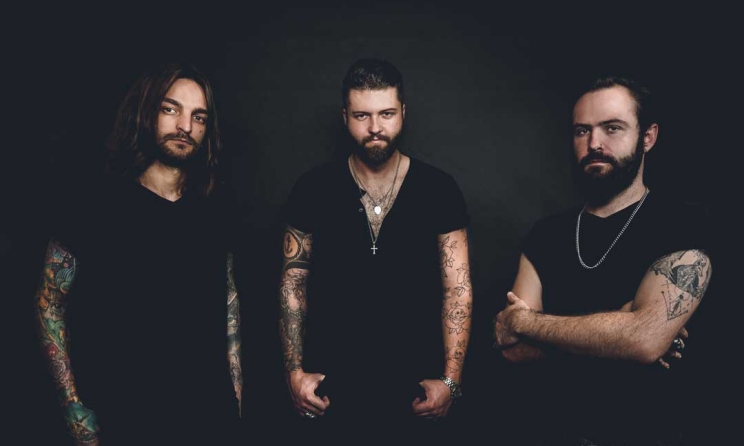
The track is available as a maxi single accompanied by two bonus tracks: a live cover of Black Sabbath’s ‘War Pigs’, and an original song called ‘Dark City Blues’, which was also recorded live.
We sat down with the musician to find out more about his music.
It’s fantastic to be chatting to such a staunch ambassador for blues rock in South Africa. To this end, let us start with your origin story, so to speak. When did your passion and love for the blues and rock begin, and how did you find your path on this journey?
ROSS HARDING: I fell in love with rock music at an early age and became obsessed with the guitar not long after. However, it was only in my middle to late teenage years that I discovered my passion for the blues. Essentially, I had been diving deep into the influences of my own favourite bands, like Led Zeppelin and Black Sabbath, and discovered that they had all been influenced heavily by blues artists. That took me on a journey to discover more about those blues legends, and I found myself going down a blues rabbit hole that I’ve never really come out of.
I became obsessed with Robert Johnson, especially because of the Faustian, ghost story kind of folklore, as well as Howlin’ Wolf, BB King and so many others. What still captures me in the blues is the history, mystery and stories. I’m a sucker for horror, the occult and all that weirdness, and the blues is full of it.
Every muso has a muse and every artist has a mentor. Who are your greatest sources of inspiration and motivation, and who have been guiding lights along your path to date?
I’m deeply interested in subject matter that provokes the mind. From a lyrical perspective, I write about anything from the occult, to politics, religion, folklore and psychology. The guitar itself continues to be an influence on me in the sense that it is the foundation of rock music. Artists like Soundgarden, Led Zeppelin, BB King and Black Sabbath have all hugely influenced me. I’m into heavier music too, like Black Label Society, and emotive bands like Kings of Leon. Those contrasts definitely come out in my music. Learning the guitar, learning the blues, that has been a massive part of my path. I love turning my amp up to 11 and really letting rip on the guitar, so of course blending that energy into songs, music and performances is part of the pleasure of my work. Understanding music, how instruments work together, how a band works, and getting deep into it is what drives me to keep doing it. To attempt to perfect it.
Your sophomore EP Chapter II released in late 2022 had its international premiere with Metal Injection. The EP received positive reviews, drawing parallels with the greats like Black Sabbath – for its use of blues and harmonic minor scales. Was this all by design or was it a fluke, drawing on the fact that your latest maxi single ‘Everything Is Black’ features a cover of ‘War Pigs’?
There are a few layers here. It’s great you mentioned blues scales and harmonic minor scales. That’s pretty much my signature, in the way I approach the guitar. I think that blend is what gives the music an air of mystery, a brooding quality intertwined in groove and blues-based rock and roll. Sabbath had that thing too. The reason the ‘War Pigs’ cover was included with this single is because thematically the songs deal with the same thing. They are anti-establishment. I’m not about to go off on a political rant, but ‘Everything Is Black' deals with the failures of the establishment.
I’d be interested to see what people make of the lyrics. It’s funny that the word ‘imperious’ has been used to describe my music on several occasions. Me and my band have a pretty humble approach in how we create music. I often feel that my music is simple. At least, I try to keep it simple. It’s perhaps that definite command that can come across in an unapologetic, sometimes imperious way. The way everything is structured is 100% by design. I am proud of that. I’ve been doing this for quite a long time, having been in different bands and many musical environments. The way my music sounds now is as close to what was in my mind as I’ve managed in my career. I owe that to my band, too.
Tell us about your ideation process, from inspiration to realisation. How do you give life to your ideas in terms of songwriting, recording and production?
The creation process starts with something poignant, something powerful, something that must move me. Often, it’s a riff or musical motif that will begin to take form. My music is quite visual. On a side note, I feel that it would do well in film scoring. Lyrical ideas will mostly come from the music. If the music moves me, the lyrics will usually write themselves. Once the songs are refined and ready to record, we have a pretty methodical and structured approach to that process. My band, featuring drummer Matt Rennie and bassist Merrick Kyle, and I know what we want and will work at making sure that’s what leaves the studio. As close to that ideal as we can, at least.
Over the past year, you released two EPs in quick succession, and now your latest maxi single. You look to favour frequency while clearly maintaining quality. Why have you chosen this strategy – above traditional longer-cycle album releases – and what insights can you share with other artists looking to follow a similar release strategy?
My goal is to build my audience by releasing music frequently. It must be quality music. So, there’s a ton of pressure, but it pays off. My opinion is that independent artists should all be releasing singles now. Personally, I think the days of the album are fading quickly, and singles are the way forward. That’s quite sad, I grew up with albums, but there’s a positive side, too. Streaming platforms want quick hits. For artists, it means making sure everything you release is as of high quality as possible. Building something with those singles is important, hence my decision to do a maxi single.
Lyrically, several of your tracks seemingly challenge solemn matters from a thematic perspective like death, the Apocalypse, doom and gloom. Do you believe it’s vital for an artist to lucidly explain exactly what they meant when writing a song, or do you feel it is superior for the listener to derive their own meaning and value?
Absolutely the latter. The only time I think an artist should explicitly divulge a song’s meaning is if the artist wants the message to be portrayed in a very specific way. But I believe in the audience’s interpretation. That is what creates a personal bond with the music. Lyrics are so powerful in that way. My songs definitely are on the darker side, but generally have a positive end, should one care to take a deeper look. There’s a lot of tongue in cheek, lots that will be missed if you’re not looking closely. I think true fans of my music have seen that. It’s almost like something extra you receive for paying attention, and that makes it valuable on a personal level to fans, which is massively important to me.


Most popular

Top Naija songs of 2026
31 Mar 2026

Top Afrobeats songs of 2026
19 Mar 2026

Top amapiano songs of 2026
16 Feb 2026

Open call: CANEX Music Business Lab and Songwriting Camp
15 Oct 2026
Open call: National Arts Festival artistic director in SA
15 Oct 2026

Ghana: Mr Eazi and MOLIY’s ‘Comfort’ earns Urban Music Awards nomination
21 Oct 2026
Disclaimer: Music In Africa provides a platform for musicians and contributors to embed music and videos solely for promotional purposes. If any track or video embedded on this platform violates any copyrights please inform us immediately and we will take it down. Please read our Terms of Use for more.

Subscribe to our monthly Newsletter
Follow us on social media


Please log in to post a comment.