







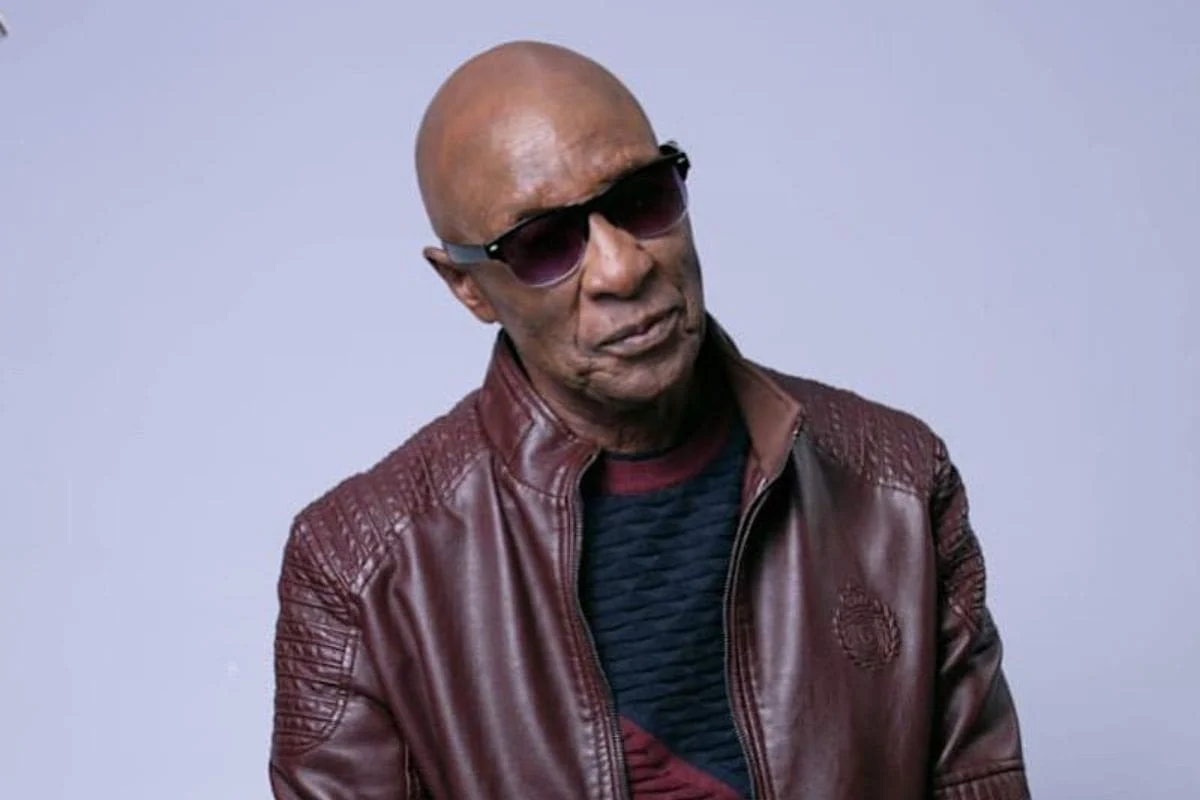



















































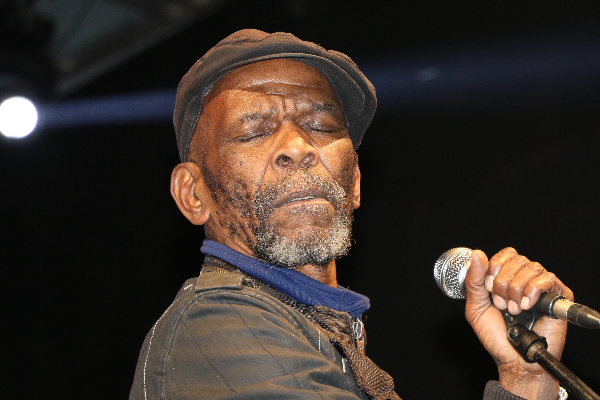
There are few South African musicians of Ray Phiri’s stature. At 70 years old, the veteran singer and guitarist is hitting the stage with full might again amid an illustrious career that has seen him as the long-time leader of Stimela and a primary member of Paul Simon’s controversial Graceland tour in the late ‘80s. Phiri spoke to Music In Africa during the Africa Day Concert in Johannesburg on Saturday despite reeling from a bad case of the flu. A philosopher at heart, Phiri spoke about various issues: his latest musical exploits, spirituality, the state of the music industry and Simon’s disingenuity.
When did you get sick?
Coming back from Azgo. But beside that, age is the common denominator. You can only do as much, so you need to be careful how you do it: preserve some energy and when the body says, ‘Hey, I need some rest,’ you gotta give it some rest. You’ll make more music next time [laughs].
You’ve been busy lately. You have a new management company [Black Major]. How is that going?
The new management are still on a probation period. We want to see what they’re bringing to the table. I’ve been in rock and roll for a long time, I know what management is all about. But people need to be given a chance to prove themselves. I’m responsible for all these young musicians I work with, so they look up to me to protect them, to carry them forward, to advise them, to be their psychologist. And I need them to be my energy and strength.
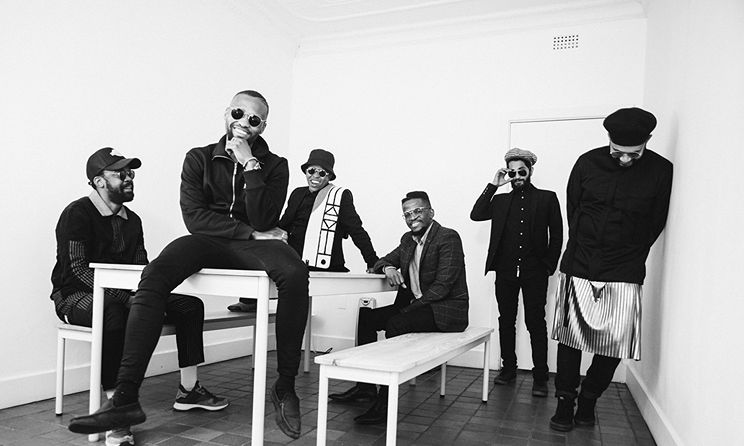
You have a new band, not Stimela…
I’m still with Stimela but this set-up gives me an opportunity to play the songs I can never play with Stimela. There’s so much music. Stimela is a cult band, although I have to be careful not to bring in new music that people might reject. I must introduce them with a retro of some of the Stimela music. That way they will see that there’s more music that can be shared with them.
Are you writing music at the moment?
I am. The only problem is that I’m a coward. I have three unreleased albums, finished and mastered. But I don’t see any reason why I should release them.
Why not?
I’m not in the business of making money, I’m in the business of archiving.
What about your fans? Maybe they’re expecting new music.
That’s why with this band I’m chronicling four decades of a growth of music. Four epochs, each of them representing a different period, a certain subject matter and a story to be told. Music is a communication tool. The money comes as a bonus for a job well done. I’m crazy. You know, you get more satisfaction when you teach and learn. If it’s all about making money, then get out of music, because you’re going to destroy the music for the sake of money.
That model seems to be working for some musicians.
I wonder if they will be in music for 53 years like I’ve been. That’s the difference. Young musicians nowadays blur the lines. They become a product, their art becomes tied up with the product. So it’s not art for art’s sake. If people are still enjoying the music I made four decades ago, then that means I’ve done the right thing.
Are you going to play music from Graceland tonight?
Graceland is a place of pain. Too many controversies, too many lies, too many shenanigans. The truth will come out someday.
Do you think you got the credit you deserved after Graceland?
I just got credited for the songs I wrote, as an arranger [laughs], which is not fair.
Are you still in contact with the Graceland band?
I am. In 2012 we were celebrating the 25th anniversary of Graceland. It felt good but you cannot keep on going back to Graceland because there’s more music. Graceland was just the tip of the iceberg. If Paul Simon is a great composer and songwriter why does he not have another Graceland, or an album as successful as Graceland?
What are Paul Simon’s positive traits? Was he a good administrator, was he someone who could get people to work well together?
I don’t think so. He took a gamble. All he did was prey on the innocence of people who love making music. And it looked like he gave them an opportunity. He never did that. The music of South Africa gave him an opportunity to revive his career.
Let’s move away from the memories and talk about the now. What’s next? Is there an explosion coming from you?
There will be an explosion. The explosion will be accepting the fact that I have to tell the world, but tell the world what? That’s the trick.
Do you know what that is?
I don’t know. I’m honest about that. If I’m hurting I won’t say, ‘I hurt but only a little.’ I’ll say, ‘I’m hurting because of X, Y, Z, I’m happy because of X, Y, Z, I’m confused because of X, Y, Z.’ Can the world help me make sense of the nonsense? So the subject matter will be very wide.
Let's take as an example the subject matter of an Africa Day concert. We all know what it’s about – part ideology, part politics, part reality. What’s the new context, the new story that we can tell the world that it doesn’t know already?
Spirituality and humanism. Spirituality hasn’t been lost yet. I’m a spiritual person.
Yes, but you’re 70. What about the young people out there?
You lead them to where the information is. You don’t push them away. If you save one you’d be saving multitudes of them. Let’s look at it this way: 51% of the world population is between the ages of 18 and 40. So where is the power? It lies within that age group.
Does it?
Yes. The actual power lies within that group. They can stop the heart of the world, they can transform the world.
Sure they can but are they doing it?
Too much information has little truth. That’s why at this point in time they haven’t found a reservoir where the information they are seeking can be found. The reservoir is spirituality. Once you’re satisfied as a spiritual being you don’t worry about a worry, because the worry will take care of itself. Your purpose as a human being, in life, is to protect, serve, educate and learn. The universe has so much for us but we haven’t touched even a little particle of it.
Do young people listen to what you have to say?
Yes. Easy. It’s because I become a child. When you talk to young people, be the child, let them teach you. Once their energy ebbs, you say, ‘Okay, let’s work together now.’ I work a lot with young people. But you see, society is sick. It has these little pockets of ideologies. ‘That’s old school and that’s new school.’ That just creates a vacuum that can be manipulated. We have to swallow our pride and reach out, and they will come. Wisdom and youth equals energy.
Let’s get down to the ground. How is today’s music industry different than the olden days?
During our youth we fought to regulate the music industry. Just like the recording industry, the music industry is equally important. Today in South Africa we have more of a recording industry than a music industry. The music industry is supposed to support the recording industry. The touring circuit, theatres, bars, clubs and so forth; I can’t take you to any club right now for you to experience it. There’s nothing. We’ve lost it. We should have thought.
During the apartheid days we became culturally strong because there were township halls, there were mining houses that had arenas, so we would go entertain the miners. We could easily advocate to the miners and the township. Programmes of activism became easier to carry through. We had a music industry. The varsities were manifesting grounds of positive thinkers. If you could get yourself inside a varsity and perform for a varsity audience, then you were performing for a class of opinion-makers of the future. The varsities are the barometer of seeing where the country is going. They see whether transformation is taking place. We cannot keep digressing and hiding behind the truth, saying ‘It’ll work someday.’ There’s no such thing.
If we have to change things, let’s change them radically now. If 71% of people in South Africa live below the poverty line, how can we level the playing field? Almost 65% of the country is very rural. Instead of saying ‘let’s urbanise’, why don’t we industrialise in poor areas so people can be productive without having to travel hundreds of kilometres to get to work? A working father away from his family destroys the socialisation of that family. We keep making the same mistakes generation after generation.


Most popular
Open call: 2026 Gender@Work music industry training in Johannesburg
09 Oct 2026

Top amapiano songs of 2026
16 Feb 2026

Top Naija songs of 2026
31 Mar 2026

Top Afrobeats songs of 2026
19 Mar 2026

Gambia: Suntou Susso announce UK tour for ‘The Path of a Griot’
09 Oct 2026

Call for applications: ACCES 2026 Emerging Artist Spotlight Competition
01 Oct 2026
Disclaimer: Music In Africa provides a platform for musicians and contributors to embed music and videos solely for promotional purposes. If any track or video embedded on this platform violates any copyrights please inform us immediately and we will take it down. Please read our Terms of Use for more.

Subscribe to our monthly Newsletter
Follow us on social media


Please log in to post a comment.