





















































The #JerusalemaDanceChallenge showed how Pan African styles can be forged
20 May 2021 - 09:23


By Francesca Negro
A year has passed since an Angolan dance troupe called Fenómenos do Semba released a video of themselves dancing in a courtyard in Luanda to the South African hit song ‘Jerusalema’ by Master KG.
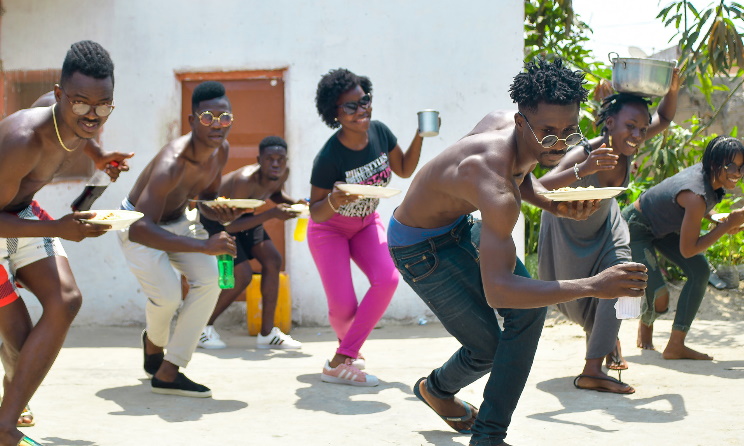
With over 16 million YouTube clicks, the #JerusalemaDanceChallenge swept the planet as social media users posted their own versions of the dance.
Its success has inspired me to offer some further reflections on the importance of the cultural meaning of this dance and its contribution to the creation of a Pan African aesthetic.
How Angolans celebrate
The dance video’s success is related to deep-rooted elements that might go unnoticed at first sight. But, taken together, they convey the joyous and proud expression of a collective identity.
Despite not being danced to Angolan music and using steps that stem from different kinetic codes, the video is still representative of the main elements of the Angolan way of celebrating: food, music, dance … and brincadeiras (joking around).
The dance takes place in a communal courtyard situated between Luandan buildings. This open but protective space in itself represents a specific way of living in a community. In the recent past of civil war, these places of mutual exchange allowed people to preserve family units, overcome collective trauma and protect local languages and cultures from the threat of colonialism.
Writing on Facebook about their video challenge, Adilson Maiza, the leader of Fenómenos do Semba, said: “There is always a reason to be happy, always a reason to celebrate.”
This same spirit of gratitude found more concrete expression in the now famous troupe’s promotion of social initiatives. They have done things like distributing food in disadvantaged areas and promoting the foundation of the Angolan Dance Association for the promotion of dance in the country.
In this sense the presence of food is very relevant and it has surely contributed to the video’s success. It reveals the genuine character of the reunion and the spirit of contentment through the symbolic act of eating. Indeed, in Angola, getting together with family and friends has a social, political and spiritual value. This was pointed out by Angolan writer Óscar Ribas in his 1965 book Izomba, about the importance of recreational centres in Luanda.
The value of gatherings gained even greater importance during the long night curfews that were at times common during the civil war (1975 to 2002). During this time dance and music seemed the only remedy to soothe a permanent fear. To the people who experienced the Angolan and South African reality of those years, the ‘Jerusalema’ video is surely a reminder of the joy of being able to celebrate togetherness under any conditions.
The dance
The dance displayed in the video is commonly known as Dança da Familia (the Family Dance). It is not a traditional Angolan dance with a semiotic code. Nevertheless, it’s frequently danced at weddings and parties. It mainly consists of a short sequence of steps, repeated within the same structure. Anyone can introduce variations and personal touches (toques) to the sequence. In other words, it is not a choreography but rather the repetition of a scheme.
The idea of a choreography does not belong to the Angolan conception of dance. Rather, dance is improvised and repeated with simple variations answering to specific rhythmic calls. It’s never linked to a specific song.
Angolan dance is a performative act rather than a product. It is always the result of the encounter of new movements with a traditional but permeable frame, and it represents a specific conception of society and life.
Angolan dance stems from the expression of a circumstance. Songs register popular dialogues and events of daily life. Gestures come from activities such as drying wheat, tilling the land or, in more urban scenarios, imitating a crippled man (o coxo) or defending the value of gender diversity.
The peculiarity of the ‘Jerusalema’ dance lies in its sequence, proposed by one of the participants and repeated in the same way in four directions. It does so with the same steps and the same rotation at the end of any sequence, while able to be embellished with any specific groove proposed by the main dancers.
The dance’s character demonstrates the focal point of the dance transmission technique in many African contexts. This takes place in a playful context, without any formal teaching. It derives from a logic of movement developed over centuries and passed on through imitation and innovation.
Commonly danced in Angola and South Africa, but also in the Democratic Republic of Congo, the Congo Republic, Cameroon and Zambia, Dança da Família could be defined as a “neotraditional” cultural product, borrowing the definition of British-Ghanaian philosopher, cultural theorist and novelist Kwame Anthony Appiah.
The music
The “dance structure” of Dança da Familia can be performed on different rhythms. During family celebrations this pattern is danced on more traditional rhythms like soukous (or sakiss) and pantsula, but also on coupé decalé, azonto or Afrobeat songs, by those who do not know each rhythm’s dance code.
All these music styles are appreciated by different generations in various countries. This dance structure embeds their specific vocabularies, reshaping them into a new cultural product. Dança da Familia can be adapted to all these rhythms, which is why it is often used at West African weddings in the south of the region, where continuous exchanges between ethnic groups have created mixed family units and multicultural traditions.
Similarly, contemporary styles like Afrobeat or kuduro travel across the globe via TV and social networks, carrying symbols and proposing modes of self-representation that drive cultural legitimacy and recognition. In this context the creation of codes is often based on the recreation of traditions – reinforcing what Cameroonian philosopher and author Achille Mbembe affirmed by defining African identity as mobile and reversible.
This has now achieved the dignity of specific aesthetic criteria, nourished by improvisation and by freedom of expression.
Through these elements, Jerusalema’s dance spontaneously promoted a more conscious concept of Africanity and sowed feelings of tolerance and contentment that have conquered international audiences.
This reminds me of the words of Kwame Nkrumah, former Ghanaian president: “All the fair, brave words spoken about freedom that had been broadcast to the four corners of the earth took seed and grew where they had not been intended.”
Francesca Negro is an independent researcher in Comparative Literature and Performance studies. She is affiliated researcher with The Centre for Comparative Studies at the University of Lisbon while collaborating as consultant and teacher with various international institution. This article first appeared on The Conversation.


Most popular
Open call: 2026 Gender@Work music industry training in Johannesburg
03 Oct 2026

Top amapiano songs of 2026
16 Feb 2026

Call for applications: ACCES 2026 Emerging Artist Spotlight Competition
01 Oct 2026

Top Naija songs of 2026
31 Mar 2026

Top Afrobeats songs of 2026
19 Mar 2026

AFRIMA 2026: All the winners
12 Jan 2026
Disclaimer: Music In Africa provides a platform for musicians and contributors to embed music and videos solely for promotional purposes. If any track or video embedded on this platform violates any copyrights please inform us immediately and we will take it down. Please read our Terms of Use for more.

Subscribe to our monthly Newsletter
Follow us on social media


Please log in to post a comment.