

































































Music and politics in Sudan have been intertwined for many decades. During the colonial era, musicians played a key role in the struggle for independence. Later on, as music was embraced by the masses, successive post-colonial governments sought to clamp down its influence on politics and society.
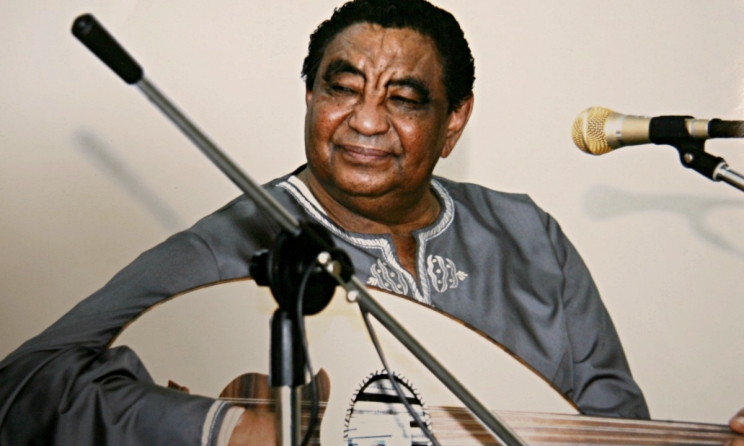
Since the onset of the Second Sudanese Civil War in 1983, the government began increasingly censoring musicians, leaving many artists frustrated over their freedom of expression. As musicians fought for artistic freedom, many of them faced state oppression, which ranged from bans on public performances to physical attacks, with many forced to flee the country [1].
Activism in pre-independence Sudan
Musicians have contributed immensely to Sudanese culture and have used their public presence to magnify the country’s rich cultural diversity and socio-political conditions. Artists played a crucial role in fuelling the resistance against foreign intrusion, exploitation and dictatorships during both the colonial and post-colonial periods [3].
As early as 1924, poet and educator Obeid Abdul Nur’s poem ‘Umm Dhafayir’ (The Lady with Plaited Hair) challenged young people to rise up and fight the British colonial administration [2]. The poem would later inspire musicians to highlight the plight of the masses in their songs.
Established in 1938 to challenge colonialism, the Graduates’ General Congress, an association of the educated class, adopted the song ‘Sahi Ya Kanari’ (Wake Up, Canary) and others to enhance its campaign for reforms and to expedite the end of British colonial rule [3] [4].
Hawa Jah al-Rasoul Mohammed, popularly known as Hawa al-Tagtaga, was one of the earliest female music pioneers and is remembered as a fearless freedom fighter whose politically charged songs inspired the anti-colonial struggle.
Aisha Musa Ahmad, also known as Aisha al-Falatiya, made a name for herself as a singer during the Second World War when she toured the camps of the Sudan Defence Force across North Africa to boost troop morale [4].
Activism in post-independence Sudan
On 1 January 1956, Anglo-Egyptian Sudan became the independent Republic of Sudan. Since independence, Sudan has been ruled by a series of unstable parliamentary governments and military regimes.
Respected singer Mohammed Wardi’s song ‘October Al Akhdar’ (Green October) was performed during the 1964 revolution when power transitioned from military to civilian rule. The song urged the government to concentrate on agriculture, hence the reference of ‘green’ in the title of the song [2].
Another military coup in May 1969 brought military ruler Jaafar Nimeiry to power. At first, Wardi agreed with the new administration, due to its leftist leanings, but later had a fallout with its leaders and was detained in 1971. In 1983, Nimeiry imposed a strict version of Islamic Sharia law, which further diminished the influential voices of musicians and poets in the country [5].
In response, Wardi released another political song, ‘Ya Sha'aban Lahabak Thouritak’, which loosely translates to ‘Oh People Your Flame Is Your Revolution’. The song encouraged the masses to shape their own destiny. The regime then called for his imprisonment and the artist fled to the US before moving to Cairo, Egypt. He returned home before passing away in 2012 at the age of 79 [6].
Enemies of the state
Sudanese governments throughout the years have sought to influence musicians for their own political agendas. Artists whose songs and lyrics expose social issues such as poverty, disease, civil war and injustices have historically been branded as ‘enemies of the state’, with various governments taking drastic measures to suppress ‘dissident voices’.
By the 1990s, during the early days of former president Omar al-Bashir’s rule, the government removed off the airwaves all music that did not support political and religious ideology. Singer Abu Araki al-Bakheit was banned from performing political songs. He was arrested and forbidden to perform publicly, after which he retired [7]. News of his retirement prompted intense reactions from his fans, which eventually led him to continue performing in defiance of the authorities. He played with nightclub bands like Rejaf Jazz and The Skylarks [8].
Female musicians have also suffered government attacks and threats by the Sudanese public who accused them of crossing gender lines by exposing their bodies in spite of Sharia’s rules.
Female musicians like Hanan Bulu Bulu were harassed and detained by government authorities, while groups such as Al Balabil came under close surveillance in the 1970s and the 1980s. Al Balabil was formed by three Nubian sisters, and although their songs were banned under Sharia, the group found a large audience in Ethiopia and other African countries.
In 1998, the National Islamic Front government enacted a new law banning women from dancing with men, or in their presence, during folklore celebrations or wedding parties.
Singer Abazar Hamid suffered the wrath of Bashir after he embarked on a solo career in 2004. His 2007 album Sabahak Rabah (Good Morning Home), which discusses a wide range of topics such as peace, unity and genocide, led to his exile due to direct threats on his freedom [9].
Sudanese poet, composer and writer Mahjoub Sharif was well known for advocating for gender equality and against dictatorship and the military government. He was repeatedly detained by several leaders in Sudan, including Nimeiry and Bashir, and spent a total of 17 years in prison [10]. He died at his home in Omdurman in 2018 at the age of 66.
The fall of Bashir and return of dissidents
In 2019, Sudanese citizens, protesting against soaring living costs, forced the military to overthrow Bashir’s government. During this time, protesters used the unifying power of music to usher in change. Several dissident musicians returned from exile to celebrate the fall of Bashir’s rule. For the first time in decades, several musicians held concerts urging young people to shape their destiny [11].
The collapse of Bashir’s hardline government had offered a glimmer of hope for a more free and vibrant cultural space. But in October 2021 army chief Gen Abdel Fattah al-Burhan led a coup that removed from power the country’s transitional government [12]. On 15 April 2023, Sudan descended into another civil war in a conflict between rival factions of the military government, once more bringing the country’s cultural activities to a halt [13].
References and citations
[1] http://en.rfi.fr/Sudans-forgotten-musical-heritage-rediscovered-Two-Niles-Sing-melody-violins-synths-Sudan/
[2] (https://theconversation.com/songs-of-freedom-the-soundtracks-of-political-change-in-sudan-115383
[3] https://en.wikipedia.org/wiki/Aisha_Musa_Ahmad_(musician)
[4] https://www.britannica.com/topic/Graduates-General-Congress
[5] http://www.sudanupdate.org/REPORTS/MUSIC/MTEXT.HTM
[6] https://www.okayafrica.com/mohammed-wardi-sudan-last-king-nubia/
[7] https://worldmusiccentral.org/2016/04/18/artist-profiles-abu-araki-al-bakheit/
[8] https://worldmusic.net/blogs/guide-to-world-music/the-music-of-sudan-south-sudan-divided-together
[9] https://www.riotmaterial.com/abazar-hamid-aka-the-beatles-of-sudan/#more-14241
[10] https://www.dabangasudan.org/en/all-news/article/sudan-s-poet-of-the-people-mahjoub-sharif-died
[11] https://www.voanews.com/a/arts-culture_banned-sudanese-musicians-celebrate-new-year-new-sudan/6182273.htm
[12] https://www.aljazeera.com/news/2021/11/11/sudan-army-chief-issues-a-decree-for-new-sovereign-council
[13] https://en.wikipedia.org/wiki/2023_Sudan_conflict
Disclaimer: Music In Africa's Overviews provide broad information about the music scenes in African countries. Music In Africa acknowledges that the information in some of these texts could become outdated with time. If you would like to provide updated information or corrections to any of our Overview texts, please contact us at [email protected].
Editing by Peter Choge and Kalin Pashaliev


Most popular
Gambia: Suntou Susso announce UK tour for ‘The Path of a Griot’
09 Oct 2026

Top amapiano songs of 2026
16 Feb 2026

Top Afrobeats songs of 2026
19 Mar 2026

Open call: 2026 Gender@Work music industry training in Johannesburg
09 Oct 2026

Top Naija songs of 2026
31 Mar 2026

Call for applications: ACCES 2026 Emerging Artist Spotlight Competition
01 Oct 2026
Disclaimer: Music In Africa provides a platform for musicians and contributors to embed music and videos solely for promotional purposes. If any track or video embedded on this platform violates any copyrights please inform us immediately and we will take it down. Please read our Terms of Use for more.

Subscribe to our monthly Newsletter
Follow us on social media


Please log in to post a comment.