





















































Philip Tabane: The African musical genius who played for the spirit
23 May 2018 - 15:04


By Gwen Ansell
South African musician Philip Tabane, who died on 18 May 2018, hated being labelled. How he’d feel about the all official obituaries that confine him inside the jazz envelope is clear:
"The jazz label – or any other label – has never worked in my case. Once, I went to play at a competition in Durban and in the end I was given a special prize because I could not be categorised. To this day, they still cannot categorise my music."
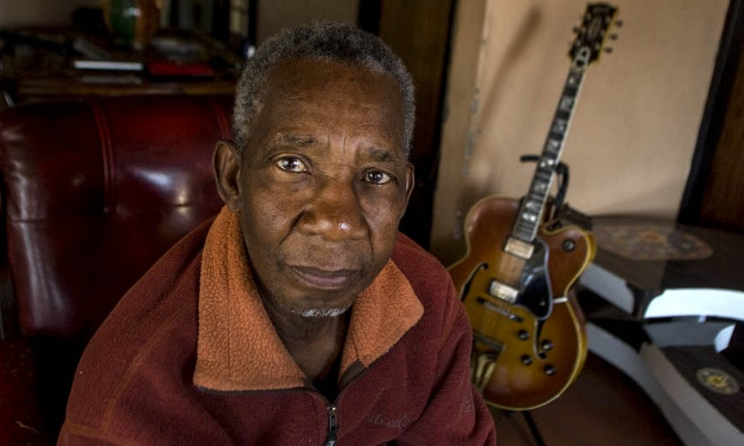
That was from my second interview with the artist, in 1997 at the old Kippies jazz club in Newtown, Johannesburg. The first had been almost a decade earlier, sitting close to the riverbank outside the Woodpecker club in Gaborone, Botswana. Clouds of smoke from the log fire he’d made kept the mosquitoes away, and began the slow, careful process of drying out his malombo drums; whose skins, he felt, were a bit damp and stretchy for that night’s gig. There was other smoke too, grey-green and herbally aromatic.
The rumour was that Tabane was a difficult interviewee. Sometimes he’d refuse to speak at all. Often, as was his constitutional right (South Africa has 11 official languages), he refused to speak in English.
I never found him anything but gravely courteous, as long as you listened. Tabane tolerated my linguistic inadequacies, calling in other band members when his flow of ideas simply couldn’t be pinned down in English.
His music was intimately woven into his cosmology and spirituality; he needed to talk about them all together and the English language was too culturally bounded to provide him with the right words.
I’m reluctant to attempt any kind of evaluative obituary. I’m not enough of an insider to provide one. But there are two fine pieces of writing that do get there. The first is journalist Lucas Ledwaba’s work-in-progress biography. For my money, Ledwaba touches the soul of his malombo music and its origins in a way that few other writers have.
The second is author Bongani Madondo’s account of his expansive week-long interview for Rolling Stone SA in 2013 that was reprinted in his book Sigh, the Beloved Country.
A family of guitarists
Tabane was born in 1934 (though some biographies give other dates) in rural Ga-Ramotshegoa, northeast of South Africa’s capital of Pretoria. He came from a family of guitarists. His elder brother, Mmaloki, he told journalists, was “better than Wes Montgomery”. The adulation radio stations gave to American players like Montgomery mystified him.
Tabane’s mother, Matjale, was a spiritual healer; he absorbed the music of her calling. His father was a devout Christian who fostered hymn-singing at family services. Tabane heard Ndebele and Sepedi traditional tunes from his local village band and despite being chased away from social functions because he was too young, he did what many young South Africans did: he covertly improvised an instrument from an oilcan and a broomstick, and tried to learn. By his teens, his parents had relented and he acquired a real guitar.
Uprooted in 1953 by the brutal forced removals of the apartheid government, the family settled in urban Mamelodi – a township in Pretoria. Tabane had formed his first band by 1959. But as the 1960s progressed, he became more interested in exploring how traditional sounds could be interpreted and extended via a blend of modern and traditional instruments. He formed Malombo, which won first prize at the 1964 Cold Castle Festival – an influential annual South African jazz competition during the 1960s.
Malombo went through multiple personnel changes as participants sought other musical directions or chose exile, but retained its percussionist rock: Gabriel ‘Mabi’ Thobejane.
In the 1970s, Malombo spent time in the US, including an appearance at the Newport Jazz Festival, of which Jet magazine said: "One of the most pleasurable finds of the Newport Jazz Festival this year was Malombo from South Africa, Malombo create some weird and haunting music on a variety of African instruments."
The time in America convinced him of the necessity of holding fast to roots inspiration, which he saw as a springboard for limitless imagination and innovation in technique. Tabane worked with prominent jazz players such as pianist Herbie Hancock and trumpeter Miles Davis, and even in his later days, he relished Miles’s music. But, he often told interviewers: "He plays to make money, and I play for the spirit". When it was suggested he played like Davis, he responded: "No, I don’t play like Miles. Miles plays like me".
Resisting the hybrids
Tabane always resisted the hybridising marketing label ‘malombo jazz’, as his music was tagged. But during the 1970s and 1980s, when his recordings gained status overseas with aficionados as astounding music, it was hardly heard at home. Many Tabane albums were not even available in South Africa. It was only after 1994, that the re-releases started happening, and fresh recording and performance opportunities began – too slowly – to emerge.
Tabane was not like any other player. His various honorary doctorates were less than his status as an original creator of unique sounds merited. To hear him live was miraculous. Dressed in a blend of cowboy-guitarist suit and traditional adornments, he’d proceed to travel from delicate, poignant melodies (often recalling his first rural home and its ways of life) to fast, mercurial runs of astounding technical virtuosity and harsh, minatory chords that seemed to rip the guts out of the instrument.
His music took you to the spheres and back: he was Africa’s Sun Ra, South Africa’s Ali Farka Touré, and a great deal more. Hamba Kahle: may his spirit rest in peace.
Here’s a selection of Tabane’s music:
Cold Castle Jazz Festival (1964)
The Indigenous Afro-jazz Sounds of Philip Tabane and Malombo (1969)
Malombo (1976)
Sangoma (1978)
Silent Beauty (1989)
Gwen Ansell is an associate of the Gordon Institute for Business Science, University of Pretoria. This article first appeared on The Conversation.


Most popular
Open call: 2026 Gender@Work music industry training in Johannesburg
09 Oct 2026

Top amapiano songs of 2026
16 Feb 2026

Top Naija songs of 2026
31 Mar 2026
Call for applications: ACCES 2026 Emerging Artist Spotlight Competition
01 Oct 2026

Top Afrobeats songs of 2026
19 Mar 2026
AFRIMA 2026: All the winners
12 Jan 2026
Disclaimer: Music In Africa provides a platform for musicians and contributors to embed music and videos solely for promotional purposes. If any track or video embedded on this platform violates any copyrights please inform us immediately and we will take it down. Please read our Terms of Use for more.

Subscribe to our monthly Newsletter
Follow us on social media


Please log in to post a comment.