






















































By Gregory Gondwe
This text provides an overview of the recording industry in Malawi, specifically its history and its leading recording studios and record labels.
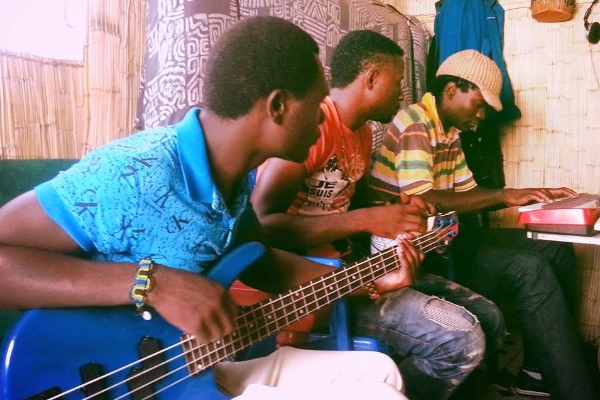
The history of Malawi’s recording industry is not a particularly long one. Malawi had to wait until 1968 when Nzeru Record Company (NRC) was established to kickstart an indigenous recording industry. Before that, recordings in Malawi were made first by mobile recording studios and later by the Federal Broadcasting Studios in Lusaka, Zambia. Later it was done in the studios of the national broadcaster, Radio Malawi, later called the Malawi Broadcasting Corporation (MBC). According to John Lwanda and Chipo Kanjo (2013), “Between the demise of NRC, in 1972, and 1989, musicians again largely depended on the MBC for recording facilities, a fact that, given the censorship of the one-party era, helped to shape the music and its lyrical content”.[i]
When it was only the MBC recording musicians, there was little sense of ownership to musicians. The institution stored their music in open-reel tapes as it had no wherewithal to have the music put on vinyl. What this meant is that even for musicians to listen to their own songs, they needed to tune in to the radio. Worse still, airplay was at the mercy of the presenters. Popular bands from this time include the Likhubula Dance Band, which backed Robert Fumulani, the Police Orchestra, the MBC Band, the Chichiri Queens and numerous others. There was also plenty of talent, but very little knowledge of how to convert one’s talent into a musical product via a recording studio. Musicians used to record at MBC because there was nowhere else. And since it was stored on reels for MBC airplay only, there was no way to sell this music on the market. Only musicians who had been to Southern and Northern Rhodesia (Zimbabwe and Zambia) or South Africa, or had the opportunity to send their music there, had their music released on vinyl. Such artists include Ndiche Mwalale, Bali Kuseli and Gerald Wayawaya, among others.
Malawi’s little-publicised National Archives[ii] in Zomba prides itself on having preserved music that traces Malawi’s history back to the colonial era. However, since no company was releasing Malawian music on vinyl and there was no recording studio other than the MBC, what the archives kept were mostly open-reel tapes from the broadcaster. It is now faced with chemical decay known as “vinegar syndrome” due to the initial incapability to preserve its material properly.
The advent of multi-party rule in Malawi in 1994 further liberated the recording environment, although distribution remained the preserve of shopkeepers[iii]. A key band in the development of the Malawian recording industry was the Alleluya Band. Although started in 1978 by a Catholic priest, Father Mario, upon his arrival in the southern town of Balaka, it was only later that the Church established what was known as Andiamo Studios, where the band was able to record its first album on cassette. The recording of Alleluya Band’s cassette albums at Andiamo Studio, for example Mtendere (1988), saw the birth of Malawi’s modern music history that soon ushered in the digital era[iv]. The emergence of Alleluya Band, led by the agile hands of guitarist Paul Banda, led people to realise what could happen with music: that songs could be recorded at independent studios, not just at the MBC studios; and that songs performed by local artists could be put on cassette and enjoyed at home, at least by those with enough money to do so.
Recording Studios
When Paul Banda (elder brother to Malawi’s famous musician-cum-politician Lucius Banda) had managed to record an album for with his Alleluya Band he started a solo recording venture by establishing his Imbirani Yahweh Studios in Balaka Town in 1991. From here the confusion ensued - everyone who had recorded an album or a single now wanted to be a studio owner. Even today, every other musician in Malawi hopes that one day they will own a studio. Because of this confusion, Malawi still has no established, professionally-run recording studios[v].
Looking at examples of top gospel and secular musicians provide some insight into the current recording trends in Malawi. Gospel songbird Ethel Kamwendo-Banda recorded her 2012 album with sound engineer Jabby Nkhwazi at 12Note Studios in Blantyre, but if you look at her previous 10 albums, you notice that they were all recorded at different studios. Then there is Lawrence ‘Lulu’ Khwisa, one of Malawi’s most talented sound engineers, who used to work for different studios before forming a band called Mathumela, which in 2012 also became the name of his studio in Lilongwe[vi]. Another example, reggae musician Hax Mumba, recorded his Chibvumbulutso Volume 1 album at MC Studio in Lilongwe in 2005, but later went to Heritage Studio in Lilongwe to record Chibvumbulutso Volume 7 in 2012. Skeffa Chimoto recorded his first successful album Nabola Moyo at Eclipse Studio (owned by the late Lovemore Mwanyama) in Lilongwe in 2011. When he found fame and wealth, he formed a band called Real Sounds in 2011, the same name of his studio in Lilongwe where he has recorded his latest album called Chikondi (2013). Malawi’s leading reggae group, The Black Missionaries, started by fallen reggae king Evison Matafale, started recording a series of albums called Kuimba One and Kuimba Two at MC Studios in Blantyre in 1999 and 2000 respectively because at that time the late sound engineer Chuma Soko was working there. When Soko moved to establish his own Pro Sounds Studios in Blantyre in 2001, the group followed him there to record Kuimba 3 in 2002. Their 2013 album Kuimba 9 was recorded at Ralph Records in Blantyre.
Usually recording an album requires just one recording studio, but there are some projects in Malawi that were recorded at numerous studios. For example, duo Symon and Kendall released Nkhwiko (2013) that involved three studios, namely Maik Studios, Sound Splash, and Petros & Dili Recording Studio. Another album done by several hands is Fikisa’s Adamwiche (2011), which was recorded at Baseline Studios, Audio Clinic, Audio Vision 360, Nyimbo Music Studio (all in Lilongwe) and Lo Budget Studios in Blantyre.
Clearly, there are numerous recording studios in Malawi. Besides the ones mentioned above, they also include Groove Magic Studios in Blantyre, owned by sound engineer and politician Joseph Tembo. Yet Malawi’s music recording industry faces numerous obstacles. Firstly, there are too many establishments operating without coordination or regulation. This leads to recordings of poor quality and acts of piracy. Secondly, an artist who records at a certain studio this year cannot be sure that the studio will still be there next time he or she wants to record. Thirdly, there is the issue of substandard recording equipment. Some recording spaces double as living rooms for the family of the studio owners. When an artist comes to record, the family members are advised to carry on as usual, but silently.
Record labels
The same can be said about music labels in Malawi, which emerge and disappear overnight, sometimes leaving musicians high and dry, while signed-and-sealed contracts remain locked up somewhere gathering dust. Some music labels that once graced headlines in the country have no trace at the moment. No one can say where they are now, what they are now doing and how many artists have actually benefited from such labels. For example, Rush Records is a Malawian-owned music company that offers music production, artist management and project management, according to its website[vii].
Another label, J&D Record Company, recorded Limbani Banda’s album Umodzindi Mphamvu (2008), as well as George Mkandawire’s Pemphero (2007) and Sally Nyundo’s Usadandaule Malawi (2008). J&D’s website[viii] says it is currently working on albums for Agorosso, Rudo Mkukupa, Evans Mereka and Zebron Kankhunda, as well as Sweeny Chimkango, although it’s not clear when the site was last updated.
Then there is Black Rhyno Entertainment Company, whose CEO is local hip-hop mogul Tay Grin. When this label emerged in 2009, like all the rest, it was noisy. Their message was that they had come to work with Malawian musicians who were determined to further their careers and promote the country’s music abroad. One of its objectives was to push more Malawian musicians to feature on international music TV channels like Channel O, MTV Base and Trace. Black Rhyno is currently inactive although its CEO insists it’s alive and kicking. Long before all these labels emerged, Zembani Music Company appeared bent on uplifting unknown musicians and turning them into household names.
Towards the end of 2014, there was much fanfare upon the launch of a new label called Spare Dog Records[ix] to record and promote Malawian artists[x]. It was set up by Mattias Stålnacke from Sweden, a guitarist and music teacher by profession. Apart from recording albums for Danny Kalima and the little-known Michael Mountain, little more has been heard about their activities on the local music market except through online and international media.
There is also Rhythm of Life[xi] run by Peter Mawanga[xii], a Malawian musician once known as Peter Paine before he started fusing indigenous music with international sounds. Through his label, Mawanga found what he calls Talents of Malawian Child (TMC), where he is now teaching orphaned children to form music groups. The label is supposed to record, produce their work, market their albums and organise performances for them, indeed typical of a record label. The proceeds of the albums are supposed to pay for the orphans’ school fees and clothing but not much has been reported lately on the success or failure of the project.
Despite giving these labels the benefit of doubt and without trying to laugh off their efforts, there is very little to write home about as far as these labels ever achieving prosperity for the musicians they claim to serve. When all is said and done, it is clear that something serious needs to happen for Malawi’s music recording industry to become a vibrant, professional, lucrative and sustainable venture for all the players as well as consumers of music.
[i]Lwanda, J. & Kanjo, C. 2013. “Computers, Culture and Music: The History of the Recording Industry in Malawi”. Society of Malawi Journal 66(1),pp.23-42. Accessed online from <http://www.jstor.org/discover/10.2307/23611942?sid=21106201915063&uid=2&uid=70&uid=4&uid=2129>
[iii] Ibid.
[iv] http://mwnation.com/vinyl-digital/
[v] Johnson, T. “Malawi’s Emergent Music Industry”. Accessed online from Rhythm of Life at <http://roluk.org/Malawi%20Music%20Industry%20.pdf>
[vi] http://www.nyasatimes.com/2012/07/22/lulu-opens-mathumela-recording-studio-speaks-out/
[ix] www.sparedogrecords.com


Most popular

Top Naija songs of 2026
31 Mar 2026

Top amapiano songs of 2026
16 Feb 2026

Top Afrobeats songs of 2026
19 Mar 2026

Call for applications: ACCES 2026 Emerging Artist Spotlight Competition
01 Oct 2026

AFRIMA 2026: All the winners
12 Jan 2026

CAPASSO backs global principles for fair generative AI music licensing
06 Oct 2026
Disclaimer: Music In Africa provides a platform for musicians and contributors to embed music and videos solely for promotional purposes. If any track or video embedded on this platform violates any copyrights please inform us immediately and we will take it down. Please read our Terms of Use for more.

Subscribe to our monthly Newsletter
Follow us on social media


Please log in to post a comment.