




















































SA kwaito musician Eugene Mthethwa chains himself inside SAMRO offices

19 Feb 2021 - 08:28


South African kwaito singer and composer Eugene Mthethwa, of Trompies fame, yesterday chained himself to a pole at the Southern African Music Rights Organisation (SAMRO’s) offices over unpaid royalties.
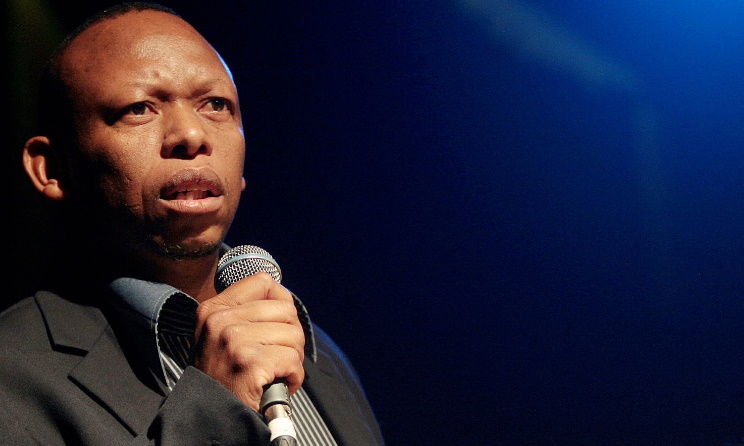
According to media reports, Mthethwa arrived at the SAMRO building about 1pm and was accompanied by singer and politician Ringo Madlingozi, demanding that the collective management organisation (CMO) pay royalties dating back to 1998.
“Today [Thursday], I have taken a firm revolutionary stance of making a sit-in at SAMRO in need of answers to the many questions that I have been decently asking without answers,” Mthethwa said in statement shared on Instagram. “I have tied myself in a chain as a symbol of how I feel SAMRO treats us, as its slaves, dogs who should eat crumbs falling from the master’s table and prisoners of our own creative gifts making us look like it is a curse to be an artist/composer. SAMRO operates in a system that robs artists/composers their duly earned royalties and rights to benefit the big capitalist monopolies who are publishers.”
Mthethwa, who last year claimed that songs he contributed to as a composer, author and co-author were allocated to other artists on the SAMRO portal, said that undocumented works were the “fertile ground for the heist taking place at SAMRO.” He went on to say that “the appointment of incapacitated leadership and management is the ideal for the sustainability of the heist.”
“SAMRO uses the majority of membership, who happen to be black, uneducated and ill-informed, to claim from users on their behalf but the truth of the matter is that, the few publishers and individuals who aren't black are the true beneficiaries of the monies collected ... SAMRO has no accountability and a trustworthy corporate governance and systems in place. I am here to get the answers and undertakings by the CEO Mr Mark Rosin, the chairperson of the board Mr Nicholas Maweni and the manager in charge Mr Karabo Senna.”
Demand for answers
Mthethwa implored Rosin, Maweni and Senna to respond to questions of transparency about music releases being labelled as undocumented works and the names of SAMRO staff members who were dismissed for “illicit and immoral activities”.
"Why is such information kept a secret and not shared publicly for members to know about this? Why is the responsibility of rectifying the undocumented works’ mess caused by SAMRO staff members who have earned salaries for years and all the benefits that most of your members do not have, is now been made the responsibility of the members, and why should SAMRO continue to exist if it cannot administer the works of its members correctly?”
Madlingozi was quoted as saying: “The issue of royalties and SAMRO is crucial to us. There is this thing of undocumented songs. Sometimes they take people’s songs and credit it to someone else. The whole thing needs to be disbanded and restarted. It is not working. It was designed to chow money of black artists.”
SAMRO’s response: We paid R100m to members this week
Music In Africa spoke to Maweni about Mthethwa and Madlingozi’s plea. “There is management team at SAMRO,” Maweni said. “Remember, it‘s COVID and not too many people are at work and I think somebody went to listen to what his issue is, but he might not be happy with that. Just today [Thursday], SAMRO paid about R100m to its members. The CEO is busy with that at the moment and that’s why he delegated one of his managers to deal with this member’s issue.”
Despite the manager’s intervention, it appears that Mthethwa and Madlingozi slept at the SAMRO building after Mthethwa shared a video on Instagram on Friday morning.
“The sun went down, the sun came up and we are still here,“ Madlingozi said. “Today is day two. We are doing this to make sure you guys don’t get to go through this.”
Open letter
Mthethwa and Madlingozi’s protest follows a 20 January open later by Mthethwa in which he compelled SAMRO members to act against alleged corrupt activities at the CMO.
“I am writing this open letter out of desperation, having made every effort to raise the matter directly with SAMRO’s management and board, government authorities (CIPC), and SABC – being the largest user of local content. All in vain. I am therefore addressing my appeal to all SAMRO members, the majority of whom are products of Bantu Education, and come from previously disadvantaged communities. Such members, as a group, have been receiving the mushroom treatment about how SAMRO administers their rights for far too long.
“The reason why I am now raising SAMRO’s shortcomings is that, with the latest introduction of their portal, it has exposed the gravity of what we were never allowed to know about a divisive system that leads to songs/works being reclassified as undocumented works/new status – with no notification to the actual owner about the reclassification,” he wrote.
UPDATE
On Friday, SAMRO issued a statement in response to Mthethwa’s protest. Read the full statement below:
SAMRO strongly rejects action by member as devoid of truth and lacking any merit
The Southern African Music Rights Organisation (SAMRO) has strongly condemned the protest action by Eugene Mthethwa, a SAMRO member, who chained himself to a pole at SAMRO’s premises.
According to a video circulated on social media platform – Twitter, Mthethwa was staging a protest regarding monies allegedly owed to him by SAMRO.
SAMRO CEO Mark Rosin confirmed that Mthethwa has raised a complaint regarding the calculation of his royalties and SAMRO has tried on many occasions, through many of its managers and board members, to amicably address his concerns.
Rosin described the protest action as regrettable. “It is impossible to deal with the issues Mthethwa has raised over the years, where there is no willingness by Mr Mthethwa to resolve the matter other than his way. We have processes that apply to all members and in our ongoing quest for transparency, we will not circumvent these processes for an individual.
“The difficulty Mr Mthethwa has is that he fraudulently gained access to SAMRO funds, which even led to SAMRO expelling him as a member. In good faith, the present board reinstated his membership. However, we now sit with an outstanding amount due to us by Mr Mthethwa which his royalty earnings get off-set against the balance. It is not a desirable situation for either party but we have had to deal with the matter through the courts,” continued Rosin.
“Quite frankly, we are both disappointed and alarmed to see a member behaving in this manner especially where his conduct is not supported by facts,” said Rosin.
Contrary to Mthethwa’s claims, SAMRO pays royalties on a regular basis and over the last two days has paid over R60m to local composers and publishers, a payment, widely welcomed.
“SAMRO exists for the primary purpose of ensuring that members’ rights are observed, advocating for an enabling environment in which music creators can derive the best possible value for their creations and we do so in a transparent manner and are open to audit and verification,” Rosin said.
Rosin said SAMRO will always try to engage constructively with its members to ensure that they understand the process by which royalties are collected and distributed.
“We hope that Mr Mthethwa chooses rather to engage and to stop his protest,” Rosin concluded.


Most popular

Gambia: Suntou Susso announce UK tour for ‘The Path of a Griot’
09 Oct 2026
Open call: 2026 Gender@Work music industry training in Johannesburg
09 Oct 2026

Top amapiano songs of 2026
16 Feb 2026

Top Afrobeats songs of 2026
19 Mar 2026

Call for applications: ACCES 2026 Emerging Artist Spotlight Competition
01 Oct 2026

Top Naija songs of 2026
31 Mar 2026
Disclaimer: Music In Africa provides a platform for musicians and contributors to embed music and videos solely for promotional purposes. If any track or video embedded on this platform violates any copyrights please inform us immediately and we will take it down. Please read our Terms of Use for more.

Subscribe to our monthly Newsletter
Follow us on social media


Please log in to post a comment.