
























































Salt and thunder: The mind-altering rock of 1970s Zambia

11 Dec 2015 - 10:53


A couple of blocks off Lusaka’s Great East Highway, Chachacha Backpackers is a breezy crib for a documentary filmmaker on the trail of a decades-old music story. The sky is blue, the scorched skin of foreign med-school interns is on display at the pool and the bar is churning out a steady supply of Mosi, Zambia’s national lager with its emblematic image of Victoria Falls splashed and splashing across the label. Mosi is short for Mosi-oa-Tunya, a Tonga phrase that translates as “the smoke that thunders” and the original name of what is considered the world’s largest waterfall. While Zambians are not prone to axe-grinding when it comes to confronting their British colonial past, the name is a proclamation of independence as the beer’s “Truly Zambian” tagline attests.
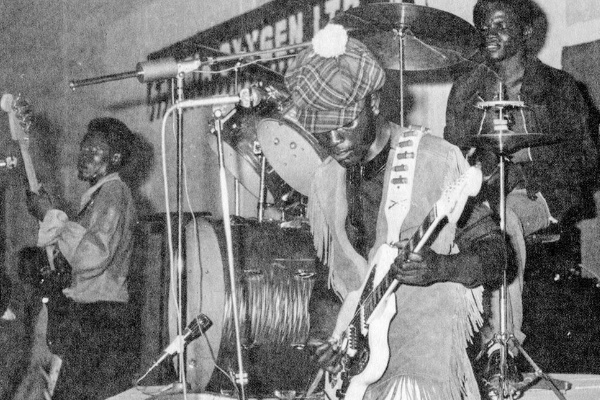
“That era was influenced a lot by Western music, which was rock in those days, and bands used to do a lot of covers by rock groups in the UK,” says Musi-O-Tunya drummer Brian Chengala. “We used to listen to Jimi Hendrix, Deep Purple, Led Zeppelin, The Who and Cream so it was that kind of thing. But then slowly, musically, we drifted away from that. Not entirely though but just the realisation that there was this other music, our own music, which was kind of forgotten”.
For a band that rose from the ashes of the Earthquakes and Crosstown Traffic, remembering their Zambian roots was what steered Musi-O-Tunya’s course. “Psychologically, you’re influenced by what you’re called so you create music that will suit that kind of name."
“As much as we wanted to play rock from the Western world, we are Africans,” says Jagari Chanda, vocalist of the band WITCH, a rock outfit whose acronym declared that ‘we intend to cause havoc’ and whose discography from 1972 to 1977 tracks the evolution of their Afrocentrism. “So the other part is from Africa – Zambia. So it’s Zambian type of rock – Zamrock”. Coined by Zambian DJ Manasseh Phiri, the term Zamrock was a meaningful affirmation but also just another word set adrift in the escalating lexicon that described progressive mutations occurring in rock music the world over. The fact that it was African didn’t make it unique. Eastern Nigeria boasted an exuberant rock scene in tandem with their more famous Afrobeat brethren. South African jazz legends Dudu Pukwana and Louis Moholo channelled African vibes through rock with Assagai, a group that released a pair of albums that rubbed shoulders with Black Sabbath on the UK’s Vertigo label. Zamrockers were aware and deeply inspired by the Pan-African juggernaut Osibisa, who proved that Africa’s contribution to rock could make waves internationally.
What made Zamrock unique was that it was Zambian. Forged by a particular set of national circumstances, it channelled an idiosyncratic array of influences that set it apart from its African peers. It’s a sound that’s difficult to nail down, self-consciously nodding to rock’s progenitors while obscuring their influence with ardent subjectivity and bending rhythms to an immoveable Zambian feel. It was also characterised by fiercely innovative guitar stylings with a penchant for wah-wah and fuzz, exposing its link to the tradition of guitar wizardry started by Zambia’s mining town troubadours in the 1950s. Insomuch as it sought to engage the world of rock on its own terms, Zamrock was the soundtrack of Kenneth Kaunda’s socialist ideology of Zambian Humanism. In fact, Zamrock owed much of its existence to the nation’s first president and founding father. A guitar-picker who took great pleasure in song, Kaunda was behind a policy that promoted local music via a quota system imposed on broadcasters. The legislation spurred entrepreneurs like Zambia Music Parlour’s Edward Khuzwayo into motion, sprouting a myriad of record labels and catapulting Zambian music into the industrial age. While popular music inhabited a live music circuit in hotels and bars in the 1960s and leant strongly on delivering covers, the 1970s marked the beginnings of a recorded music catalogue of truly Zambian originals with Zamrock as their template.
“President Kaunda declared that he wanted mostly Zambian music to be played by our broadcasting services so we were pushed into the studio,” says Violet Kafula, female vocalist of the Crossbones at the time and now revered as the godmother of Zambian pop. While carving a place for women in the music industry, Kafula hit the mark with one of her contributions to the band’s sole release and proved that Zambia had an appetite for local pop. “I came up with ‘Mwebalume Bandi’ and in two weeks, it sold about 14 000 copies. Up to now, it’s still a hit. That’s what made me the first female artist in Zambia because there were no female musicians on the scene”. While the runaway hit affirmed Kaunda’s vision for music, the country’s economic policies buckled when the price of copper, the export upon which Zambia’s wealth was precariously balanced, took a nosedive in the mid-70s. Coupled with the alienating geopolitics of an ardent struggle supporter landlocked in liberation-era Southern Africa, Zambia plunged into hardship with Zamrock documenting the social ramifications of the economy’s demise.
“It was tough. Life was hard and the country was young. We had gained independence but there were fewer schools and fewer jobs,” says Norman Muntemba, who played bass and shared vocal duties in the Zamrock three-piece Salty Dog. “The good part was that with our independence there was renewed faith in the fact that this was a country that would go on and that we are people who would go on. The music was just fantastic because it also helped us explore our sense of independence and our sense of reaching out”. Muntemba’s take on music as a social tool informed the group’s self-titled release of 1976, an eclectic Zamrock outing in which Salty Dog responded to the country’s battles with an album steeped in stoicism and hope.
At the core of Salty Dog was the childhood friendship of Norman Muntemba and the late Jackie Mumba, an inseparable pair of creative spirits who were more than happy to entertain willing ears with their home-spun banjos. “People in the neighbourhood would gather and encourage us to come and sing to them,” says Muntemba, recalling a time when bands just sprouted up organically. “Eventually, word spread around that there were two nice young musicians and somebody would come along and offer to buy equipment. Once you started rehearsing, other people would hear there’s a band being formed and come along to offer their talents”. Muntemba (bass) and Mumba (guitar) cut their teeth on a variety of mutations that culminated in Way Out Impression with Alex Mwilwa on drums. The three-man unit provided the perfect vehicle for their heavy-metal leanings, dipping into the sounds of Led Zeppelin and modelled after the Jimi Hendrix Experience.
When it came to record an album, the band toned down the rambunctious and did some soul searching. Confronted with Zambia’s post-independence hangover, they decided to craft a manifesto for the times and hang it on a new name. Salty Dog was neither nautical nor a nod to the 1969 album by England’s Procal Harum. Built on the band’s understanding that the phrase was slang for sperm, Salty Dog was a substance capable of giving birth to new ideas that would develop and change the lives of people around them and a razor-sharp articulation of their new vision. Responding to the ubiquitous silhouette paintings found in African markets, Muntemba elicited the contribution of illustrator Trevor Ford for their self-titled album’s cover. So it was that a peeved mutt wearing a paisley tie and smoking a cigar graced the sleeve with an enormous solar orb licking the horizon in the background.
“The band had a very wide range of music that we used to like and listen to,” says Muntemba. “If you listen to the album, you can find it represented many genres”. Examining how the album is bookended gives credence to Muntemba’s insight. The album opener 'Fast' tethers psychedelic fuzz improvisations to bold bass loops with menacing intensity while “Lullaby” closes the set with just Mumba picking out a whimsical tune on electric guitar with sustain bathing the song in a meditative hum. What happens between these tracks unpacks the album’s substance via reggae, blues and folk. The standout track “See the Storm” conjures an eerie dystopian landscape in which Muntemba’s vocal calls for everybody to stay calm while the sun disappears and lightning strikes across the sky. “That’s on account of what we were passing through. In essence, we were saying that the storm is going to pass and we have to go and shine afterwards”.
The album’s single was less veiled in metaphor, evoking the type of belt-tightening that would have been experienced by most Zambians with the country mired in a debt crisis. “’Down in my Shoes’ is about a guy who was not getting paid much money and he’s talking about 50 kwacha,” says Muntemba, emphasising the absurdity of the wage. “He recognises his lot but he’s resolved that he has to carry on and get through. That’s the beauty of it. We weren’t talking about these hardships in a negative way. He had to feed a family and the landlord was always knocking on his door because he was late with the rent. Those were the realities and we were saying that we have to get up and fight and move on until we sort these things out”.
Norman Muntemba and I spend an afternoon together at the offices of Goman Advertising, the marketing and communications agency in Lusaka that he presides over. Muntemba’s work as a graphic artist produced a string of memorable Zamrock album covers for his musical peers and I detect the same mind behind a company banner in the lobby with the image of two ants carrying an enormous purple apple. As the information age dusts the neglected corners of global rock, Salty Dog’s album has found its way into the hands of Canadian LP and CD reissue label Strawberry Rain Music. It’s a fortuitous home for a rock nugget as label-owner Jason Connoy ardently pursues audio and artwork fidelity and has rooted his enterprise in the ethics of legitimate licensing and fair deals. There’s even a partnership with 70s label Zambia Music Parlour (ZMPL), whose vaults have yielded a treasure of analogue reels on the verge of extinction. While I puzzle together the story of Zamrock in word and film, Strawberry Rain is restoring and archiving its soundtrack. With releases by Salty Dog, Harry Mwale Experience and Keith Mlevhu in circulation and with Crossbones, Blackfoot and a documentary on their heels, Zamrock has another storm brewing.
I meet Norman Muntemba, Rikki Ililonga, Brian Chengala, Jagari Chanda and Violet Kafula in a Zambia of developing-nation contrasts. It’s a travel destination of backpackers and exclusive wilderness retreats and little in-between. Shopping malls have mushroomed on the fringes of the nation’s capital and draw swanky SUVs into attendance. Yet, with over 60% of the nation living below the poverty line, the type of rock that Salty Dog produced in the 1970s has much to address about the country’s present circumstances. “I’ve got my guitar and I play at home quietly to myself but I do intend to give some of my songs to young artists to record,” says Muntemba, eager to pass the Zamrock mantle to a younger generation. “We’ll see where we get with that. Veterans never die so I’m still around”.
Originally published in The Lake in August 2015 and ZamRock.org on 17 November 2015.


Most popular
Open call: 2026 Gender@Work music industry training in Johannesburg
09 Oct 2026

Top amapiano songs of 2026
16 Feb 2026

Call for applications: ACCES 2026 Emerging Artist Spotlight Competition
01 Oct 2026

Top Naija songs of 2026
31 Mar 2026

Top Afrobeats songs of 2026
19 Mar 2026

AFRIMA 2026: All the winners
12 Jan 2026
Disclaimer: Music In Africa provides a platform for musicians and contributors to embed music and videos solely for promotional purposes. If any track or video embedded on this platform violates any copyrights please inform us immediately and we will take it down. Please read our Terms of Use for more.

Subscribe to our monthly Newsletter
Follow us on social media


Please log in to post a comment.