










































NEFCISA
NEFCISA

The Music In Africa Foundation (MIAF) is proud of its partnership with the Industrial Development Corporation (IDC) as a Strategic Implementing Partner (SIP) for its Social Employment Fund (SEF). Through this collaboration, MIAF is running a national programme that is creating jobs, addressing skills gaps, and strengthening South Africa's creative industries — in line with the SEF's overarching goal to generate work for the common good and build community value through employment, social contribution, and inclusive economic participation. Operating under the banner NEFCISA (National Employment Facility for Creative Industries in South Africa), the initiative is recruiting and training participants, matching them with host organisations, and has already placed 1 500 workers across the country — surpassing its original target of 1 000. NEFCISA is delivered through a network of 20 host organisations spanning five provinces, who are actively hosting participants and contributing to work for the common good across South Africa's creative and cultural industries. Key Objectives: Support employment and entrepreneurship in the creative industries. Offer skills development and training programmes. Foster partnerships between public and private creative sectors. Promote South African creativity at both provincial and national levels Foster community development through social contribution.

ACCES
ACCES

ACCES Conference and Showcase Festival is Africa's leading music industry gathering, bringing together the people shaping the future of the continent's music business. Artists, entrepreneurs, executives, investors, policymakers and cultural leaders from across Africa and around the world come to ACCES to build partnerships, exchange ideas, discover talent and create new business opportunities. Since its launch in 2017, ACCES has become the continent's premier platform for professional exchange and music market development. Combining a high-level conference with a curated showcase festival, networking, exhibitions and industry programmes, ACCES offers a unique space where creativity meets business and where African music connects with the global industry.

Gender@Work
Gender@Work

Music In Africa Gender @ Work is a three-year training programme aimed at upskilling and increasing the participation of female professionals in the African music sector. Launched by the Music In Africa Foundation (MIAF) in April 2019, the programme is connected to the MIAF’s ACCES music conference – a pan-African event held in a different African country every year. This connection enables the programme to reach new participants in a different African country every year. The programme marks the beginning of a more concerted effort by the Foundation to support the participation and inclusion of women in all facets of its programmes and the music sector in Africa as a whole. Over the three years, the programme will aim to address gender imbalances in the sector through training, lobbying, facilitating knowledge exchange and dialogues that foster the interest of women. The broader objectives of the programme are to: Provide industry training for women on critical music industry skills, focusing on: Stage management Electronic music production and recording Music business management Technical knowledge Provide an opportunity for both professional and aspiring women to benefit from the Music In Africa network and its broad range of activities in 2019, 2020 and 2021. Provide a solution-based platform in the form of a round table at ACCES with a view to identify challenges, discuss opportunities and lobby for the interests of female practitioners. Offer participants the opportunity to benefit from programmes offered by MIAF’s partners. Increase access to educational materials. Integrate participants in the broader ACCES programme to maximise experience and exposure to the industry. Record and present training materials on the www.musicinafrica.net, including but not limited to tutorials, templates and other best-practice materials. Communicate women-based themes that support the initiatives and messages of the programme. MAIN TRAINING ACTIVITIES Training in first country (Ghana): In the first year, participants will be trained on all aspects of stage management by a team of experienced stage managers from 10 to 17 November 2019. The programme will offer robust classroom training as well as practical, hands-on training in which participants will also be given the opportunity to manage various aspects of the ACCES performance programme. Training in second country: The second training iteration will take place at ACCES 2020 when the programme will diversify its course to include music production lessons and training on other music business topics. A round-table platform will also be introduced to coincide with the ACCES programme. Training in third country: The third training iteration will take place at ACCES 2021 in a different country, offering an advanced course. HOW DO YOU GET INVOLVED?  As a participant, facilitator or trainer: The programme enrolls up to 12 trainees every year. All opportunities are advertised publicly on this website, and will be added to this page. Please keep checking this page for new calls (below under UPDATES & CURRENT OPPORTUNITIES). As a partner Please contact Claire Metais at [email protected]. APPLY The call for applications for 2020 will be announced soon. The Music In Africa Gender @ Work programme is made possible with the support of the Prince Claus Fund, Siemens Stiftung and Goethe-Institut.

Sound Connects Fund
Sound Connects Fund

For cultural and creative practitioners and organisations operating in southern Africa, access to funding remains a major challenge. The COVID-19 pandemic has also had a massive impact on government policy, spending and the economy in general, and has seen spending on culture being moved further down the list of priorities. Further, the cultural and creative industries repeatedly cite four main areas where investment is needed for growth, which are increased visibility, mobility including access to new markets, finance and support structures.

Instrument Building And Repair Project

Experience the Vibrations African Instruments Exhibition online in 3D

Features

World bids farewell to iconic Ethiopian pianist nun Emahoy Tsegué-Maryam Guèbrou

30 Mar 2023 - 12:26

cc-img flag-img

She was an enigma as much as she was an open book. For years, journalists tried to piece together the intriguing story of Emahoy Tsegué-Maryam Guèbrou, an Ethiopian nun who for 40 years was holed up in the ascetic confines of a monastery and whose piano playing prowess earned her the moniker ‘The Honky Tonk Nun’.
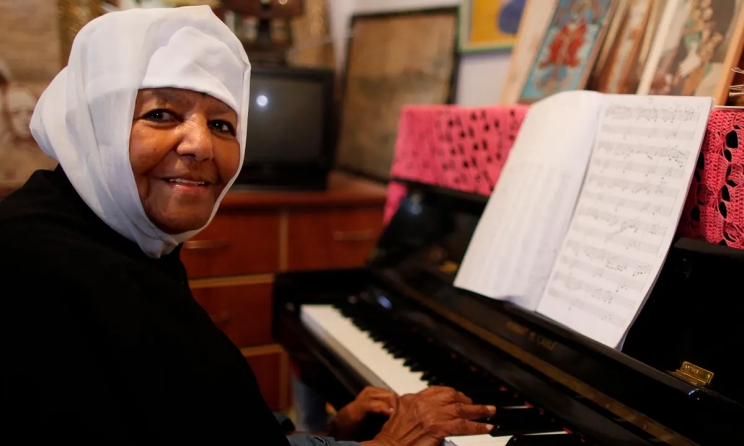
The late Emahoy Tsegué-Maryam Guèbrou.

Emahoy, who died at the age of 99 at a Jerusalem monastery on 27 March, lived a full life – one that was in service to humanity and to God. As an astoundingly talented pianist and a pioneering female musician, Emahoy’s contribution to Ethiopia’s musical tradition and equality movement will, no doubt, be celebrated for many years to come.

But perhaps as an indication of how contradictory her life was, few people would have had the chance to hear about Emahoy until 2006 when her works were revisited through Ethiopiques, a compilation series paying homage to Ethio-jazz greats such as Mulatu Astatke and Alemayehu Eshete.

This is when the global media sought to unravel the mystery behind this low-key icon. As it turned out, she eschewed scrutiny and only a few journalists like Kate Molleson, who made the documentary The Honky Tonk Nun about Emahoy, would be privileged to share her story with the world.

Born on 12 December 1923 in Addis Ababa, Ethiopia, to a well-to-do family, Emahoy enjoyed a privileged upbringing that saw her attend school in Switzerland. It is here that she first encountered Western classical music and took piano and violin lessons.

After school, Emahoy returned to Ethiopia where she enjoyed success as both a civil servant and a singer in the palace of Emperor Haile Selassie. In her article for the Guardian in 2017, Molleson writes: “Portraits from this period show a gorgeous young woman with a wry smile and a bold fashion sense. She went to high-society parties and sang for Haile Selassie. She had a car and raced a horse and trap around the city. She was a feminist: the first woman to work for the Ethiopian civil service, the first to sing in an Ethiopian Orthodox church, the first to work as a translator for the Orthodox Patriarch in Jerusalem.”

This idyllic existence was interrupted when Italy invaded Ethiopia in 1936 and Emahoy fled to Europe before finding her way to Cairo where she continued to pursue her passion under the tutelage of Polish violinist Alexander Kontorowicz.

She would later return to Addis Ababa where she played professionally until she earned a scholarship to study at the Royal Academy of Music. However, she was unable to take up the offer for reasons that are not clear. It is believed that this setback caused her to abandon her career and she become a nun at Gishen Mariam Monastery in northern Ethiopia for a decade.

It is during this period of seclusion that her musical abilities flourished again when she began infusing the techniques of her Western classical training with the religious music that she was now being exposed to.

In describing these compositions, Molleson writes: “There’s a stunning timelessness to her music: the ornaments are virtuosic and the chords lilt like a Chopin waltz – almost, but not quite. With Emahoy, nothing is regular. No fixed metre, no pulse that can be set in notation, no strict adherence to any one scale system. Her melodies flit between traditions; they float on their own axis. She found spiritual clarity and satisfaction through music, composing for violin, piano, and organ; she found inspiration from classical and liturgical canons along with popular Western styles like blues and ragtime.”

Emahoy released her first album in 1967, with her new collection Jerusalem set to come out on 14 April. Proceeds from her music are donated to charitable causes in Ethiopia.

She relocated to the Debre Genet monastery in Jerusalem in 1984 after her mother passed away, where she lived and played the piano until her death.

Please log in to post a comment.

Most popular

Disclaimer: Music In Africa provides a platform for musicians and contributors to embed music and videos solely for promotional purposes. If any track or video embedded on this platform violates any copyrights please inform us immediately and we will take it down. Please read our Terms of Use for more.

newsletter banner

Subscribe to our monthly Newsletter

Follow us on social media