
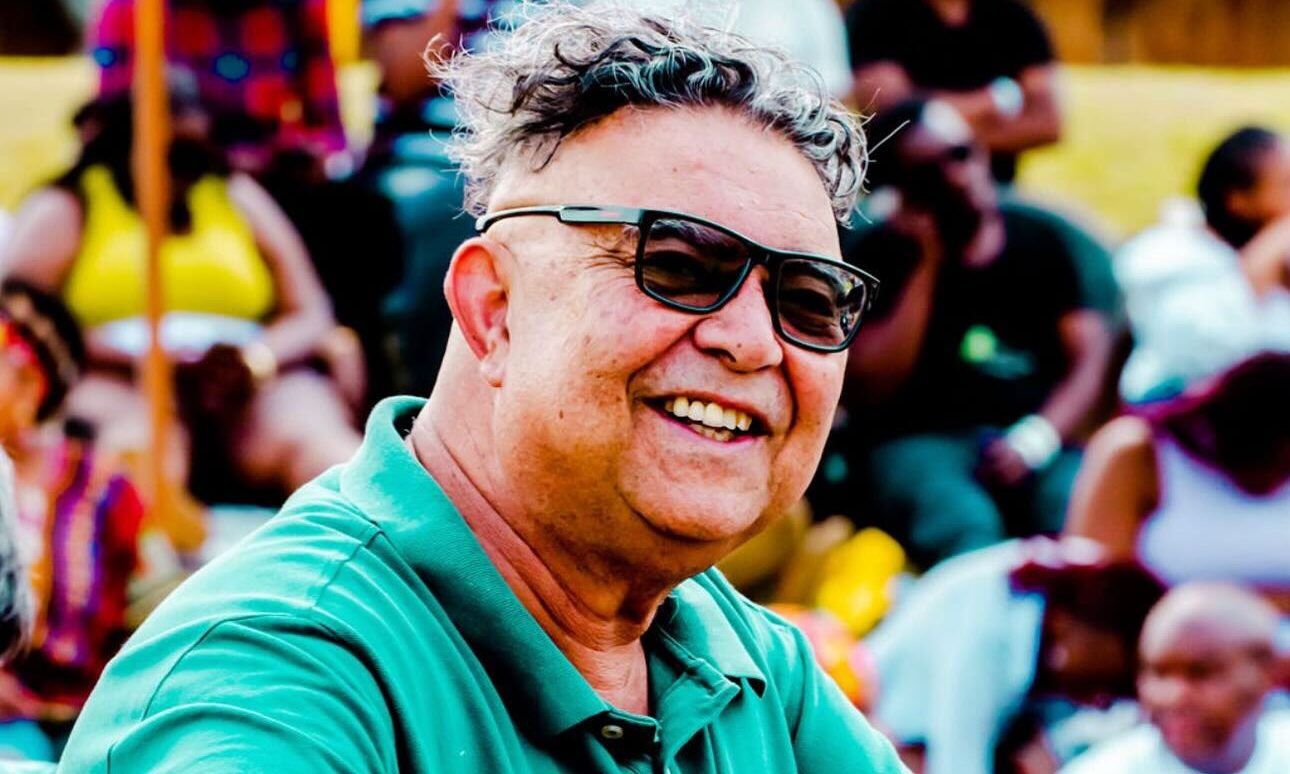




















































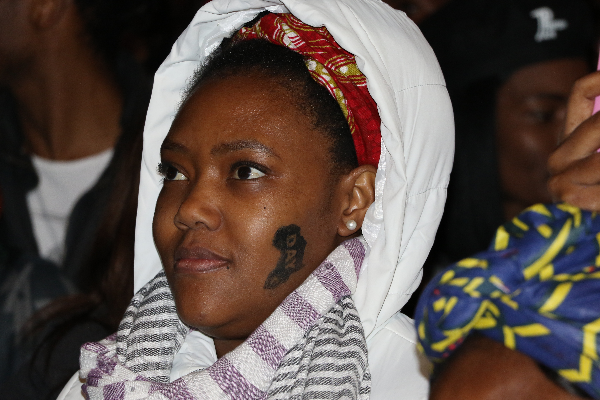
A fan watches an act during the Africa Day concert in Johannesburg on Saturday 27 May.
These were the questions that concertgoers were asking when they tried to explicate the poor attendance during Saturday’s Africa Day concert in Johannesburg. Instead of the 6 000 fans expected at the 15 000 capacity Nasrec amphitheatre near Soccer City, about 1 000 were given free rein to attempt cartwheels without fear of kicking each other in the face. It almost felt like you were a Middle Eastern sheikh with a penchant for live music on your birthday. “I want a mix of hip African artists,” he tells his assistant, “and I want them all just for me!”
The more cynical types blamed a lack of musical taste and culture, saying South Africans are only interested in ‘rap crap’. How else could one explain the bad turnout with the likes of Baloji, Bombino, Petite Noir, Jojo Abot, Ray Phiri, Jah Prayzah and Thandiswa Mazwai on the bill? Those of us who opted for a more balanced approach considered lack of information as the culprit.
“Bombino is seeing great interest in his own country and is coming up very strong around the world. But when it comes to southern Africa, a lot of people don’t know us here. It’s a very different style of music, the desert style, but we’re trying to make a good impression,” the Nigerien guitarist’s American drummer, Corey Wilhelm, told Music In Africa after the band’s performance. Bombino had played the night before at Zakifo, a festival held in the coastal city of Durban as part of the IGODA circuit.
“Zakifo was great,” Bombino said. “It was a small crowd but there was a lot of energy. The energy in Johannesburg is even better. For me, Africa Day will truly have a meaning the day we are independent. When Africa is independent. Of course today we celebrate what is called Africa Day; it’s an important commemoration and it is an honour for me to play here in Johannesburg, as an African, as a Tuareg even.”
Bombino’s diplomatic sentiments weren’t exactly echoed by Baloji, the Congolese band leader who during his performance earlier in the night told the crowd, “I don’t believe in Africa Day. It’s like Women’s Day – it’s b*llsh*t,” to which some ladies frowned while most yawned. Baloji wasn’t going to score with Johannesburg’s fairer sex, nor was he going to get kudos for flying the flag of African unity. But with such a small crowd, the concept of unity was easy to forsake. When Music In Africa reporter Ano Shumba pressed Baloji to explain what he meant by the “b*llsh*t” comment, the animated singer stuck to his guns without much elaboration. “Africa Day does not mean much to me. I don’t like Africa Day the same way I don’t like Women’s Day. We don’t need one day to care about Africa. It’s stupid.”
Perhaps what Baloji wanted to say was that every day should be Africa Day, as should Women’s Day. His conceited approach to Shumba’s questions didn’t end there. Here is part of the Q&A that followed:
SHUMBA: If you don’t like Africa Day then why play an Africa Day concert?
BALOJI: “I enjoy playing in an African country. We are just happy to perform on the continent, that’s our priority.
SHUMBA: You live in Belgium and I assume you got support from someone in that country because there is a trend of African artists relying on the US and Europe for support?
BALOJI: I am my own man and I am not where I am because of support from someone in Europe. I believe we as African artists can do it without the help of artists from other continents.
SHUMBA: Are you doing anything to help young African artists?
BALOJI: There are no rules when it comes to helping other artists. Everyone has to do their thing to push music. First of all I have to help myself. I am not there yet and until I am there that’s when I can help them. Maybe Davido can help them. First I have to make myself strong.”
Another artist making himself strong was Ray Phiri, who was cleaving the cold front with a hatful of flu meds before taking the stage. The South African legend spoke to Music In Africa backstage about his new musical undertaking, touring at 70 and Paul Simon’s exploitation of African innocence during the Graceland years. Read the full interview here.
Even though Baloji may have made the wrong impression on African patriots and the ladies, his performance was one of the most revered by those who were there solely for the music. Full of energy, musical synergy, and perhaps anarchy, the lanky performer and ex-Starflam member presented a compelling mix of Central/West African rhythms and modern electronica. A highlight was the presence of rumba guitarist Dizzy Mandjeku who provided a large part of the traditional element to Baloji’s sound.
Although bearing the most attention-grabbing vocal timbre on the night, Petite Noir, like the crowd, didn’t get much satisfaction from his under-rehearsed band, whose members were often gaping at each other in search of a consensus about when the next part of a song should arrive. We’ll forgive them this time but expect a better showing when the next big tour rolls in. For now Petite Noir live is a pale imitation of Bowie/Kele Okereke, mostly because his band doesn’t possess the brio needed to carry his powerful voice. If he wants the crowd before him to heave as it should, about six months in the band room ought to do it.
The Africa Day Concert may have been a disappointment from an attendance point of view but to the few who were present the event represented a virtuous gamble to expose the more creative side of African music. Let’s hope that next year the organisers won’t revert to the safe model of billing a hundred DJs and MCs. There are enough of those gigs around to stupefy any serious music lover.


Most popular
Ghana: Mr Eazi and MOLIY’s ‘Comfort’ earns Urban Music Awards nomination
21 Oct 2026

Top Naija songs of 2026
31 Mar 2026

Top Afrobeats songs of 2026
19 Mar 2026

Top amapiano songs of 2026
16 Feb 2026
Open call: CANEX Music Business Lab and Songwriting Camp
15 Oct 2026
Nigeria: CANEX WKND unveils 2026 programme
21 Oct 2026
Disclaimer: Music In Africa provides a platform for musicians and contributors to embed music and videos solely for promotional purposes. If any track or video embedded on this platform violates any copyrights please inform us immediately and we will take it down. Please read our Terms of Use for more.

Subscribe to our monthly Newsletter
Follow us on social media


Please log in to post a comment.