



























































BCUC are persistent… They’re in a new European city for the first time breaking new ground. The crowd is a little sceptical, a little conservative, occupying the back and wings of the venue. But BCUC know this game inside out. By now they’ve played hundreds of gigs on the Old Continent, they’ve been sowing seeds here circa 2015. This is the South African band’s 34th show of 42 scheduled for their Elektronikalizer spring 2024 tour, and the place is Bulgaria’s capital Sofia.
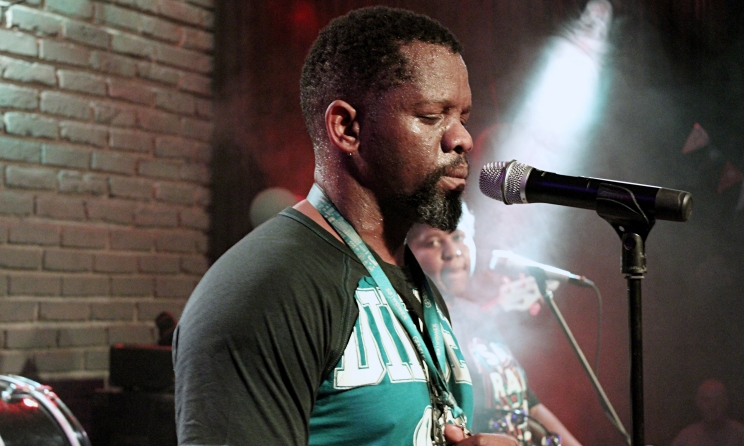
They start to chip at it, they go through the motions, which for this crowd are definitely unorthodox: on stage, there are just percussionists and singers with tambourines, whistles, cowbells and other musical trinkets, and towards the back a bassist balancing half of his bodyweight on a barstool. By the third song, the stomping starts coming in. By the halfway mark, the whole place is heaving in a trans. A real religious conversion has begun. Persistence, and then they’re yours, forever.
“We work very hard,” BCUC singer Kgomotso Mokone, the only lady in this seven-piece group, tells me earlier during soundcheck. “When we do this, we’re really at work, because we always see the potential for another gig – so that we can work even more. We have to make a certain amount of impact so that you come again. We buy gigs by playing good gigs. We create an experience that we’re all invested into – us, the audience, everybody. Our mission statement is to connect people. Music for the people, by the people, with the people.”
Bantu Continua Uhuru Consciousness formed 21 years ago in Soweto and many locals will remember the band playing the Johannesburg bar circuit with that exact “for, by, with the people” mantra, before they became a festival favourite at home and abroad, and before The Guardian gave their albums rave reviews and Gilles Peterson called them the best live act he ever saw. Angélique Kidjo even had them on stage with her at WOMADelaide in Australia.
BCUC has done well for an underground band whose sound is unlike any other (this should give hope to those who feel that only super-pop artists can make it). Places like the UK, Netherlands, Germany, France and Scandinavia love them for their ability to turn any occasion into something that resembles that Zion dance party in The Matrix, but without the new-age pretence. While on tour, there are fans who make an effort to see the band multiple times in multiple cities. These are the kind of people who will be your fans for as long as they live, and BCUC have an army of them by now.
Apart from its astutely orchestrated organic sound, what’s that special magic that BCUC wields to grab music lovers so effectively?
“When you’re at our show you feel commonality through diversity, and you feel the harmony and you experience healing like an out-of-body connection with something that you can’t explain,” frontman Nkosi ‘Jovi’ Zithulele, whose stage presence is that of a shorts-wearing athletics coach on amphetamines, says. “We sing about our ancestors, depression, rising above the challenges, reconnecting with your parents. These messages are universal. We have songs that are specifically South African, like ‘Ramaphosisa’, but we don’t play them while on tour because we want our songs to resonate with everyone. Many people here don’t know where South Africa is. When you say South Africa, they ask, where in south Africa?”
Conversely, BCUC know South Africa all too well, and when we start talking about the local music scene, Jovi and Kgomotso don’t have too many positive things to say. Even though they won’t admit it, it seems like the band is largely boycotting playing local events.
“The problem in South Africa is that the promoters want to get rich and pay the artists very little,” Jovi says. “Many of them have sponsors, the backing of provincial governments, but that money will go to everyone else except the artists. And so, there was a moment when we said to ourselves that we are too good to allow this to constantly happen to us. We had to insist that it wouldn’t.
“In Europe, we’re growing our audience but we’re still not being played on radio as it is happening in South Africa. There was a time in South Africa where we were intentionally playing festivals and that really helped make us into the band that we are now. By the time we arrived in Europe, we were already veterans. That investment, that experience, paid off in the long run.”
BCUC’s Sofia performance ends with a drenched Jovi hugging and thanking every audience member for coming to the show. This is evidently part of the ritual, and it’s sincere. In Bulgaria, where communist fatigue still wears down the minds of many people and where little is known about African culture unlike in Europe’s more cosmopolitan centres, BCUC have made new fans. One cannot but wonder how long these musicians can keep this up. This is a band that has about three minutes of downtime during sets, when Jovi shares his philosophy with the crowd – about his wish for peace, love and respect among all. The rest constitutes hard, physical playing and thumping, and what looks like a full-body Olympic workout.
“You know about the sangomas? Jovi asks me rhetorically. “They dance until an old age. That’s because it’s no longer you when you’re onstage, it’s your people, our ancestors showing off. Our ancestors showing their hunger, their wisdom, their skill. We carry a lot of soul and inherited spirit.”
Kgomotso adds: “Youssou N'Dour, Salif Keita, Mam’ Miriam Makeba … That’s who we’re made of. Those are our people. We’re going to do this until the end.”
BCUC will be back in Europe for another tour this summer. Follow the band on Facebook for more info on the current and upcoming tours.


Most popular

Call for applications: ACCES 2026 Emerging Artist Spotlight Competition
01 Oct 2026

Top amapiano songs of 2026
16 Feb 2026

Top Naija songs of 2026
31 Mar 2026

Top Afrobeats songs of 2026
19 Mar 2026
Open call: 2026 Gender@Work music industry training in Johannesburg
03 Oct 2026

AFRIMA 2026: All the winners
12 Jan 2026
Disclaimer: Music In Africa provides a platform for musicians and contributors to embed music and videos solely for promotional purposes. If any track or video embedded on this platform violates any copyrights please inform us immediately and we will take it down. Please read our Terms of Use for more.

Subscribe to our monthly Newsletter
Follow us on social media


Please log in to post a comment.