


















































By Nkwenkwezi Languza
Digitisation is a process of converting an analogue object, data or an image into electronic digital format. The term ‘digitisation’ is often used when diverse forms of information (such as objects, text, sound, images or audio) are converted into an electronic digital code (consisting of binary code of 1’s and 0’s) that can be read by computers or other electronic devices. Converting from analogue (original representation) to digital ensures that the format can be opened by using computer software and then made available to others throughout the world via the internet.
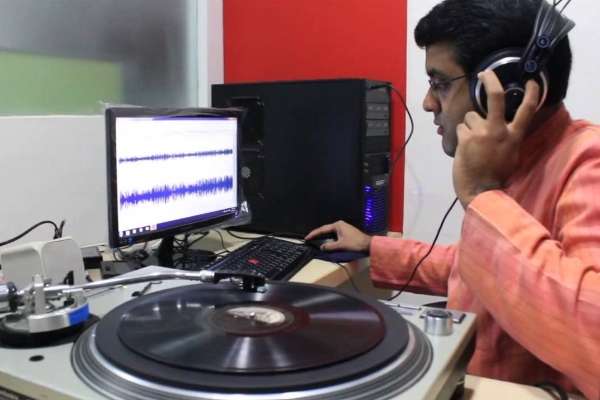
In relation to sound/music, the analogue information has been recorded on analogue formats eg. phonograph wax cylinders, wire recordings, dictabelts, gramophone records, reel-to-reel tapes, cassette tapes and various others. This information is then converted to digital information (binary code) and can be used for various purposes, including saving the information on CDs, mini-discs, digital audio tapes (DAT) and/or as computer files (.wav, .mp3, etc). This process is done using a computer (with a decent soundcard and software such as Sound Forge/Wavelab/Quadriga) or via a playback machine (eg. wax cylinder machine, reel-to-reel machine or dictabelt machine) connected to the PC through an analogue-to-digital converter, with speakers, etc.
Quadriga is a solution used for the digitisation of a variety of media types, tranforming single carrier sound archives into digital mass storage systems, with a strong emphasis on audio quality and metadata accuracy. This solution utilizes sophisticated technology, providing real-time monitoring and logging of audio streams, in order to automatically generate technical parameters of archival significance.
Why is digitisation important?
Collections are digitised primarily to provide access to others. Digital files can be made available and shared over the internet so that people can listen and/or study them. When collections have been digitized, they are easier to move, store and use for various purposes.
Collections are also digitised to protect and preserve heritage materials. To digitally preserve something is to maintain it over a long period of time. Despite potential damage, one reason for digitizing some materials is because they are so heavily used that digitization will help to preserve the original copy long past what its life would have been.
Regarding digitisation, the Technical Committee of the International Association of Sound and Audiovisual Archives (IASA)[i] recommends the following:
- The material is digitized and the master file is saved as a .wav format.
- The playback file is also saved as a wav files. This is the file which is used for example to get rid of the pops and crackling sounds, etc.
- For access purposes, the file should then be saved on a computer as an .mp3.
Technical knowledge and training
The challenging thing about digitisation is that it is not just a process of simply ‘dumping’ a cassette tape into a tape deck connected to a computer through an analogue-to-digital converter and pressing play to record that signal on your computer. The process also requires some understanding of the following; amongst others:
- how computers, software and soundcards work
- basic sound engineering, to operate a sound desk and various other equipment
- how various pieces of equipment are linked or should be to each other
- various cables used to connect the machines
- various sound formats
- how to handle and store the various formats
- waves, frequencies, amplitude, etc.
- Bit depth, sampling rate, etc.
- digital audio file types and quality (.wav, .mp3, .aiff, .flac, .au, .wma, .aac, etc)
- Digital Mass Storage Systems (DMSS)
- file sizes (kilobytes, megabytes, gigabytes, terabytes, etc)
- also, having a trained ear for sound.
Handling and storage of formats
The way in which these formats are handled and cared for has an effect on their longevity. As a result of the physical and chemical make-up of the analogue formats, with time they deteriorate, break and/or crack, bend/warp, grow mould, develop ‘sticky-shed syndrome’ (a problem affecting reel-to-reel tapes made between the mid-70s and mid-80s), etc. It is then required that they be taken through a number of processes in an attempt to ‘reverse’ these effects and restore or fix them. Various institutions and organisations have come up with guidelines on how to go about storing the formats and how to work on them when they are already damaged. Specialised equipment, which is quite expensive and not easily available in South Africa, is used to remedy various situations, for example for ‘baking’ warped vinyl LPs, cleaning dirty discs, ‘rewinding’ tapes with sticky-shed syndrome, etc[ii].
‘Baking’ is a process of flattening a warped vinyl disc using an industrial/ professional microwave. This process involves the gentle heating of the disc while it is sandwiched between two plates of glass, with the weight of the upper sheet of glass being sufficient to ease the record back into a flat state without danger of damaging the record.
This process is also used on tapes with sticky-shed syndrome. After tapes have been ‘baked’, they are slowly rewound to check the status of the syndrome. The British Library uses a machine they refer to as the ‘Grandfather Clock Machine’. This device was designed by a sound engineer who worked for the Sound Archives. The International Association of Sound and Audiovisual Archives (IASA) recommends that a tape that has gone through this process be transferred immediately and the ‘bad’ master be filed away somewhere in case it is ever needed again.
Cassette tapes sometimes require re-boxing and reel-to-reel tapes splicing. For cleaning gramophone records, the Keith Monks record cleaning machine is used. The ultrasonic bath/tank is used for vinyl and shellac records that are particularly dirty with grit or dust before ‘washing’ them on a Keith Monks machine[iii].
There is also always a risk of accidental damage through improper handling, malfunctioning equipment or disaster.
One of the encouraging factors to making sure that these formats are always properly preserved and handled with care should be that one may in the process of digitising the only ‘copy’ available in an archive or collection, or in the country, or maybe even in the world![iv]
Challenges and risks of digitisation
Digital preservation is made more complicated by the fact that technology changes so quickly - a format that was once used to store something inevitably becomes obsolete. Computers are no longer made for floppy discs, for example. Obtaining the hardware to convert a file from an obsolete format to a newer one can be expensive. As a result, the upgrading process must take place every 2 to 5 years, or as newer technology becomes affordable, but before older technology becomes completely unobtainable.
Many archives as well as other institutions struggle to catch up and stay up to date with regards to both digitization and digital preservation. The Library of Congress in the USA[v], IASA and various other organisations provide numerous resources and tips for individuals and archives looking to digitize and digitally preserve their collections, some of these are outlined here below.
Digitisation is a time-consuming process, particularly depending on the condition of the holdings prior to being digitized. Some materials are so fragile that undergoing the process of digitization can damage them irreparably.
Digitisation can also be expensive. Institutions want the best sound quality in digital copies so that when they are converted from one format to another over time, the highest-quality copy is maintained. Smaller institutions may not be able to afford such equipment. Manpower at many facilities also limits how much material can be digitized. Archivists must have an idea of what their patrons wish to see most and try to prioritize and meet those needs digitally. The cost of upgrading hardware or software every few years can be prohibitively expensive.
Manpower and funding also limit digital preservation at many institutions. Training is another issue. Many archivists do not have a computer science background. The skills required to recover sounds from traditional archival formats are being lost; as are the skills to ensure best practice in project planning; the skills to research their survival by selecting the best modern archival solutions for content migration; and the skills required to make recordings accessible in the internet age. There is therefore a growing need for specialized training in sound archiving as a result of the accelerating change in audio-visual technology. This calls for personnel at sound archives to be exposed to training sessions from time to time, to stay abreast of the latest developments, which aim at curbing the challenges audio-visual archivists face on a daily basis.
Intellectual control of digital holdings presents yet another issue, which sometimes occurs when the physical holdings have not yet been entirely processed. One suggested timeframe for completely transcribing digital holdings was every 10 to 20 years, making the process an ongoing and time-consuming one.
The equipment used in the archival sector is becoming obsolete and the development of technology and recording systems (the carriers as well as with the necessary recording and replay equipment) is becoming increasingly sophisticated. The commercial lifetime of systems has become also increasingly shorter. The traditional audiovisual formats (such as analogue tapes) and their lifetime is therefore of particular interest to archivists. The future availability of suitable and functioning replay equipment is becoming a burning issue for several modern formats. For instance, in the computer world, the availability of dedicated drives has always been of greater concern than the stability and longevity of the respective carriers. This situation is aggravated by the obsolescence of dedicated software and operating systems.
The future of digitisation
Several audio archives are now systematically transferring their holdings into self-controlling and self-regenerating mass storage systems to escape the vicious circle of ever-decreasing life spans of carriers and their dedicated hardware. It has become apparent that, in setting up strategies for the safeguarding of audio-visual material, future migration has to be taken into cognisance. With all machine-readable documents, the performance of recording and replay equipment is a central factor in the safeguarding of data. Great efforts have to be made to keep equipment in the best possible condition.
The analogue formats and machinery that were used for audio archiving for over 80 years have been replaced by an overabundance of digital systems. While the new technologies require a new set of skills, there is a large legacy in archives and broadcast libraries of older analogue audio-visual recordings, which will continue to require the skills of highly-trained professionals to access the content optimally and ensure it is migrated to modern archival formats[vi]. Without these skills, many recordings held in collections will be lost.


Most popular

Top Naija songs of 2026
31 Mar 2026

Top Afrobeats songs of 2026
19 Mar 2026
Ghana: Mr Eazi and MOLIY’s ‘Comfort’ earns Urban Music Awards nomination
21 Oct 2026

Top amapiano songs of 2026
16 Feb 2026
Open call: CANEX Music Business Lab and Songwriting Camp
15 Oct 2026
Nigeria: CANEX WKND unveils 2026 programme
21 Oct 2026
Disclaimer: Music In Africa provides a platform for musicians and contributors to embed music and videos solely for promotional purposes. If any track or video embedded on this platform violates any copyrights please inform us immediately and we will take it down. Please read our Terms of Use for more.

Subscribe to our monthly Newsletter
Follow us on social media


Please log in to post a comment.