




























































A father and son’s bold bid to preserve Ghana’s traditional rhythms

29 Aug 2024 - 13:10


It is a small, almost hidden room within Ghana’s Cape Coast Castle, whose low entrance forces me to stoop slightly. Designated as a museum and rehearsal space for local traditional music, its walls, browned with age, are painted with adinkra symbols: Sankofa, a reminder to return to the roots, Gye Nyame, representing the omnipotence of God, and so on. The room also serves as storage for various traditional symbolic objects and instruments, from drums of different makes to handheld gongs. No wonder the air is so thick with history and culture.
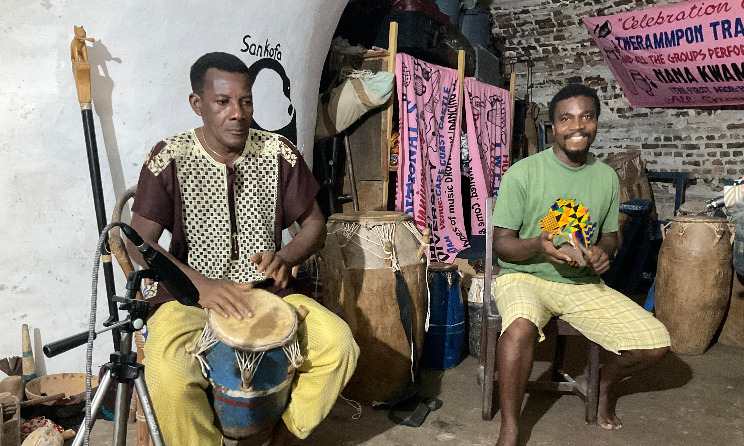
Part of my mission on this trip is to meet Odomankoma Kyerema Kwamena Pra, the drum maestro devoted to preserving local musical traditions and the man behind this establishment. Beside him is his son, Frank Kobina Pra, who, though quieter, shares his father’s stature, stutter and zeal.
Days before this conversation, I attended an intimate showcase by Twerampong Traditionals, founded and led by the older Pra. The performance – which seamlessly marries traditional rhythms like asafo, adzewa, adenkum, kununku, osoode and Moses with modern sounds, incorporating guitars and keyboards – includes folk medleys, dance and storytelling that address social issues with humour and gravity.
Pra’s story started right here in Cape Coast, where he grew up near the Asafo, a traditional warrior group deeply embedded in local cultural practices. His early experiences with drumming are informal yet formative – by age three, he was already mimicking the elders with makeshift instruments. At 15, he earned the title ‘Okyerema’.
“This title means master drummer,” he tells me, smiling. “It marks my responsibility to communicate important messages through drumming.” According to him, the spiritual dimensions of traditional Ghanaian music are central to his work. “In our world, we interact with spiritual beings through music and drum language,” he explains, cautioning that “if we move away from the spiritual aspects, we risk losing important values and harming our environment.”
In the 1970s, Pra embraced teaching to preserve drumming traditions, collaborating with the Nana Kwamena Kum-led group named Wasamba and educating students on these rhythms until 1993. Pra cites Kum as a major mentor to him. In tribute, he holds annual cultural events in Cape Coast. He also founded Twedeampon Traditions in 1982 to address the fading traditional music and sustain Kum’s legacy.
In 1994, Pra’s influence spread beyond Ghana’s shores through his collaboration project with the Danish development agency DANIDA in Denmark, where he introduced Ghanaian drumming to European audiences and blended it with jazz.
“It was fantastic,” he recounts. “And it helped spread our cultural heritage internationally.”
To my question about his approach to integrating Western instruments into traditional drumming, Pra notes: “Culture is dynamic. To stay relevant, we need to evolve and blend traditional and modern elements.”
He also envisions a future where female drummers can achieve divine status, a concept traditionally reserved for men: “There were no female drummers in the past, but times are changing. I believe women can also become divine drummers once they reach a certain age and understand the spiritual aspects of drum-making.”
At this point, Pra introduces Kobina, who moonlights as a sound engineer. “He joined the group at age 10 and has been learning ever since,” Pra beams with the particular delight of a proud father. “While he is busy with various tasks, he plays both drums and keyboard.”
“He instilled in me the importance of traditional drums, starting with the bell, which he taught me is the backbone of our music,” Kobina, whose early exposure includes training with his father at their home in Ayeden, adds.
Like his father, Kobina now teaches traditional drumming in local schools and runs workshops across Europe.
“This year, I’m excited about the growth in traditional performances and projects,” he says. “I’m actively introducing schoolchildren to our traditional music and integrating it into art exhibitions.”
Later, I accompany Kobina in a taxi, about 30 minutes from the castle, to a basic school where he conducts free music workshops.
Witnessing the students’ positive response to traditional drumming training confirms the substantial effect of Kobina and his father’s work.
“It’s a good way to stay connected to our culture,” says the diminutive Samuel, a pupil wearing a backpack full of books. Jennifer, another pupil, adds that “knowing our culture helps us stay grounded in our identity.”
“When they learn about the traditional drumming training, almost the entire school wants to join,” says Adam Kwesi Otchere, a teacher at the school. “I expect fewer students, but nearly 30 to 40 join, which is impressive. Seeing their enthusiasm for traditional drumming and music is touching.”
According to the United Nations Educational, Scientific and Cultural Organisation (UNESCO), among other things, “safeguarding measures for traditional performing arts should focus mainly on the transmission of knowledge and techniques, of playing and making instruments, and strengthening the bond between master and apprentice.” The organisation adds, "Cultural media, institutions and industries can also play a crucial role in ensuring the viability of traditional forms of performing arts by developing audiences and raising awareness amongst the general public. Audiences can be informed about the various aspects of a form of expression, allowing it to gain a new and broader popularity, while also promoting connoisseurship which, in turn, encourages interest in local variations of an art form and may result in active participation in the performance itself.”
In a conversation with Graphic Showbiz in February 2023, Ghanaian multi-instrumentalist Nii Tettey Tetteh called for greater state support to leverage traditional music and dance for economic gain, holding that the country is missing out on substantial foreign exchange by not fully developing its traditional arts sector. “Traditional music and dance are items we have complete ownership of. We don’t need any so-called strategic investment partners to help us mine or refine them,” he said.
As for Kobina, he sees a need to counterbalance the dominance of modern genres like techno and hip hop with traditional music: “Afrobeats is an example of how African rhythms are merging with pop music. I envision a future where traditional African music and European styles will combine to create new forms.”
He also observes a positive shift in Western perceptions of traditional music. “During my recent tour with Total Hip Replacement [a band he currently plays in], I integrate Ghanaian highlife rhythms into reggae. The audience appreciates the uniqueness of blending traditional Ghanaian drums like the fontonfrom with reggae music.”
Kobina, like his father, holds a strong belief in a spiritual significance within the music he practices. “In Denmark, I observed how traditional Ghanaian rhythms create an emotional impact during performances, which reveals the deep connection between our traditional practices and spiritual experiences.”
He also observes that European audiences romanticise traditional African music for its authenticity and organic nature, an interest that contrasts with the contemporary digital music scene. “European audiences value the tangible connection to traditional music that’s crafted by hand and rooted in cultural practices,” he says.
After our conversation at the castle, father and son give an impromptu performance. The older Pra plays a traditional drum while Kobina strikes the handheld metal gong. Their shared stammer instantly fades, replaced by this truly gripping musical exchange between generations. Such an amazing sight.
I head back to Accra with a newfound respect for Cape Coast, and the Pras' dedication to both traditional and modern aspects of its culture, and make a silent promise to myself to return soon. Very soon.


Most popular

Top Naija songs of 2026
31 Mar 2026

Ghana: Mr Eazi and MOLIY’s ‘Comfort’ earns Urban Music Awards nomination
21 Oct 2026

Top Afrobeats songs of 2026
19 Mar 2026

Top amapiano songs of 2026
16 Feb 2026
Open call: CANEX Music Business Lab and Songwriting Camp
15 Oct 2026
Nigeria: CANEX WKND unveils 2026 programme
21 Oct 2026
Disclaimer: Music In Africa provides a platform for musicians and contributors to embed music and videos solely for promotional purposes. If any track or video embedded on this platform violates any copyrights please inform us immediately and we will take it down. Please read our Terms of Use for more.

Subscribe to our monthly Newsletter
Follow us on social media


Please log in to post a comment.