






























































The man behind one of South Africa’s most loved songs, the 1984 disco anthem ‘Flash a Flashlight’, has slipped below the radar in recent years. But now Benjamin Ball is back from the wilderness, armed with new songs and finishing off a brand new album. He visited the Music In Africa office recently to share his incredible story...
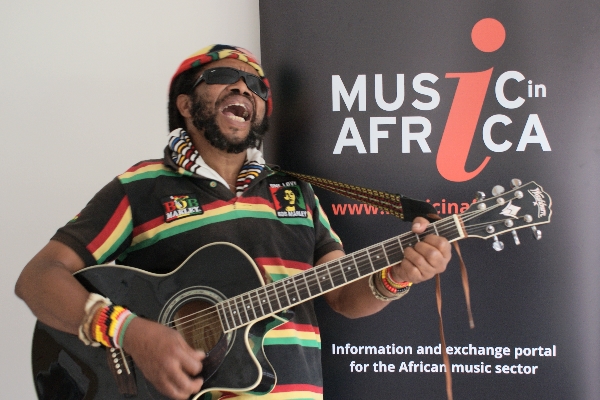
Born Benjamin Msane in Durban, he grew up in Manenberg and other parts of Cape Town. He learnt the guitar as a teenager and moved to Johannesburg as a young man, initially performing alongside popular mbaqanga group Abakwhenyana when they did shows on the mines, under the guidance of producer Simon Ngwenya. Benjamin then joined bubblegum hitmakers CJB, alongside Cyril Nkosi, Neo Maphaka and Thami Ndluli from Taboo, as well as singer Ali Katt. Inspired by the burgeoning reggae scene as well as the latest pop trends, together they recorded some long-lost tracks such as ‘Crack’ and ‘Is it Love’ on the RPM label. Another early track, ‘Give the people what they want,’ was banned by the SABC, a common occurrence at a time when apartheid severely restricted the careers of musicians and the lives of ordinary South Africans.
The ‘Flashlight’ story
Jaded by the threat of obscurity and censorship, Benjamin decided to go solo. In late 1983 he teamed up with two of the local industry’s top producers of the time, Blondie Makhene and John Galanakis, as well as label exec and manager Peter Snyman, and recorded a new track of reggae-tinged disco music, titled ‘Flash a Flashlight’. The single came out a few months after Brenda & The Big Dudes’ massive hit ‘Weekend Special’ and soon became the second anthem of the ‘bubblegum’ era, during which local stars began to challenge and even surpass overseas acts in terms of sales and popularity.
Benjamin recalls: “Blondie had just done ‘Weekend Special’ and after that he wanted a new artist. He came with me to John Galanakis. We programmed the music there with the drumbox, the whole drum beat. Then everything just came together. I came and started singing the words, just like that, out of my heart. I started banging them, one way. After that, the song just went... It was not so long actually, it took one day. John is the main guy who gave it the groove. He hit that style and I started singing, he was like ‘wow!’. It was Blonde and John and me, the three of us. I gave Cyril the songwriting credit. He didn’t play nothing, but because he told me the song was a hit I gave him a credit as a composer.”
[audio:https://soundcloud.com/afrosynth/flash-a-flashlight autoplay:0]
The rest, as they say, is history. The song became a massive hit, rivalling even ‘Weekend Special’. Benjamin continues: “It was played by SABC. Peter Snyman had contacts so it was played on all the stations. I performed and was doing interviews in Venda and all those places. I went to all the radio stations to do interviews. When I came to Pretoria the album sold gold. One record bar sold 25 000 units of ‘Flash a Flashlight’! They gave me a gold disc. Just imagine - I’m not talking about other places, just in one record bar in Pretoria it made gold! That guy was selling it like cakes! Everybody wanted that song, it was going like mad. That’s the song that came and killed ‘Weekend Special’.”
The song’s popularity led to live performances all over the country, not only to black but also coloured and Indian audiences, rare in the still segregated music industry and pre-empting the ‘crossover’ trend of later in the decade. “I used to perform a lot of gigs at that time,” continues Benjamin. “I remember I performed with Blondie & Pappa in Sharpeville, Soweto. It was their show, I was just a guest. But I took over the show, because when I came with ‘Flash a Flashlight’, I couldn’t get off the stage! People didn’t want to me leave. They were throwing panties on the stage. They were going crazy! It was in a big hall, it was packed. I had to do the song over and over because I didn’t have another track. So I sat down and said I’ve got to start working on a follow-up, and I came up with the album.”
Employing the help of the top Sotho soul group The Black Five, which included revered singer Nana ‘Coyote’ Motijoane (later of Stimela), to back him live and to help write new songs. ‘Flashlight’ was soon included in a full-length album, Paulina (1984), which unsurprisingly went gold, establishing Ball as one of the leading solo acts of the day, managing to bridge the pop sensibilities of the bubblegum trend with more timeless and international reggae influences.
“What appeals to the people is that reggae is freedom music, it’s freedom-of-speech music,” explains Benjamin. “It expresses how you are feeling, how when you’re down you must not be down, you must pick yourself up… Reggae is like soul. It gave people courage to express their feelings. It must not be kept inside, because when you keep your feelings in, it ends up eating you and becomes a sickness. So reggae is a music that expresses, spiritually.”
“I had a lot of things in my head,” he continues. “I had reggae and disco, reggae with a disco feel. Reggae but in disco. Reggae in a club. I always thought of putting reggae in a nightclub… Carlos (Djedje) wanted African roots, but I always expressed to him, ‘These days, man, if you wanna make money, to establish yourself and for people to like you, you’ve got to go with the people. You’ve got to flow with them. You can’t give them something they don’t understand. Myself I can’t eat pap and morogo from Lesotho, it’s sour, I can’t even get it in my mouth. But some people like Blondie, they go crazy for that. We’re different. That’s why I said to Carlos, ‘I’ll stick to my style. I’m not copying nobody. I’m not copying Bob Marley. This is my style.’”
Out of the Bushes
For the next decade he continued to release solo albums and singles, such as ‘I Need It’, ‘Come to Me’, ‘Take A Chance’, ‘Reggae Dance’ and ‘She’s Dangerous’. Re-uniting with Blondie and venturing deeper in a roots reggae sound, Ball re-branded himself as Bhingi in the early 1990s. In 1991 he released what he considered to be his best album, with tracks like ‘Bhingi and Roots’. But for some reason the album flopped. Wanting to venture into songwriting for other artists, Ball teamed up with Dr Victor, a prominent band leader for many of the stars in the Dephon stable, as well as a notable producer, frontman (of Taxi) and solo artist himself, also fusing pop and reggae. Ball claims Dr Victor asked him to write new tracks for him, which he did, but allegedly lost. From there, in the mid-1990s, Benjamin’s career gradually faded.
Benjamin took a break from music and trained to become a sangoma (traditional healer) while living in Soweto, Johannesburg. Once qualified, he practiced as a sangoma, prescribing medicinal herbs to treat various ailments, including for the late mbaqanga musician Bhekumuzi Luthuli. The experience rejuvenated him and ultimately led him to return to music, with a new album in the making, titled Out of the Bushes. According to Benjamin, “I went off to the bushes, learning herbs and all those kinds of things. I said to myself, now I’m finished with my training, I must go back to the music. When I came back to the music, I came with this stuff. It was a long break…That’s why the new album is called Out of the Bushes - I’m finished with all the training.”
He says the album is nearly complete, but he is still looking for someone to mix and master it. It follows a 2013 single and video, ‘Dancing in Zion’. Meanwhile some of his tracks, ‘Flash a Flashlight’ and ‘I Need It’ were recently given a house remix by local producer Dr Beat. For the past few years, the artist has been living in Mtwalume in rural Kwazulu-Natal, near Port Shepstone and Umzinto – the ancestral home of the Msane clan. “Music is my full-time thing. That’s why I sit and I want to be relaxed, so I can compose. I always believe it’s about patience. To fish, you have to have patience to catch a fish, otherwise you won’t catch nothing. Music is the same thing. If you are to have a lot of songs, you have to keep on composing - don’t stop composing. I believe in that, I don’t stop. I’ve written maybe four or five hundred songs.”
Much has changed since the 1980s, but Benjamin feels he still has plenty to offer the music industry. “Today’s music is not the same - you don’t get people playing guitars now. The DJs now are taking over completely. You don’t get real musicians these days. Real musicians are old, I think their ideas have expired. My ideas don’t expire because I flow with the world, and I’m always down to earth. I know what’s happening…You’ve got to get young boys to come and work on your music, you’ve got to get young ideas.”
In terms of advice for aspiring musicians, Benjamin had this to say: “If you want to be a musician, you’ve got to put it all out there - everything you’ve got, your heart. You’ve got to pour it all out. And if you can’t, you’re not gonna make it. When I first sang ‘Flash a Flashlight’, I didn’t expect it to be a hit. I just sang ‘Who’s got me dancing, on the floor, roots got be crying out for more…’ I was crying in my heart. I sang what I was feeling. And that feeling is something that nobody can just give to you. It has to come from the inside…”


Most popular

Top Naija songs of 2026
31 Mar 2026

Ghana: Mr Eazi and MOLIY’s ‘Comfort’ earns Urban Music Awards nomination
21 Oct 2026

Top Afrobeats songs of 2026
19 Mar 2026

Top amapiano songs of 2026
16 Feb 2026

Open call: CANEX Music Business Lab and Songwriting Camp
15 Oct 2026

Nigeria: CANEX WKND unveils 2026 programme
21 Oct 2026
Disclaimer: Music In Africa provides a platform for musicians and contributors to embed music and videos solely for promotional purposes. If any track or video embedded on this platform violates any copyrights please inform us immediately and we will take it down. Please read our Terms of Use for more.

Subscribe to our monthly Newsletter
Follow us on social media


Please log in to post a comment.