




















































Former Nairobi street kid reclaims the city with his sax

22 Sep 2016 - 13:38


On a breezy Thursday evening in August, i find myself strolling along Aga Khan Walk in Nairobi’s CBD. The streets and avenues are too congested with evening traffic and this major pedestrian spine offers a less headache-inducing alternative. Aga Khan Walk is exciting, because it could throw anything at you – a second-hand book seller, a church choir on rehearsal, a rowdy gang of skating teens, a lottery ticket vendor, a doomsday preacher, even a madman. The street is lined with park benches that have been turned into yet another ‘jobless corner’in the CBD, a place for those without employment to sit and stare into their bleak future.
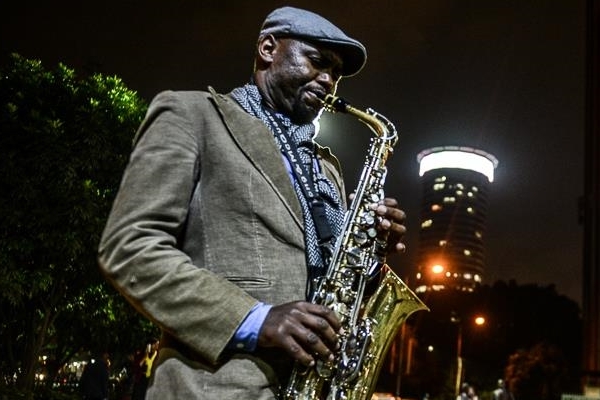
My stroll is interrupted by a sultry sound. It’s Moses Odhiambo alias Mosesoo, whose saxophone performances have been making news on Kenyan TV screens and social media lately.
Most of the music on the streets of Nairobi is playback performances by gospel artists hoping to sell their CDs. It is usually loud and a nuisance but attracts passers-by because it is accompanied by dance and because the gospel in Nairobi is spread on loudspeaker. You will also find beggars, especially blind ones, playing drums or the flute.
In a city where the busking culture mainly draws fire-eating magicians, tricksters, jugglers, preachers and acrobats, his is a unique offering among street performances.
Huddled around Moses is an improvised choir of passers-by. I join them in singing along to a rhumba tune by the late Daudi Kabaka, ‘Msichana wa Elimu’, a golden oldie released back in 1967.
"Msichana mrembo kama wewe (A girl as beautiful as you)
Kitu gani kinachofanya usiolewe (What keeps you from getting married?)
Elimu unayo yakutosha (You have enough education)
Hata ngámbo umeenda ukarudi (You’ve even been abroad and back)
Miaka yaenda mbio sana (The years are passing)
Sura yako yazidi kuchujuka" (And your face keeps ageing)
It is Mzee Eddy who provides the lyrics to the second and third stanzas. Mzee Eddy is tall, grizzled and stooped, and tells me he comes every Thursday to listen to Moses while he plays old school Kenyan songs. The rest of the singers are young men, while some passers-by stand at a distance and watch. There’s companionship among these strangers as they sing and dance to the music.
Moses always steps out in a flat cap, a broken suit and a scarf, for his performances. It’s a style that makes him accessible yet professional. He plays twice a week, from 5pm to 7pm.
He is a self-taught saxophonist whose story finds its way back to the streets. He is a former street boy. The 29-year-old grew up in the Soweto slums of Nairobi’s Kayole area. At the age of 10, Moses and his three brothers moved out of home after their father relocated to their rural home to recover from alcoholism. His mother could not feed and educate her seven children, so they dropped out of school to fend themselves. This saw him becoming a street rascal, surviving by selling waste plastic and scrap metal.
He lived in the streets for five years and a local church, Kenya Assemblies of God church, later offered to pay his school fees. Despite the help, he had no money for food, so he would return to the streets in the evenings and on weekends. Because he was too grown to return to Class Two, the school allowed him to skip three classes and join class six.
He passed the primary school exams and enrolled at Pumwani High School in Nairobi. Shortly afterwards, he developed a love for music and joined the school band as a trumpeter. He excelled in his studies and school leadership and was eventually elected as school captain. Throughout his high school years, he was supported by an organization called Daraja, which assisted needy artistic students such as acrobats and singers.
But reality dealt with him. Despite passing his secondary exams, he could not pursue his education at tertiary level owing to final challenges. He was later invited to teach music students under the sponsorship programme and this saw him at playing the saxophone for the first time. Fortunately, when the donor programme ended, he was given the saxophone that he plays to date.
In 2010, he started selling second hand clothes so as to earn a living. In April 2016, he stopped selling clothes performing in the streets. That same month, he scouted the Nairobi CBD for a pitch, a place to play his sax. Some open spaces were too noisy, others too empty, and others were flanked by traffic. At Aga Khan Walk, he found people lazing. The tempo of the street was just right, and he wanted to cheer up the idlers. Vendors discouraged him with woeful tales of dodging greedy city county officers. But one said he’d like to hear how that instrument sounds, because he had never seen anything like it. Moses realized that the sax is an instrument not accessible to most people on the street.
At Nairobi City County offices, he was asked to pay Sh26,000 (US$260) a monthfor numerous licenses.
“It’s ridiculous! Who makes that kind of money on the streets? I didn’t even intend to make money from this!” he lamented to me.
Eventually, he picked up his saxophone, steadied his shaky hands and played. So far, no county officers (what are these?) have harassed him. He hopes the City County officials will leave him play in peace.
He dedicates Tuesdays to gospel hymns, and as expected in a city where gospel music is far more popular than secular music, he gets most tips on this day. On Thursdays he plays Kenyan golden oldies, otherwise known as Zilizopendwa in Swahili, and ballads.
He plays some of the most popular and most requested songs such as ‘Malaika’, a famous Swahili love song in East Africa, ‘Take 5’, a jazz classic and ‘All of Me’ by John Legend. His personal favourites are ‘This is my Story’, You Raised me Up, Eric Wainaina’s ‘Ngwetereire’ and any song by Fundi Konde, a veteran Kenyan Rumba artist.
In the last five months he has been playing, Moses has received opportunities to play at many corporate events and private parties. He also played at the Safaricom Jazz Festival – one of Nairobi’s most coveted music events.
“People take photos of me and post them on social media, and now i’m having people call me even from the US and Europe. Sometimes people dressed in office wear don’t stop to listen, but some take down my number and call me later, inviting me to play at their events. I have just signed a deal with Ole Sereni hotel in Nairobi to play there every Friday. I had none other than Michael Khateli the celebrity photographer volunteer to do a professional photoshoot of me and a graphics design student offered to do my branding material for free. I have received much more than I have given,” he said, indicating that he has moved from a single room to a one-bedroom house, and is now able to take care of his family.
It was only after five weeks of playing that Moses decided to accept tips from people. He previously refused gifts from people as he did not want to be mistaken for a beggar.
“People would walk up to me and give me money and i would turn it down. One man told me he wasn’t giving me money because i’m a beggar, but because he was appreciating my art,” he said.
What lies ahead for the self-made maestro?
“I want to buy equipment that would amplify instruments like guitars, so i can have other musicians play with me. I’m also expanding my repertoire. I use my audience’s requests as a guide when I rehearse for three hours daily,” he said.
You can follow Moses Odhiambo on his Facebook page.


Most popular

Top Afrobeats songs of 2026
19 Mar 2026

Top amapiano songs of 2026
16 Feb 2026

Top Naija songs of 2026
31 Mar 2026

Afrofest and StageVibes offer ACCES-affiliated artists performance opportunities in Toronto
06 Nov 2026

SA: DJ Tira sets 20 November release date for new EP
11 Nov 2026

ACCES nominated for best music biz conference at MBAA
11 Nov 2026
Disclaimer: Music In Africa provides a platform for musicians and contributors to embed music and videos solely for promotional purposes. If any track or video embedded on this platform violates any copyrights please inform us immediately and we will take it down. Please read our Terms of Use for more.

Subscribe to our monthly Newsletter
Follow us on social media


Please log in to post a comment.