



















































Grammys 2022: What Fela Kuti has to do with West Africa’s growing pop fame
01 Apr 2022 - 10:11


By Sanya Osha
There are a record number of African nominees for the 2022 Grammy Awards and they are almost all from West Africa – Angelique Kidjo (Benin), Rocky Dawuni (Ghana), Femi Kuti, Made Kuti, Wizkid, Burna Boy and Tems (Nigeria).
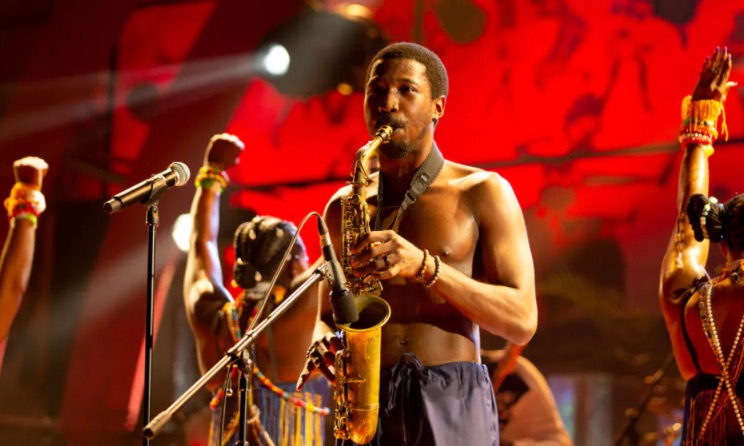
Most of these artists are also proponents of Afrobeat (Femi and Made Kuti, following the musical and political form defined by Fela Kuti) or new breed Afrobeats (Wizkid, Burna Boy and Tems). Kidjo, too, has admitted to being influenced by Fela.
As with Afrobeat, Afrobeats is music characterised by harmonic and melodic grooves, call and response choruses and intricately layered syncopation (disrupted rhythms). But Afrobeats is more commercial, radio-friendly and often politically vacuous – easily digestible by mass audiences.
There have been extensive conversations on the differences and similarities of Afrobeat and Afrobeats. But within this selection of Grammy nominees what is immediately obvious are the lines where the two genres come together.
It is interesting to observe the dissemination of Fela’s legacy in the form of the varied work of his numerous musical children many of whom pay direct homage to him by copious sampling and outright imitation.
The Kuti dynasty
Fela’s dominance of the music scene spanned the 1970s and 1980s. After he was incarcerated by the Nigerian military authorities in 1984, his son Femi steadily began to come into his own musically. Femi is still decidedly more old school Afrobeat than new school Afrobeats. He served a long musical tutelage under Fela, and struggled to carve his own artistic niche but would always be seen primarily as an Afrobeat musician.
Femi, visually and politically speaking, is a much more safer bet than his father. He has avoided needless controversy and partnered with a wide variety of globally accomplished US musicians such as pianist Randy Weston, rapper Mos Def and singer Macy Gray amongst other noted collaborations. Femi has received six Grammy nominations.
Fela had never fitted the Grammy mould due to his uncommercially lengthy compositions, controversial nature and outright rebelliousness. But none doubted his musical genius. In many ways, he is irrevocably fastened to the classical Afrobeat template in terms of lyrical acuity, political awareness, aesthetic definition and spiritual curiosity.
Initially, Femi may have been tempted to adopt the title of Afrobeat heir apparent and might have short-changed himself in the process. But it is never a wise proposition to try and imitate Fela. Instead what is possible and also judicious is to attempt to assimilate parts of his vast legacy rather than the whole of it. And this is precisely what the current Afrobeats stars are doing.
Made, Femi’s son and Fela’s grandson, is more removed from his domineering grandfather’s influence and so he is able to explore his vast musical heritage at his own pace and with much less external pressure. Yet still Made is closely linked to his father, and music and not controversial politics, is what essentially motivates him. Up for his first Grammy, he is more mellow and likeable than his fiery grandfather.
If Femi and Made represent the old guard of Afrobeat and a ever-growing legacy in Nigerian music then Wizkid, Burna Boy and Tems are the poster children of the now and the future.
The new school
Burna Boy’s connections to the Kuti dynasty also run deep. His maternal grandfather, Benson Idonije, the revered broadcaster and jazz aficionado, was Fela’s manager in the 1960s. Fela himself had been a broadcaster until he decided to cast his lot full time in the music industry. There is a raunchy video of Burna’s mother, Bose, dancing on stage beneath a bare-chested Fela, part of Fela’s sprawling entourage.
Burna has sampled numerous Fela songs – such as ‘Soke’ and Y’e’ – and he is open about his indebtedness to the maestro. Burna’s socio-political vision, cadences and musical flow are lifted straight from Fela.
Wizkid, on the other hand, is slightly more circumspect in his sampling of Fela tunes. But arguably his biggest hit, ‘Joro’, approaching 200 million views on YouTube, is derived from the “Joro jara joro” refrain in Fela’s famous incendiary song, ‘Zombie’. Wizkid also collaborated with Femi earlier in his career as if he were seeking an authentic Afrobeat imprimatur.
Tems, the youngest of the lot, is probably the least directly influenced by Fela’s Afrobeat. She is more indebted to US R&B and soul music. Her deep, sultry voice is combined with a style and vibe leaning towards the Afrocentric Afrobeat look. But there are many more artists in the wings, angling for the future Afrobeats spotlight – among them Rema, Buju, Joeboy, Omah Lay, Fireboy DML, Olakira, Ckay, Jaywillz and Asake.
Celebrity culture
Here is where Afrobeat differs from Afrobeats. Fela shunned crass materialism and he had an almost Robin Hood mentality in the dispensation of personal wealth. He avoided the consumerist flexing of today’s pop stars.
Burna Boy has finally come into his own as a mature artist. His politically conscious, Grammy-winning last album, Twice as Tall, rails against colonialism, global oppression and racism. But Burna’s lifestyle and personal values are saying something else. He is enthralled with large and flamboyant chains and necklaces, Lamborghinis and trophy girlfriends and other trappings of celebrity hip hop culture while also attempting to burnish his mystique as a serious artist. He was difficult to find when the youthful #EndSARS protesters in Nigeria recently needed local celebrity voices to aid their cause.
Wizkid has no lofty pretensions. His main concerns, also evident in his most recent album, Made In Lagos, are beautiful girls, matters of the heart, club dance floor domination and A-list celebrity status.
Massive crossover
Afrobeats is no longer confined to Nigeria, Ghana or West Africa alone. Artists from southern Africa, Rwanda, the UK and Europe have all been bitten by the bug.
The global acceptance of Afrobeats can be perceived at several levels. First of all, there are superstar Beyoncé’s collaborations with Wizkid, Burna, Tiwa Savage and Yemi Alade on her Black Is King album. Justin Bieber was quite happy to hop on the re-mix of Wizkid’s global hit, ‘Essence’. There are also Burna’s collaborations with Sam Smith, Stormzy, Pop Smoke and Jorja Smith to think about. Or Fireboy DML’s chart-storming collaboration, ‘Peru’, with Ed Sheeran.
Indeed these massive crossovers are telling an unambiguous story: Afrobeats has acquired global legitimacy because it brings a unique swag and flavour to an otherwise jaded music scene. It’s a swag that has roots all the way back to Fela Kuti.
Sanya Osha is a senior research fellow at the Institute for Humanities in Africa, University of Cape Town. This article first appeared on The Conversation.


Most popular
Call for applications: ACCES 2026 Emerging Artist Spotlight Competition
01 Oct 2026

Top amapiano songs of 2026
16 Feb 2026

Top Naija songs of 2026
31 Mar 2026

Top Afrobeats songs of 2026
19 Mar 2026
Open call: 2026 Gender@Work music industry training in Johannesburg
03 Oct 2026
AFRIMA 2026: All the winners
12 Jan 2026
Disclaimer: Music In Africa provides a platform for musicians and contributors to embed music and videos solely for promotional purposes. If any track or video embedded on this platform violates any copyrights please inform us immediately and we will take it down. Please read our Terms of Use for more.

Subscribe to our monthly Newsletter
Follow us on social media


Please log in to post a comment.