





























































Banna was a man whose music and person was always compelling. He had skill and he had style. He was a fast-fingered player, possessing the skill to go in any musical direction, ranging from playing and thinking to talking and communicating.
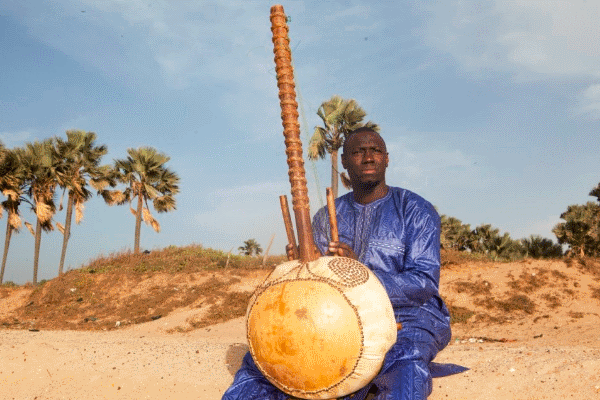
He mastered the balafong, a fixed-key or frame xylophone. The instrument has a gourd resonator underneath each key. The frame is an open box in a three-dimensional trapezoidal shape, larger in both height and width at one end, tapering to the other, reflecting the graded sizes of the 17 keys and the corresponding diminishing size of the gourd resonators.
His father, Jali Madi Kanuteh, alias Balafo Madi was born in Sankarang Duwako in Guinea Conakry. His mother Aja Kunadiya (Lucky) Sakiliba Susso was born in Horo-koto Nyambia in Mali. They travelled to The Gambia, together with a merchant, called Fili Darboe and Banna was born in The Gambia in 1916 in Niani Kayai in the Central River Region.
Bana Kanuteh co-wrote the Penguin modern classic “Sunjata” with Bamba Suso. The Sundiata epic turned on the career of a prince in Kangaba. Vowing to avenge his murdered father and brothers, Sundiata overthrew and killed the usurper Sumanguru, creating Mali.
The Thailand story of Princess Suryothai had a similar theme: a family of usurpers was undone by the legitimate heir, whose moral claim to the throne was burnished by his wife’s selfless sacrifice in battle. Early Ottoman Sultans also murdered their brothers to secure the throne.
Both Bamba Suso and Banna Kanuteh gave their own personalised accounts of the life of “Sunjata” in this wonderful Penguin Modern Classic. Bamba Suso, who was from the eastern division and whose parents were from Mali gave a Madinka view that reveres tradition and is spoken. This was how an ‘Ngara’ or Master Musician should perform! Banna Kanuteh, on the other hand, also from the Upper River area was a powerful, flamboyant and sometimes abrasive character. A born showman, he punctuated his singing with virtuosic instrumental interludes.
Bana Kanuteh has been referred to as “the great performer”, a title reflecting his performance style and musical selection, which displayed his early griot playing and training along with his love of the balafong and other traditional musical forms. He travelled the African continent and became fluent in more than 20 languages. He left a musical legacy that enriched not only his family and his country, but also the Griots and Jalis who have maintained the tradition of balafong playing with musicians of every colour and creed around the world.
The brilliance of Banna’s playing was obvious to many. He travelled widely to provide entertainment for celebrations and trade festivals. The richness of African tradition can be heard in all of his plays; and of course the people loved to dance to the music that he played.
He was also instrumental in the development of the National Troupe of The Gambia working with his wife Jali Mamanding Kuyateh and Dembo Konateh, who also played a major part in the development of West African music. He began to travel in the 1950s and made his first recordings for the BBC World Service; and by 1960s he had become a major influence on the development of the Gambian National Troupe.
Banna played the drum during wrestling contests and when the Mandinka Kankurango masquerade was performing, either at weddings or naming and circumcision ceremonies. He also played the wollof-harp, the xhalam and used to perform with his ensemble, including his three wives and prominent Gambian kora players on Radio Gambia. The programme was called ‘Fata-fingla Kukoto,’ meaning African Renaissance and later developed into Banna la Sumungwo (Banna’s Show).
In this programme, he explained that up to the point the project was undertaken records of African slave heritage were insufficient and provided little evidence, as to where an individual slave or family was from. This, coupled with the fact that the slaves themselves came from cultures without written languages and a clear idea of larger geographic areas, made it almost impossible to trace individual slave roots.
He then explained that the current research of his time had allowed historians to understand which tribes and peoples came from what areas and what music, language, and culture they brought. With this research, he was able to draw the initial connection between the blues and traditional African music.
He then began to distinguish between the first slaves arriving from Senegal, The Gambia and Guinea, and the later slaves coming from Ghana, Nigeria, and the Cameroons. The first group had established a distinctive Afro-American culture, as they came to the colonies in groups and built the plantations.
The second group was dispersed throughout the already formed plantations and they adapted to the established culture they found in America. From this he drew the conclusion that Afro-American music could be traced back to the area between the Senegal River and southern Guinea.
He also discussed the distribution of individual tribes in the colonies, because the Europeans generally didn’t actually capture the slaves, who were shipped to the colonies. At the time of the slave trade, West Africa was in constant internal struggle so it was the losers of the wars that were enslaved. Thus, tribes of fierce warriors were hardly ever found in America. Two tribes that were often found in slave colonies were the Wollofs and the Mandingoes.
Banna married Jali Mamanding Kuyateh in the late 1970s. He fathered the famous Jali Madi, a well-known musician in the Gambian music scene; Sheriffo Kanuteh, a prolific griot, professional ballet dancer and balafonist with Sona Joberteh and the Sofa Nyama band; and Alieu Kanuteh, a remarkable balafonist. He had three female daughters.
Banna expressed his music in the context of 800 years of village-life griots, allowing the music of his ancestors pervade his musical narrative. He explained the way in which great warriors like Sunjata affected the growth of the village and the values that were espoused. Banna died in 1995, leaving a legacy that will in time be seen as the defining era in Balafong music.
Considering the totality of Bana Kanuteh’s legacy, his place in the history of music is comparable to the greatest among the 20th Century musicians.


Most popular

Top amapiano songs of 2026
16 Feb 2026

Call for applications: ACCES 2026 Emerging Artist Spotlight Competition
01 Oct 2026

Top Naija songs of 2026
31 Mar 2026
Open call: 2026 Gender@Work music industry training in Johannesburg
03 Oct 2026

Top Afrobeats songs of 2026
19 Mar 2026

AFRIMA 2026: All the winners
12 Jan 2026
Disclaimer: Music In Africa provides a platform for musicians and contributors to embed music and videos solely for promotional purposes. If any track or video embedded on this platform violates any copyrights please inform us immediately and we will take it down. Please read our Terms of Use for more.

Subscribe to our monthly Newsletter
Follow us on social media


Please log in to post a comment.