

























































It’s not often that a duo can take the stage and set it alight – particularly if the band members have played together for less than a year, and only one of them has an instrument in their hands – but this seems to be MaxX & Love’s speciality. I saw them on three separate occasions, and each and every time, the crowd just couldn’t get enough, so I set out to discover what makes them so unique and so … loved.
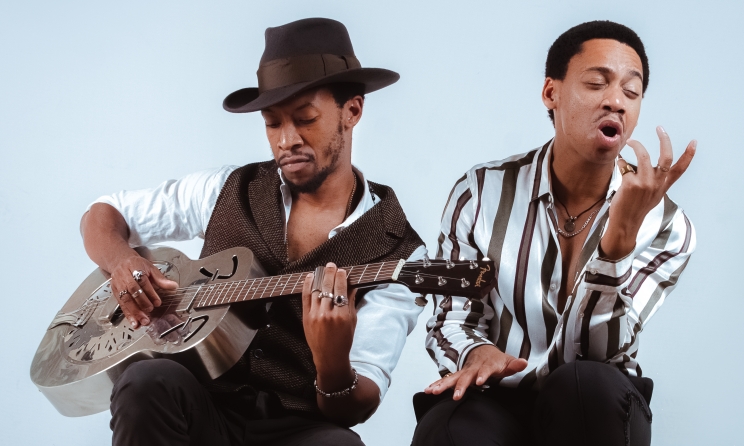
In a nutshell, what you get to see under the spotlight are two young (they’re both 28) handsome black Joburg guys who are dressed to the nines, and who simply ooze confidence. Sechaba Ramphele (Love) is a trained actor/singer who really knows how to hold the audience in his palm, while MaxX Monticoe’s sweeping and soaring blues guitar licks are equally commanding. Once in a while, Love will pick up a tambourine or kick on a bass pedal to add some oomph to a beat, but generally, the voice and single instrument are enough. It’s all in the delivery.
They are not the first actors to sing; there’s a sizeable list of Hollywood greats including Johnny Depp, Jeff Bridges, Scarlett Johansson and Jamie Foxx who like the mic. It does mean that MaxX and Love fans get the added benefit of, in addition to the music, being treated to a show. It’s a formula that works
Love says: “A big part of what we do is creating a show, so if we’re not getting a reaction, then we’re not doing something right. But we are surprised by how quickly and how positively people have reacted to us ... I think a lot of that has to do with being in the right place, at the right time. Lots of artists have done good work, but nobody noticed them …”
Is he just being modest? I tend to agree with his next statement: “The standard of performance, especially in South Africa, has dropped. A lot of folk wear the same thing at sound check as they do onstage, and they deliver their performance in the same way they would if they were playing at home. That bores me to tears.”
MaxX expands: “Because of our theatre background, we have a very high respect for our audience, and for our performance. This involves how you arrive, how you get into wardrobe, get into character, how you present your art, what you need to give your audience, how you leave the stage. This is known as ‘theatre etiquette’ in theatre circles – that’s where our theatrics come from.”
Both hail from theatrical backgrounds. Love had theatre training at school, and was taught how to hone his singing by among others Elma and Walter Dammann, former teachers at Drakensberg Boys Choir School. “Theatre is a big foundation point for our performances: how we take things from point A [us] to point B [the audience],” Love says. “It gave us a foundation of how to deliver narrative, and it gives us a connection point. In fact, it's the most common ground that we have.”
Aah. Now we’re getting into the meat of the matter. MaxX & Love didn’t just materialise from nowhere; individually, they put in the woodshedding, the 10 000 hours of grind and polish, before they met up at AFDA and began working together. And they’re still working hard at it.
Says Love: “Working on the show involves lots of rehearsals, a lot of touching base, in terms of what songs sound good, what songs we want to play, which ones are not working. We also do very in-depth debriefs after shows, straight afterwards, while it’s still fresh. This includes everyone who is part of the team, including the photographer and videographer.”
I thought that their dress code came from ‘50s rock ‘n rollers, but boy, was I way off the mark! MaxX fills me in: “It’s always been fascinating for me how people perceive how we look and what we play … a lot of people think we have this ‘Western’ or ‘cowboy’ look … but if you go back to the early ’20s and ’30s guys, like Willie Dixon, Little Walter, Muddy Waters … you knew if someone was a blues man back then, because they dressed up, they had suits, hats and elaborate hairstyles, and there was a certain pride that went with that. It’s all to do with the way you approach the stage, you don’t just get up there. Our outfits need to embody the music that we’re playing and the characters that we’re projecting. We’re going more for the Southern Mississippi look.”
Love adds: “A lot of our idols were big character creators. Maxx comes from a very strong rock ‘n roll and blues background, and that shows in his outfits – the chains he wears, the waistcoats, the hats, the way he bends those hats – and we do have different outfits. The reference point for my [current] outfit was ’80s pop/soul/funk ... Michael Jackson, Prince, James Brown. We try to keep a theme, colour-wise and style wise, but otherwise it’s pretty personal, and it does change over time.”
These guys don’t just dress up to sing love songs. Lurking behind the costumes and theatrics are lyrics that reveal depth. Here’s the first verse of ‘Creep’:
The easiest person to disappoint is myself
I often feel my childhood self is pulling at my pants
Tugging at my sheets, with wide eyes and narrow expectations
I often feel him creep.
“It’s about my childhood self,” Love explains. “The song came about when I was going through a very rough patch. It explores darker feelings, and getting those feelings out; it’s about being haunted by childhood dreams and expectations, about who you are, and who you would be in this stage of adulthood. It’s about wrestling with those feelings of inadequacy, or disappointment, to your childhood self, and learning how to be kinder to yourself as an adult, as you develop, and realise what you are capable of.”
Songwriting doesn’t flow in linear fashion from lyrics to melodies, or vice versa. “Both of us come up with ideas,” says MaxX. “One of us comes with an idea, and we build from there. We do what needs to be done, depending on who can lay which brick better. We try to give space to whatever can be put on the table; then we try to work it out. A lot of our journey is organic.”
The primary genre they draw from is the blues, which they regard as the foundation of Western contemporary music. Some songs start off with a good blues progression, but somehow get deconstructed, and turn into something else. Primary influences? Love: “Howlin’ Wolf in terms of performance, voice, the character he adopts. He taught me to love blues as a style” MaxX: “Lightnin’ Hopkins. He can make his guitar sound like an entire band by the way he plays it. I like the big production in minimalism.”
MaxX & Love are experimenting with expanding their format and have done a few performances with other musicians, to test the waters and see if it works. “But we have to be careful not to lose the essence of our show, of what we do. That said, we need to start selling ourselves, and people need to know that we can go beyond being just a duo,” Love says.
They are currently busy with four different recording projects. “We’re recording a single,” Love says. “We’ve started scoping out the recording space for that; we’re testing out recording an EP, with other musicians, to see how that works out. We’re doing a project with Andre Kriel of The Black Cat Bones, and probably the whole band, as a collaboration. We’re hoping it’s a commercial thing that can sell; and we’re doing a score for a movie, with a director who I know and have worked with before, on the importance of the father figure – it’s about sending a message out on this theme.”
Interest in the pair is picking up. “There have been a couple of people who have approached us about promoting us,” says MaxX, “but we’re doing it ourselves at this point, because we have the experience in the acting industry, and the more we control, the better we feel, and the safer we feel.”


Most popular

Top amapiano songs of 2026
16 Feb 2026

Call for applications: ACCES 2026 Emerging Artist Spotlight Competition
01 Oct 2026

Top Naija songs of 2026
31 Mar 2026

Top Afrobeats songs of 2026
19 Mar 2026

AFRIMA 2026: All the winners
12 Jan 2026
Open call: 2026 Gender@Work music industry training in Johannesburg
03 Oct 2026
Disclaimer: Music In Africa provides a platform for musicians and contributors to embed music and videos solely for promotional purposes. If any track or video embedded on this platform violates any copyrights please inform us immediately and we will take it down. Please read our Terms of Use for more.

Subscribe to our monthly Newsletter
Follow us on social media


Please log in to post a comment.