




























































Moonchild Sanelly: My new album has a song for the side chick

10 Jun 2022 - 09:27


South African singer Moonchild Sanelly has refused to let others gauge her worth. The 34-year-old does not conform to standards, and uses her music to advocate for women. Along with the microphone, Moonchild uses her body to speak out on matters that she feels passionate about, and has no hesitation in doing so.
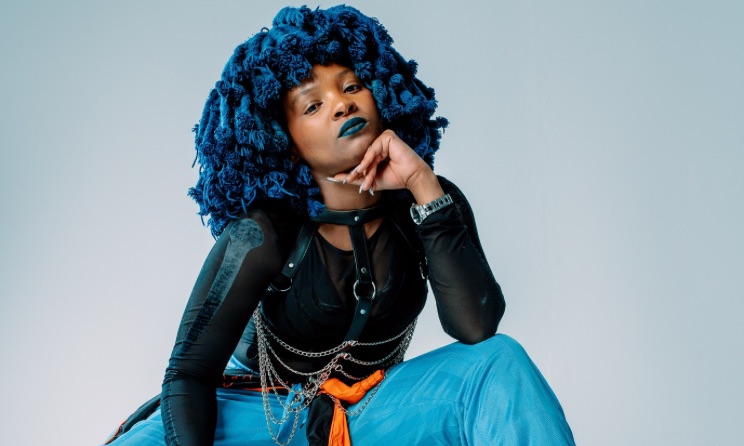
With somewhat revealing outfits in her music videos, at performances and on social media, the ‘Yebo Mama’ hitmaker demonstrates that it takes a strong woman to attain independence. Moonchild knows what people expect a successful woman to look like, but gives no quarter when expressing her views on female empowerment and sexuality. On her latest album Phases, Moonchild stands tall by breaking social norms and boundaries.
Music In Africa spoke to Moonchild, who is the pioneer of her self-coined genre “future ghetto punk”, about her 19-track album, her image, the objectification of women in music, and how her sound is perceived outside Africa.
MUSIC IN AFRICA: What message are you sending in Phases and what inspired the project’s title?
MOONCHILD SANELLY: This album basically celebrates every shade of women. For instance, if there’s a woman who feels mad and it evokes the feeling of them being a stalker, you will call them a stalker. But for women on their own, they will be like, ‘I know what that motherfucker made me feel like’, and actually on this record, it’s acceptable. It’s fine because we are different. We go through different phases as women in general, and therefore every part is actually okay. That’s why on the album I celebrate the side chick. I’ve got a song for a side chick to get her mac on a married man. I’ve got nothing to do with the marriage; I’m being realistic about what we are as women and our choices.
Strippers! I love strippers. I’ve got everything to do with strippers, and I love celebrating them. I love them getting what’s due to them because the girls are working and they’re actually so smart. They’re always working towards something but society deems it as nothing. I celebrate sadness, I celebrate happiness, I celebrate us in different shades. I always say this, ‘It’s already an adventure sport being a woman.’ This album does not celebrate women’s success based on societal expectations. My themes are the general liberation of women and having a voice all the time.
What differentiates your previous album Rabulapha! from Phases and what have you improved on musically?
The difference is, I was not this big and I’m now in a position where I’ve come full 360 commercially. My fans, from whenever they decided to be fans, are all included in this body of work. What I’ve always wanted to do is ultimately bring people to know exactly who I am. And this is the person who’s not necessarily just strategic, because I study markets; I move accordingly and that’s why I‘m always on radio stations around the world. The people who know me from Rabulapha! are the alternative kids – it’s the different kids, the black sheep, the ones who just want to do their own thing, the expressive ones, the individuals ... There are those who know I never stopped. I’ve always done things for my soul and my business. That’s my sole business. This album is everything I’ve ever worked towards. This is my sound.
You are currently touring Europe. What is the perception of your music in Europe compared to Africa?
In South Africa they asked me, what the fuck is this? In Europe, they eat me the fuck up. That’s why I started touring before I made it commercially in South Africa. I’ve been touring for five years overseas, before being commercially successful in South Africa as an alternative artist, because it’s so refreshing to see something new, and in South Africa it’s so scary to see something new. I don’t undermine that because you‘re literally performing for people who have always had freedom and you’re coming from a space that’s not always free. The people who are bringing up the people who look up to my music are those that had to carry a dompas [apartheid era internal passport used for segregation purposes]. That mental space is not necessarily free because it still comes from a very compressed point of view.
My mom never taught me how to cook. She said, ‘I will teach you to hustle so that you can hire people to wash dishes for you, because I know you don’t like dishes, and I won’t force you to because I am not bringing you up for marriage.’ And I'm exactly that girl. I’m still dealing with people who come from oppressed backgrounds. I don’t undermine it, that’s why I did the commercial mission. I simply wrote it down in 2016. I said, ‘From February to August, I’m going to have three hits in South Africa, I’m not going to change and they’re going to be commercial hits.’
What message are you aiming to send with your revealing outfits and what has the response to that been like?
Basically, I’m protesting with my body and not everyone has to get that. That’s why I also have music that stretches out the message, and everyone has to get that I’ve got the world to conquer. To people who are calling me a prostitute and things like that – I’m about to drop sex toys. So, for everyone who calls me a prostitute, they are going to affect my bank account. I will sell them a toy that means something to them because I study opinion, instead of being affected by opinions, especially when negative.
You speak about the liberation of women in the bedroom. Can you talk more about that?
I always say, for as long as you open your legs, you must open your mouth, otherwise it will forever be a busting hole and you will never know what the word orgasm means after having babies, because going back, the background we have, we have to tolerate shit to be a good wife. But what about you as a participant in a sexual activity? When you open your legs, you should also open your mouth for you to matter in that participation because you are not an accessory, you are a participant. That narrative needs to change, sex is not a service.
In most of today’s pop music videos, women can be seen as being objectified. Similarly, women speak and sing in seductive tones and dance in a sexually provocative manner. Despite your remarks about standing up for women to be independent, aren‘t you sending out the same message that you’re trying to counter?
Don’t you think it’s about time for men who watch those videos to say, ‘It’s about time women owned it for themselves?’ Don’t you think? Why does my existence perpetuate your narrative based on your pleasure? That’s on you. That’s why men are rapists, because we perpetuate what you already are animalistic about, which is our bodies. That’s not a question I can answer for men, you need to ask men about that. What am I doing owning my body when you think you own it? What am I doing owning my body when it’s mine and you bug it? What does it mean me owning my body and perpetuating what you decide to think of it? That’s on men, not on me.
Image and branding define artists, and some artists change their image as their careers progress. What are your thoughts about image?
I’ve been rejected looking like this and I’m successful looking like this, and it wasn’t the same without looking like this. You guys will have to bear with me because I’ve never operated under pressure. In fact, if I did, I wouldn’t look like this. I’m not pressured by what people expect or don’t expect. I do me in my time and I really don’t care because it really was not a marketing strategy. I’ve been rejected because it wasn’t a marketing strategy. In fact, it didn’t feel safe to have someone look like me and I’m winning. This is what I want to teach the young black child: to go rewrite their big dreams because success is not a uniform. There’s no expiry date for my dreams, and the world will just have to adjust to what I do when I do it – because I’m in the world with my narrative and not a part of the world’s narrative. I would not be here if I cared a lot. Instead, I study stuff, write about it and make money. I cash in feelings.


Most popular

Top Naija songs of 2026
31 Mar 2026
Ghana: Mr Eazi and MOLIY’s ‘Comfort’ earns Urban Music Awards nomination
21 Oct 2026

Top Afrobeats songs of 2026
19 Mar 2026

Top amapiano songs of 2026
16 Feb 2026
Open call: CANEX Music Business Lab and Songwriting Camp
15 Oct 2026
Nigeria: CANEX WKND unveils 2026 programme
21 Oct 2026
Disclaimer: Music In Africa provides a platform for musicians and contributors to embed music and videos solely for promotional purposes. If any track or video embedded on this platform violates any copyrights please inform us immediately and we will take it down. Please read our Terms of Use for more.

Subscribe to our monthly Newsletter
Follow us on social media


Please log in to post a comment.