






























































By Frederic Gore Bi
This text provides an overview of the media in Ivory Coast, particularly as it relates to the local music industry.
News organizations, whatever the form, have always accompanied the development of the music industry in Ivory Coast. Even at the height of the one-party system, the state media (the only ones that existed at the time) never ceased in providing support for music and promoting it through appropriate medium and forums. The ‘mediatization’ movement of 1990 further strengthened the contribution of the media in promoting musical art under the rule of Felix Houphouet-Boigny.
The RTI: Pioneer in the promotion of Ivorian music
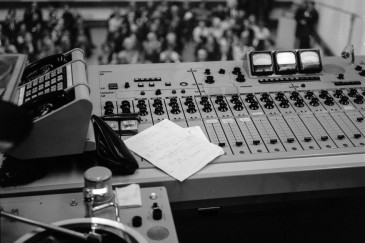
Ivory Coast, like most sub-Saharan African countries, has long lived under the burden of a single party and the state media, which were the only ones that counted. The Ivorian broadcasting corporation, Radio Television Ivoirienne (RTI)[i] that was part of this policy was the only Ivorian audiovisual media at the time. It therefore acted as a launching pad for Ivorian musicians. Through its various channels, the RTI enabled Ivorian artists and even those elsewhere to air their music. Programmes such as ‘Podium’, ‘Nandjelet’, ‘First Chance’, ‘First Lines’, ‘Passion Sunday’, ‘Holy Evening’, ‘Super Star Station’, ‘Jamboree’ and ‘Varietoscope’ (all musical entertainment programs) with regard to the television, and ‘Djamo Djamo’, ‘Travailler fini-fini’, ‘Masculin-Féminin’, allowed or saw the emergence of many celebrities and music stars in Ivory Coast.[ii]
‘Afrique Etoile’ (African Star)[iii], led by Macy Domingo and Yves Zogbo Junior[iv], has hosted the most famous musicians of the continent and beyond, allowing the Ivorian public to view its rising musical stars and also for the stars to expand their market value. This wave of artists from elsewhere on Ivorian podiums at the time was interpreted as a ‘colonization’ of Ivorian music by musicians from elsewhere.
In addition to the efforts of the RTI, one must also mention the print media that was present at that time. From 1960, date of its independence, to 1990, the year that saw the establishment of a multi-party system, Ivory Coast had two dailies, Fraternité Matin and Ivoire Soir, and two magazines, Fraternité Hebdo, the official newspaper of the Democratic Party of Ivory Coast (PDCI) and Ivoire Dimanche, a weekly arts and culture magazine). These journals contributedin their own way to the operation and evolution of the Ivorian music.
The tradi-modern artist Germain Bi Gokon[v], better known by the pseudonym Kayeli (one of hit titles being imposed on the 1977 edition of the famous show of the now deceased animator Edmond Roger Fulgence Kassy) talks about this time: “Before, there were no other media than the public one. When we produceda work, we had to come on the radio or TV to promote it. I must admit that those responsible for these state mediums really helped us in our task.”
On the question of how to describe this help, Bi Gokon answered bluntly: “The facilitators of RTI were people who knew music and their advice was good advice”, adding that “a man like RFK (Roger Fulgence Kassy[vi]) knew how to play musical instruments. And when he said your album is good, you’d be sure it was not a flattery. The audience greeted it favorably. And when he said the opposite, you either go home and improve your product, or persist and witness the flop of your sound pancake.”
The late Diegou Bailly, a talented writer, participated actively in grooming new talent. Many still remember the story that appeared in Ivoire Dimanche, issue 710 of 16 September 1984. This illustrious journalist wrote on the Smurf-Break-Dance, a new type of dance that came from the USA and its spread in Ivory Coast. Yves Junior Zogbo, who later became a star, was the catalyst for this American rhythm that was not well known by some Ivorians. His high-quality paper helped dissipate doubts on the apprehensions many held with respect to this dance music that came from the USA.
Political and media pluralism
In 1990, the wind from the east resulting from the ‘La Baule’ speech by François Mitterrand, former president of France, changed the political situation in many African countries. Some monarchical systems, called one-party democratic system by euphemism, which prevailed forcefully since independence, began to falter under opposition. Ivory Coast did not escape this reality, and this change resulted in the opening up of the media that was previously state controlled. Thus in 1990 the return to multi-party pluralism brought free expression. Some 187 titles appeared on the market, regularly or occasionally, and the audiovisual sector recorded the arrival of new channels of commercial radio stations such as Radio Jam, which got its license in March 1993 and hit the airwaves in 2000, and Radio Nostalgie, a subsidiary of Nostalgia International and set up in Abidjan since the early 1990s.
The Ivorian media landscape became enriched by numerous FM. Eight categories emerged: non-commercial private radio or local radio (over 100 stations); rural radio; religious stations; private commercial radio; school radio; foreign radio stations; institutional radio; and state radio.
Private satellite television and platforms like Canal+ Horizon (with more than 40 000 local home subscribers) flooded the Ivorian market. This gave even more opportunities for Ivorian artists to promote their musical works. Parker Sacko, rapper and presenter on Cocody FM 98.5, a local radio station based in Abidjan and its suburbs, shared this idea: “Before, our elders were forced to go through the channels of state media to promote their works. This left the artist at the mercy of those responsible for the press. But now with the partial opening of the audiovisual space, young artists are given a range of choices for media promotion of their albums,” says he who calls himself the best of his generation.
Online media
With the rise of the internet in Ivory Coast, many websites have cropped up. The most popular is Abidjan.net[vii], which features Ivorian and international news through articles and caricatures from various local newspapers (economy, sport, culture, politics, briefs).
However, there are other great websites from Ivorians specialized in culture and show business, like Abidjanshow.com[viii].The first portal dedicated to Ivorian showbiz, it contains video clips, music and celebrity information. UrbanPress.ci[ix], one of the most visited sites in the field of show business, has a similar function.
To this list of websites that promote Ivorian music, one can add the websites of musicians or bands like Magic System’s Salif Traoré (A’Salfo)[x]. Such sites allow artists to provide news and information about their careers, and keep in touch with their fans and promoters, despite the distance that often separates them.
Social networks have emerged as an alternative media platform. Accessible to all, their ease of use and ownership by a very large number of people make them powerful distribution channels. Facebook, Twitter, YouTube, Google+ and others are now used by many artists who are promoting their albums. A video on Youtube or Facebook can have a far larger audience than a clip screen on a local television channel. For example, an artist like DJ Arafat has built part of his fame through Facebook, where he regularly posts the videos of his new dances or musical concepts. This social network is used by over 1,5 million Ivorians, so these videos boast a phenomenal success.
The Facebook pages and Twitter accounts of artists are a powerful means of communication and promotion of their musical works. Another good example is Magic System. With well over a million ‘likes’ on their Facebook page, this musical ensemble can pass regular messages to their fans, with whom they interact all the time – an easy and effective way of keeping their fans updated. With Web 2.0, the promotion of musical works becomes even easier and cheaper - a road that Ivorian artists walk flawlessly.
The fields of music and the media are source of substantial revenues that generate nearly 1250 jobs in Ivory Coast, with annual minimum benefits of 1.6 billion CFA francs (nearly US$3million) per year. This had made some observers say that the press is to music what the nectar to the bees: in other words, vital for its development and promotion. And even though the Ivorian music industry has for some time been facing rampant piracy on a large scale that takes a heavy toll, it remains a dynamic sector thanks to the contribution of the media in all its diversity.


Most popular

Top Naija songs of 2026
31 Mar 2026

Ghana: Mr Eazi and MOLIY’s ‘Comfort’ earns Urban Music Awards nomination
21 Oct 2026

Top Afrobeats songs of 2026
19 Mar 2026

Top amapiano songs of 2026
16 Feb 2026

Open call: CANEX Music Business Lab and Songwriting Camp
15 Oct 2026

Nigeria: CANEX WKND unveils 2026 programme
21 Oct 2026
Disclaimer: Music In Africa provides a platform for musicians and contributors to embed music and videos solely for promotional purposes. If any track or video embedded on this platform violates any copyrights please inform us immediately and we will take it down. Please read our Terms of Use for more.

Subscribe to our monthly Newsletter
Follow us on social media


Please log in to post a comment.