













































By Anjara Rasoanaivo
The rapid development of the media in the past 25 years has changed the musical landscape of Madagascar. Be it for the promotion of culture or for sheer hype, the media has played an important role in this transformation process. This text provides an overview of the media in Madagascar, particularly as it relates to the local music industry.
Radio
One only has to take some time out for observation, tune in to the radio and stop briefly at each station: local radio stations give significant airtime to Madagascan music. While there is no general policy imposed by law on playlists and on the maximum number of songs by Madagascan artists to be usedin broadcasting, it is clear that radio managers lend support to localartists.
Malagasy National Radio (Radio Nationale Malagasy - RNM)[i] is the national station, strictly controlled by the state. It offers programmes that give priority to local and traditional music. Ratovondrahona Harrison, Director of the RMN, explains: “Our policy is mainly to highlight typical Madagascan songs. We must recognize that there are unknown talentsout there that can sell well internationally. For every five songs that RNM broadcasts, three are Madagascan.”This is a good ratio that supports local arts.
Since the late 1980s, the emergence of private radio stations has enableda greater variety of musical styles to be broadcast. Forprivate radio stations, airtime quotasarenot strictly respected, but the will to showcase local work is very strong. For Radio Des Jeunes(RDJ)[ii] (or Youth Radio) broadcast on FM 96.6MHz and covering the capital, Antananarivo, and the city of Antsirabe (162km south of Antananarivo), and highly appreciated by young people, the guiding principle rests on the identity that the radio stations imposes. “We receive and explore the songs from record companies, producers, artist managers or singers. Then we audition and choose songs that we broadcast on radio. The frequency of play depends on the enthusiasm of the audience for a given song,”explains TahianaRasolojaona, founder and director of the RDJ, a private radio station, also available on the web. To help promote Madagascan music, RDJ and other radio stations air specific cultural and music programmes. For RDJ, creating the RDJ Mozika Award has enabled artists to establish their careers.
Television
In Madagascar the radio is the most effective media because it reaches a greater number of people. After radio comes television. Through the national TV channel, Televiziona Malagasy (TVM)[iii] and nearly a dozen private TV channels, music has acquired another avenue to express itself. TVM has allowed many Madagascan artists to promote themselves and to gain fans. Take the example of Silo[iv], a well-talented artist and multi-instrumentalist, known both at home and abroad, who confirms: “I made my first appearance at TV at the age of seven, and that influencedmy career a great deal.”
The show Mbarakaly, broadcast on the TVM in the 1980s, was a purely cultural programme that launched great names of Madagascan music (such as Jaojoby and Régis Gizavo) and even became a cultural reference. The same goes for the cultural programmeTselatra, which broughtinto the spotlight several Madagascan musicians and singers. Unfortunately, these cultural programmes have not withstood thefinancial difficulties facing the artistic universe of Madagascar. Since then, other TV channels have createdprogrammes designed to promote and discover new Madagascan stars. Such is the case with Pazzapa, modeled after the concept of American Idol, now broadcasting on Dreamin TV[v], a private television channel created in 2012 that served as a springboard for new popular artists such as Firmin and Melky.
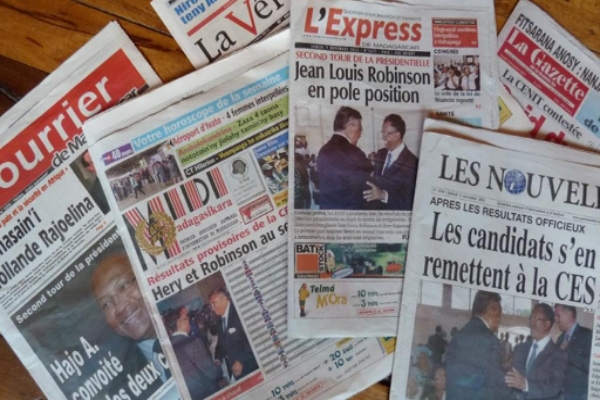
Through TV and radio, Madagascan artists promote their music. In addition to these, the mainstream press also promotes the music of Madagascar. For example, the newspaper Midi Madagasikara[vi]devotes two pages daily to art and culture, and reviewsthe musical creationsof artists through artist interviews and news of the latest releasesand upcomingshows. The same goes for the dailies Les Nouvelles[vii] and L’Expressde Madagascar[viii], which devote full pages every dayto art and culture, prioritizing music.
For now, no newspaper or magazine in Madagascar is entirely devoted to music. Nevertheless, many cultural journalists try to promote Madagascan music through their columns. In the 1990s, two passionate rock journalists created a columndedicated to rock, ‘RubRock’, in the newspaper Midi Madagasikara,as well as ‘RockNews’ from 1996 to 2001 in the newspaper L’Express de Madagascar. Theseaimedto promote the rock scene in the country through interviews, reports and media coverage of the rock stars of the time.
Online
With the growth of internet - and given that a significant proportion of the Madagascan population is connected and active on digital media -musicians have adopted new technologyto reach their fans. Some web communities have created channels on YouTube (such as Masombahiny, Vazo, Tsara and Radioparadisagasy) that upload the music videos of Madagascan artists, allowing tens of thousands of subscribers to access them and enabling Madagascan music to travel beyond the country’s borders. Moreover, artists use other platforms like Soundcloud and Reverbnation, as well as social networks like Facebook, to promote themselves. For example,Voots Kongregation gathers several talented musicians to explore and combine various music styles, and use Facebook topromote their music online[ix].
If the media helpsin promoting music in Madagascar, it is also a double-edged sword. Today, talent is not enough. The problems that have been plaguing the Madagascan media over the past decade have handicapped the promotion of music in Madagascar. Broadcastinga music video on TV is not free and costs 15 000 Ar (roughly €5 Euros) per play per TV channel. The same goes for radio, though at a lower price of 5000 Ar (just under €2) per play per radio station. Because of this, promoting an artist’s music can cost more than €1000. As a consequence, artists invest a lot in the ‘hype’,sometimes to the point of sacrificing quality.
• Ratovondrahona Harrison, Director of Radio Nationale Malagasy (RNM)
• Silo Andrian, artist
• Tsiry Andria, CEO of SarysyFeo.mg


Most popular

Top Naija songs of 2026
31 Mar 2026

Top Afrobeats songs of 2026
19 Mar 2026
Ghana: Mr Eazi and MOLIY’s ‘Comfort’ earns Urban Music Awards nomination
21 Oct 2026

Top amapiano songs of 2026
16 Feb 2026
Open call: CANEX Music Business Lab and Songwriting Camp
15 Oct 2026
Nigeria: CANEX WKND unveils 2026 programme
21 Oct 2026
Disclaimer: Music In Africa provides a platform for musicians and contributors to embed music and videos solely for promotional purposes. If any track or video embedded on this platform violates any copyrights please inform us immediately and we will take it down. Please read our Terms of Use for more.

Subscribe to our monthly Newsletter
Follow us on social media


Please log in to post a comment.