






























































Music videos stand as one of the most prominent forms of entertainment in Eritrean contemporary arts. Their prominence has sharply increased during the last decade with the rise in digital sharing and streaming of media, which has led to the decentralization of entertainment and less reliance on state television. The text provides an overview of the development and current dynamics of Eritrean music video production and consumption.
Early music video production
Though the 1960s heralded a new dawn for modern Eritrean music, music videos were hardly produced while Eritrea was still under Ethiopian rule. The legendary Tekle Tesfazghi’s ‘Fikrey Telemeni’ with the Roha Band, televised on state TV, was one of the earliest productions.
At the dawn of independence, the cultural bureau of the revolutionary movement filmed various live concerts, as well as making some music videos with battlefield visuals. After attaining independence in 1991, the newly established state broadcaster premiered concert videos of the revolutionary movement’s several bands. These shows, simultaneously distributed on VHS cassettes, were effective in helping to construct an Eritrean national identity and consciousness, as they introduced the various cultures, dances and costumes of Eritrea's diverse ethnic groups.
The revolutionary movement and its ideals were reintroduced to the public in the media through a series of cultural shows. For those too young to understand the revolutionaries and their 30-year-war for independence, the TV shows made a difference. One of the most popular songs was 'Tegadalay' (fighter) by Tekle Adhanom (aka Hiwkot), an exiled avant-garde singer. It eulogized the freedom fighters and was regularly aired along with other music videos of stage performances filmed in liberated areas.
In the early 1990s, Eri-TV[i], which was on the air for a limited number of hours per week, featured a few music videos made with simple static takes in state palaces and parks. These were mainly euphoric songs about the utopic destination that the nation aspired to become.
The need for producing more music videos became increasingly obvious, exposing the lack of private music video production companies, largely because there were limited resources at the single television station. Canadian media theorist Marshall McLuhan's notion of technological determinism was clearly evident in Eritrea, as the rise of VCR players in households in the 1990s led the way for a new paradigm of alternative entertainment packaging. This new market led to video cassette productions of music video compilations as well as local comedies, each typically around two hours in length, a stage that marked the earliest non-televised commercial music video production in Eritrea.
In time, new media houses emerged to fill the void. These included EVS, which was established by professionals who returned from exile in the 1990s. AVIE, the audiovisual unit of the government's Cultural Affairs Bureau, was another production house that produced Eritrean music videos, many of which are still broadcast on national television over 20 years later.
Modern music video production
During the late 1990s until the early 2000s, there was a hold on new music video development in Eritrea when the country was engaged in what is considered one of Africa’s biggest wars. From around 2005 onwards, music video production in Eritrea slowly got back onto its feet. The rise of low-budget independent filmmakers in Eritrea came about as a result of the relative affordability of digital cameras and editing tools, which in many cases simply meant a decent computer. Most of the music videos produced during this period reflected a nationalist rhetoric for mass mobilization in support of the war.
Eritrean singers, whose main source of income is from live performances in nightclubs and at weddings, made music videos with the primary goal of getting airplay on state TV. Having a music video aired once in a while became a big deal for Eritrean musicians, and a reason to congratulate artists and video producers for having 'made it' onto the air, often after a long wait.
The digitization of video content and the subsequent proliferation of online platforms such as YouTube initially posed a threat to existing productions, although local film sales arguably suffered more than music videos, which are typically produced for promotional purposes rather than to generate income. In fact, many Eritrean artists would want their clips to be uploaded and shared widely. This ‘viralization’ of video clips takes a different form inside Eritrea, where due to slow internet speeds and streaming difficulties, internet cafes function as media hotspots where new and old musical releases are compiled for entertainment. Today, with the proliferation of low-cost mass storage devices and improved compression techniques, users now leave internet cafes with tens of hours of entertainment content, the most popular of which are Tigrinya and Amharic (from Ethiopia) music videos and films.
Today music videos are crucial for the success of singles and albums. The demand for Eritrean music videos is high among Eritrean audiences dispersed throughout the world, as well as the population inside the country.
Since 2010, artists and producers who suffered from dwindling revenues due to unprecedented piracy on YouTube have ultimately given in to uploading their work onto YouTube in the aim of reaching a broader audience and getting some advertising revenue. This has led to the phasing out of many distributors, who used to sell home-produced DVDs. The function of distribution is now being overtaken by popular online platforms like LYE.tv and Halenga, which stream local and regional content for a commission that is shared with the artists.
Recent improvements in the production quality of Eritrean music videos cannot go unnoticed. In 2011, the National Festival Expo of Arts recognized this aspect by awarding music videos for best directing, video and editing [ii]. Recognizing the significance of music videos in contemporary Eritrean art, awards were given to Siye Video Production, Amir Graphics and Yonan Video Production[iii].
Another recent development in the Eritrean music video landscape is the emergence of Tewahdo (orthodox) gospel music videos. This genre, which originated mainly in Ethiopia, is still quite new because Tewahdo gospel songs were in the past exclusively sang in the liturgical language, Geez, and seldom left the confines of the church. Today, however, Tewahdo gospel is growing in size, with the rise in demand coming from audiences both within the country and outside it.
Notable Eritrean music video directors and producers inside the country include Daniel Abraham, Merhawi Meles, Tesfit Amanuel, Eriwood Entertainment[iv], Halenga Records[v] and Yonas Solomun. Eritrean filmmakers residing in Europe, such as Awet Seyoum, Essey Tesfagabir and Solomun Tsehaye, are also producing music videos, mainly for Eritrean artists who have migrated to Europe.
Challenges
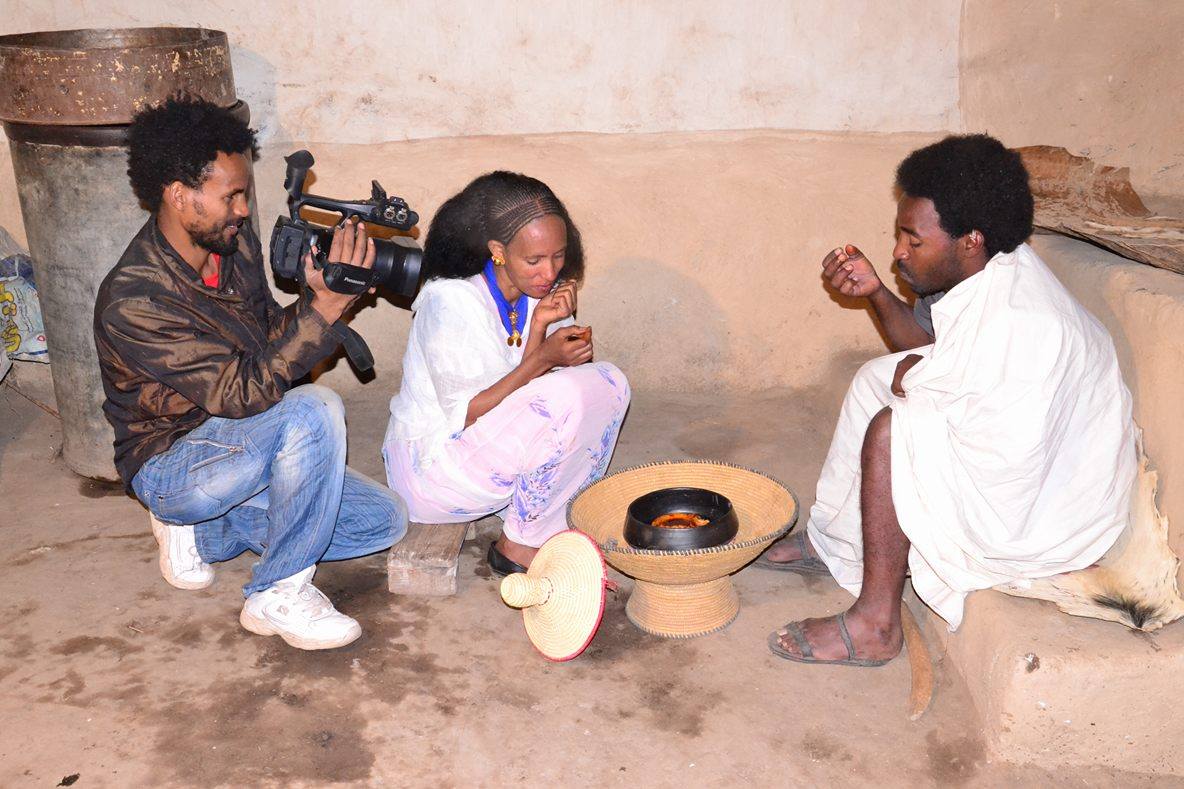
Eritrean music videos are typically produced on a very low budget (around only $400) with semi-professional equipment at best. The typical music video production cycle in Eritrea begins with acquiring a permit from the Censorship Office of the Ministry of Information. Artists then pick out directors (who are often the lyricists of the songs themselves) to direct the ‘clip’, as well as a cameraman, an editor and dancers.
In the Eritrean paradigm, a director’s job is primarily logistical: seeking permission from homes, hotels, bars or clubs for shooting and managing the production budget.
There is another important task that an artist along with their director and cameraman must achieve: finding the right girl. Finding attractive models for music videos often determines whether a video is a success or a failure, as Eritrean viewers usually have high expectations of beauty that if not met will inevitably form a bigger part of the conversation around the video, as is evident in the public comments on YouTube.
While music video production in Eritrea is generally low-budget, the scene has grown to a point where having a good music video is essential to either make or break a song.
A key challenge for Eritrean music videos is the relatively small size of the potential audience, which is limited to speakers of the local language in Eritrea and sometimes in Ethiopia and the diaspora. With these small audiences, coupled with Eritreans' limited access to the internet, local music videos cannot attain millions of views.


Most popular

Top Naija songs of 2026
31 Mar 2026

Top Afrobeats songs of 2026
19 Mar 2026

Ghana: Mr Eazi and MOLIY’s ‘Comfort’ earns Urban Music Awards nomination
21 Oct 2026

Top amapiano songs of 2026
16 Feb 2026

Open call: CANEX Music Business Lab and Songwriting Camp
15 Oct 2026

Nigeria: CANEX WKND unveils 2026 programme
21 Oct 2026
Disclaimer: Music In Africa provides a platform for musicians and contributors to embed music and videos solely for promotional purposes. If any track or video embedded on this platform violates any copyrights please inform us immediately and we will take it down. Please read our Terms of Use for more.

Subscribe to our monthly Newsletter
Follow us on social media


Please log in to post a comment.