




























































Nina Ogot on forging her identity and the role of music in society
23 Sep 2022 - 11:40


Poised is the word you want to employ when describing Nina Ogot’s stage bearing. Perhaps the reason the Kenyan songstress eschews over-the-top displays and the fiery militancy of some of her contemporaries is that she has a more powerful tool at her disposal; a special gift she can deploy the instant she steps on stage.
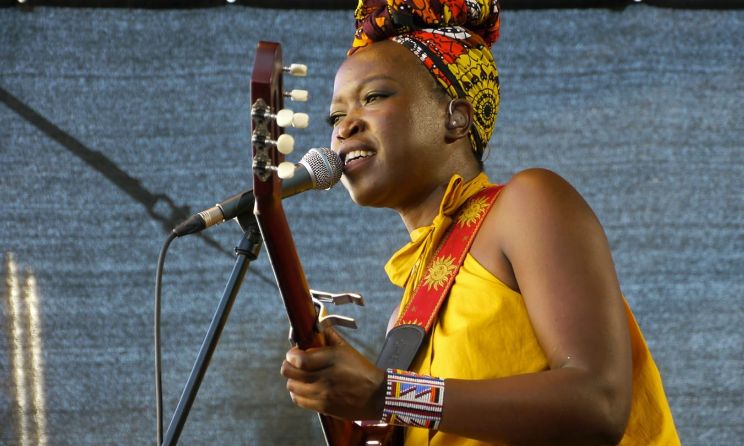
For many, it is the voice that soars effortlessly over auditoriums, gently caressing both body and soul. It could also be the lively arrangement, the delicate blend of strings and percussion, or the quiet activism of her work – all a product of solid musicianship built in a career spanning over a decade and distilled into three masterfully crafted albums.
Give her music a listen and you will soon discover an artist in control. There is a deliberate attempt to create a sound that is truly representative of her traditional Kenyan roots and urban upbringing. An attempt, if you will, to bottle and preserve the cultural essence that is in danger of being lost.
Whether she was thrust into it by accident or design, Nina Ogot finds herself occupying the position of the high priestess of the Kenyan Afro-acoustic movement – entertaining, educating and even chastising the faithful around the world.
So it is not surprising that the age-old debate on the indivisibility of the artist and society came up in a recent one-one the celebrated singer had with Music In Africa.
MUSIC IN AFRICA: Describe your musical journey
NINA OGOT: I would say my musical journey has been as true as it can be. This is because when I was a child, I already knew that I wanted to make music. So I started with piano lessons at the age of 11 and then shortly after that, at the age of 16, I started to get more curious about the guitar and it became my instrument of choice in my mid-20s, when I chose to take music as a profession. My band started as a trio – two guitarists and a percussionist – but now it's grown into an eight-piece band.
Who is Nino Ogot the artist and Nina Ogot the individual?
Nina Ogot the artist and Nina Ogot the individual are exactly the same person. I try to ensure that my art reflects my essence 100% and that the people who come to watch me on stage get to know me to some degree. They will know me on a platform that is not necessarily part of my everyday life but my stories are about my everyday life. I try to present that as honestly as I can so that the audience gets the true version of me on stage.
How would you describe your music?
My style is certainly a fusion of elements of tradition and urban sounds from Kenya. Initially, it was called Afro-acoustic and the title stuck. I like modern instrumentation and modern ways of singing injected with components of my urban upbringing in Nairobi and my tradition. So I use a lot of my native Dholuo language in my lyrics. I also use Kiswahili and references from other parts of Kenya.
What do you hope to achieve through music?
If you're a priest, you use your pulpit to indoctrinate people in a certain way, and when you're a musician, you have the stage. This stage enables me to connect with people that I would ordinarily never interact with – people of different backgrounds, origins or even generations. So my music is a bridge. It's a generational bridge. It's a cultural bridge, and yes, it's a bridge of emotions and of universes.
What is the current state of Kenyan music?
Kenyan music has certainly grown over time. If you compare the trajectory it's taken over the past 20 or 30 years, you can see some significant progress. You can also see the role that women are playing in the industry and the fact that they are now acknowledged as peers to their male counterparts. Additionally, artists are able to earn money from their craft.
I would, however, say Kenyan music still has a long way to go because if you look at how we're represented internationally, we are not really there yet. The systems are also still largely flawed if you consider issues like royalties collections and privacy threats.
What would you consider to be your biggest accomplishment?
I think it is hard to tell because there are so many things that we take for granted yet there are big accomplishments. There are so many challenges we face as artists that make it difficult to sustain a career in the first place. So, to be able to have a career that spans at least 13 years and to still feel hopeful about the future is a great accomplishment to me.
Who do you look up to musically?
That's a tricky one because I've had a lot of influences that are not necessarily Kenyan. And what I realised is that I have to be me to find my own way in order to be a participant and a contributor to the music scene.
I have to be unique and I have to stand up for something that's authentic. The only way I’ve found to be able to forge my own identity is to sometimes silence other people's voices and listen to my own voice. Listen to the music that comes from me so that then I can see Nina Ogot. Not Nina trying to be Miriam Makeba.
So I look at other musicians just as samples, however great or small they are. The contribution is still significant if it's inspirational. And so I've had a lot of musicians who've not only inspired me but have also given me the desire to be authentically me.
What are some of the challenges facing a Kenyan female artist?
When you look at a lot of platforms you see very few female artists who are playing an instrument or contributing beyond the vocals. It is because people always believe that a man who plays an instrument plays it better than a woman. I've been lucky enough that I sing and play instruments, but I know a lot of women who struggle being just instrumentalists. There is also the issue of family. If you want to start a family as a female artist, how do you structure a career around children and a husband and still have a solid career that doesn't get interrupted?
Do you consider yourself an activist and what is the role of activism in Kenya music?
I certainly consider myself an activist, just not a political activist. Maybe a social activist because I use my music to instigate change to some degree. It's true that I do have audiences that don't always understand my lyrics but the intention is that for those who eventually get to be curious enough to want to know, I use my songs to tell stories about society and to reflect the condition of the society. This allows people to really reflect if it's something we want to change. That is activism.
How can Kenya grow its creative industry?
I think first it’s important to establish what a creative industry is. Does it exist? Absolutely yes! So how do we harness this creativity? That is the question because we have a lot of talent out there but not much is being done to harness it. We first need to develop hubs where artists can go – places where creative talent can be identified, developed and showcased. We also need mentorship programmes to show young people what to do and how to manage their artistic careers. Then we need systems that manage talent ethically and professionally to enable artists to benefit economically from their work – not the flawed and corrupt ones currently in place.


Most popular

Top Naija songs of 2026
31 Mar 2026

Top Afrobeats songs of 2026
19 Mar 2026

Ghana: Mr Eazi and MOLIY’s ‘Comfort’ earns Urban Music Awards nomination
21 Oct 2026

Top amapiano songs of 2026
16 Feb 2026

Open call: CANEX Music Business Lab and Songwriting Camp
15 Oct 2026

Nigeria: CANEX WKND unveils 2026 programme
21 Oct 2026
Disclaimer: Music In Africa provides a platform for musicians and contributors to embed music and videos solely for promotional purposes. If any track or video embedded on this platform violates any copyrights please inform us immediately and we will take it down. Please read our Terms of Use for more.

Subscribe to our monthly Newsletter
Follow us on social media


Please log in to post a comment.