




























































Preservation of music heritage in South Sudan

28 Aug 2017 - 13:32


South Sudan is one of the most culturally rich countries in the world, but this is not widely known. It has culturally diverse traditions, with various cultural practices of ceremonies, poetry, drama, music, dance and art, all due to over 64 indigenous languages spoken in the country. Before South Sudan declared independence from Sudan in 2011, the Southerners who were treated as minority group along ethnic and religious lines, accused the then Sudanese government of denying them the political power and economic support.
Preservation of culture after independence
Over a year after independence, the then undersecretary of culture Jok Madut Jok was tasked with uniting one of the world’s most diverse populations, then estimated at 10.5m people living in one of the world’s least developed countries after decades of war.
In September, 2012, a three day workshop was held in Juba led by Ministry of Culture – in partnership with The United Nations Educational, Scientific, and Cultural Organisation (UNESCO) and the African World Heritage Fund – aimed at building their capacity to preserve the rich cultural heritage and also historic and natural sites.
The Institute of African and Asian Studies (IAAS) of the University of Khartoum then finalized a project aimed at assessing the need to safeguard the important collection of audio visual materials of traditional Sudanese Music housed in the Folklore and Traditional Music Archives of the University of Khartoum. Through a financial assistance of US$12,167 by the Intangible Cultural Heritage Fund, an action plan for the management and preservation of the Archives was set up.
In South Sudan, a museum and theater were also proposed, and the Ministry of Culture set aside a plot of land for the complex in Juba. Thousands of historic documents that had been rotting in basements across Juba were moved into a large tent. To fill the museum, UNESCO teams went from village to village, collecting musical instruments, weapons, and beaded jewelry. Then, in each region, they would have a festival and invite neighboring tribes to learn about one another. The project was a success, according to the then UNESCO culture specialist Ellen Lekka.
In addition to the national archives, UNESCO did a project called Travelling Exhibition between 2013-2014 during which communities in three states (Eastern Equatorial, Western Bar El Ghazal, Western Equatorial) were visited and music recordings in addition to collection of objects, folktales, traditional craft techniques, dances, among others were collected.
State of digital and physical archives
According to the UNESCO project, Folklore and Traditional Music Archives constituted a valuable collection containing more than 3,000 audio recordings and photographs of traditional Sudanese music collected since 1963 as a result of different research initiatives on folklore and oral traditions from diverse Sudanese communities.
In 2013, Sudan Radio and TV, had archives of radio tapes, video tapes of TV programmes, and documentary film. Sudan Radio had archive of 160,000 hours of radio tapes. These were being cleaned, conserved and digitized with over 26,000 - 27,000 hours been converted. Sudan TV had 60,000 TV tapes in a range of formats, none yet converted. Also on the same campus as Sudan Radio and TV was a cinema archive of 7,000 documentary films of huge importance for Sudanese history and culture since independence. These were in a very poor state.
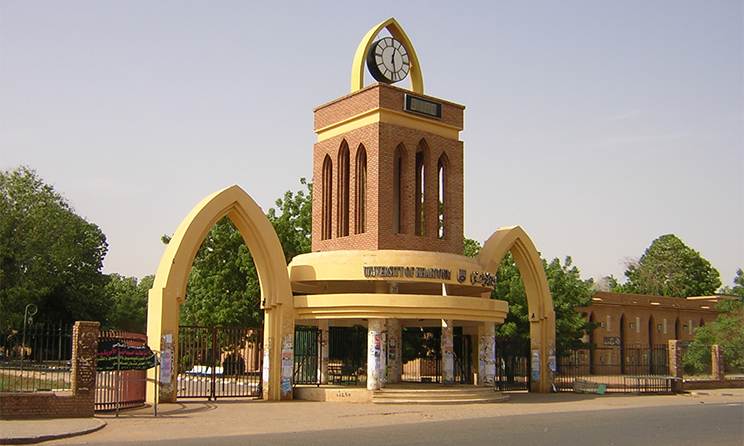
Inaugurated in 1902, Khartoum University holds materials on music, folklore from different parts of Sudan and also has a digital library.
An uncertain future
In December 2013, a power struggle erupted between President Salva Kiir, of the dominant Dinka tribe, and Vice President Riek Machar, from the smaller Nuer. The following day, soldiers moved across the capital executing civilians. The ensuing new civil war from that personal clash pitted the Dinka against Nuer and all South Sudanese.
No ground had been broken on the historic cultural complex, so artifacts collected for the museum were sent to the Nile River Museum in Egypt for safekeeping and other documents were moved into a rented house. After a promising ceasefire in 2015, South Sudan began picking up the pieces of unfinished cultural projects.
But in July 2016, on the eve of the country’s fifth birthday, the president and the vice president, backed by their loyal troops, resumed their power struggle.
For weeks soldiers in Juba killed and raped with impunity, targeting minority tribes, foreign aid workers, and local journalists. Salah Khaled, the country director for UNESCO was shot multiple times and eventually left the country. By July 9, nearly 200,000 people had followed suit.
As the world celebrated World Refugees Day on 20 June 2016, it was reported more than three million people, or a third of the population of South Sudan have fled their homes, creating Africa's biggest refugee crisis since the Rwandan genocide.
According to the Anna Rowett, the serving head of Culture Programme, UNESCO Juba, there are currently no music archives. Some music instruments were collected by Ellen Lekka under the Travelling Exhibition programme. Some of these are now on display in Egypt, but there is nothing notable collected by UNESCO in Juba.
Challenges and formulation of policy
There is lack of funds from within the government budget and donors are focused on humanitarian needs than responding to needs for culture. According to the initial UNESCO project, cultural challenges include the urgent need for capacity-building to create an improved mechanism for data acquisition, digitization, storage and retrieval, as well as implementing adapted measures to ensure the security and safety of the archives.
Also, war, famine, displacement and the ravages of time, climate and lack of funds means that the cultural heritage of the country is under severe threat.
However, there is a growing interest in culture heritage preservation despite the numerous challenges. A culture policy is being developed and the ministry of culture has a consultant working on it with UNESCO advising its development.
References
- http://news.nationalgeographic.com/2016/11/south-sudan-archives/
- https://www.voanews.com/a/south-sudan-preserves-historical-cultural-sites/1502389.html
- https://ich.unesco.org/en/news/digitization-of-sudan-folklore-and-traditional-music-archives-00046
- http://simon-tanner.blogspot.ug/2013/07/digital-sudan-cultural-heritage-revived.html
- http://www.dailymail.co.uk/wires/ap/article-3680358/Official-5-soldiers-killed-shooting-S-Sudan-capital.html
- http://www.ibtimes.co.uk/world-refugee-day-2017-crisis-south-sudan-worlds-fastest-growing-refugee-emergency-162694
- http://www.reuters.com/article/us-southsudan-history-idUSBRE84N0OC20120524


Most popular

Ghana: Mr Eazi and MOLIY’s ‘Comfort’ earns Urban Music Awards nomination
21 Oct 2026

Top Naija songs of 2026
31 Mar 2026

Top Afrobeats songs of 2026
19 Mar 2026

Top amapiano songs of 2026
16 Feb 2026

Open call: CANEX Music Business Lab and Songwriting Camp
15 Oct 2026

Nigeria: CANEX WKND unveils 2026 programme
21 Oct 2026
Disclaimer: Music In Africa provides a platform for musicians and contributors to embed music and videos solely for promotional purposes. If any track or video embedded on this platform violates any copyrights please inform us immediately and we will take it down. Please read our Terms of Use for more.

Subscribe to our monthly Newsletter
Follow us on social media


Please log in to post a comment.