





















































By James Propa
Recording a song in Uganda today is so simple that you can move out of your house in the morning and by evening you will have a “bounced” song on a compact disc for less than $100. This was not the case some 10 or 30 years back.
Between 1940 and 1970, musicians in Kampala had to go to Nairobi, Kenya to get their songs recorded. At that time there was no recording equipment in Uganda. Talented musicians in the country had to learn skills like playing the solo guitar from their Congolese counterparts. During these times also songs were recorded live, with the artist playing the guitar and singing at the same time.
Production in Uganda has traditionally been in line with the Congolese style, mainly seen in the guitar playing on the majority of Ugandan songs. Of late, the industry has moved towards the Nigerian style of music, primarily because Ugandan musicians want to break into the lucrative Nigerian market. Some musicians have gone further to do collaborations with Nigerian musicians. One might say that the Nigerian style is currently dominating the local industry.
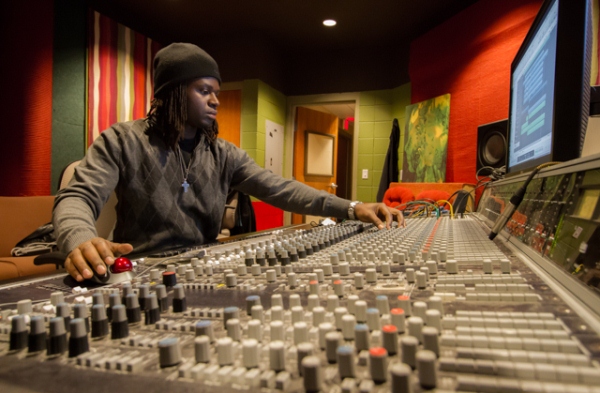
Today there is an audio production studio in almost every town in Uganda, but not all of them have what is required to produce a song that can compete on the market. Some of them have poor equipment and soundcards, making the quality of their produced work relatively poor. The producer and the musician have to be creative to know when and where to bring in external instruments such as a solo guitar or African percussion so that the song can be harmonious to the ears.
In the past the government has banned songs that are seen to be inciting violence or openly against the government. Songs from artists like Ronald Mayinja have been banned because of their political message, though this is less common. Actually Ugandan politicians enjoy music and usually have musicians at their parties.
This overview text of the Ugandan recording industry aims to point out some of the biggest production houses in the country, as well as video producers and record labels.
Audio production
Let us look at some of the audio recording studios in Uganda that operate in the music production industry. The producers can be said to be injecting new creativity to the industry.
Audio 1 Records is owned by senior producer Paddy Kayiwa and mainly focuses on Afrobeat, zouk, band music and RnB. The studio is located in Makindye. Paddy Kayiwa is one of the first Ugandan producers in the new era of Ugandan Music.[i]
Power Records studio also located in Makindye, is owned by producer Rinex and has resident producers such as Roonie, Rinex and Wani. This studio is known for dancehall, luga flow and Afrobeat. It is seen as the go to place by established musicians who seek to produce a club banger.[ii]
Buddies Audio Studio is found in Ntinda, Kampala and is owned by senior TV host J Kazoora. The studio houses producers Andy and Dreign. The studio is known for its creativity in the production of hip-hop or RnB. Some of their productions are competitive in the media and nightclubs.[iii]
Located in Mengo, Lubaga, Jeeb Records can be referred to as the home of zouk music. Its proprietor and producer, Crouch, has a magic touch when it comes to zouk. The studio is also good with RnB and band music.[iv]
Monster Studios is owned by musician Roni Banton. This Najjanankumbi-based studio will give you the best of dancehall and Afrobeat. The producers here include Nash Wonders and Shiddy Beats. Monster Studios’ productions were on several radio charts in 2014.[v]
Calling the Song Factory the home of band music and kadongo kamu would not be wrong. This studio is owned by producer Doctor T and is located in Mengo, Lubaga. This studio works primarily with band and kadongo kamu musicians.[vi]
The Ugandan government supports the music industry and has been able to come up with a first-class recording studio to help young people get their music recorded. UNCC Records is located at the Uganda National Cultural Center[vii]. This studio has helped groom musicians like Ziza Bafana and producers like Nash Wonder.
The list of recording studios in Uganda is endless. Among other studios also that come up when talking about the recording industry are Badi Studio, Avie Records, Bless Touch, Fire Records and Jahlive. There are many more studios that are yet to capture the attention of the masses but possess some fresh talent when it comes to recording of music.However it is critical that an artist understands their genre well in order to get the best out of the recording studio.
Video Production
Beyond audio production, some artists prefer to distribute their music on radio while for others video production is essential. With more demand for video production, production houses have upped their game in recent years and some are producing outstanding videos. A good video will cost anything from $600 upwards. The cost depends entirely on the concept and what gear is needed. Below are some of Uganda’s production houses and their areas of strength.
Jahlive Videos is owned by Frank Mugerwa and located on Salaama Road in Makindye. Jahlive is good with regular daylight shooting as well as outdoor night shoots. Jahlive’s videos get media play on television and in nightclubs.
Meddie Menz is a child company of Ark Menz, hence their work tends to be very similar. These companies are known for scriptwriting and daytime shooting. They also compete favourably for airplay on television.[viii]
Having learnt the art of video editing and camera work at Jahlive, Grate Make, owned by director Pest, now produces work that can compete in the Ugandan music industry. Grate Make has fresh concepts and is one of the companies with a lot of its videos playing on TV and in clubs.[ix]
The director of Experience Pictures, Kim decided to rebrand from Seasonz Films after taking leave from production work. He came back with a new line of work and fresh concepts. His experience and creativity is seen in their powerful story telling techniques[x]. Superstar Films is also an offshoot of Jahlive Records and currently focuses on dancehall videos[xi]. Savy Films is the new kid on the block. Savy Films’ director Sasha Vybz trained in South Africa and is skilled in lighting.
Ugandan videographers recently got together to form the Uganda Videographers Association (UVA)[xii]. Through this association they are able to collaborate, so that two or more companies can co-produce. This move has proved successful for some videos, for example Eddy Kenzo’s ‘Sitya Loss’, a worldwide hit. This is something that an artist with strong financial muscle should think about in order to get the best out of the available video production talent. If a concept can be built by one company, another company can concentrate on filming and lighting and another on the editing and coloring, then that video can’t fail.
Record Labels and Management
In Uganda record labels are arguably not the force that really runs the industry; instead they are influential in promotion and artist management. There are a few notable record labels such as Fenon[xiii], which signed Blu*3 and a few other artists, and Badi Music[xiv], which has signed a few young stars like A Pass. Swangz Avenue is also doing good work with Irene Ntale and Winnie Nwangi.[xv]
It tends to be the musicians who fund their own recording and videos, rather than the labels. Many established Ugandan artists host music camps that sometimes sign musicians, though sometimes it is not really ‘serious’ signing as there is very little that the signed musicians actually get. Some of the groups that sign artists include Leone Island (aka Team Chameleone)[xvi] owned by Jose Chameleone, Fire Base[xvii] owned by Bobi Wine, De New Eagles[xviii] owned by Geoffrey Lutaya and many more.
Finally, in terms of talent management, there are a few household names like Emma Carlos, who has managed Khalifah Aganaga, Coco Finger, Spice Diana and more under his company Twinkle Star[xix]. You also cannot overlook people like Nisha Bridget, who manages Jamal, and Aly Alibhai, who has managed acts like Navio, The Mith and Blu*3.
As a resource for young Ugandan musicians or an entry point for anyone wanting to learn more about the Ugandan recording industry, this overview text has attempted to point out some of the major production houses in the country, as well as video producers, record labels and managers.


Most popular

Top Naija songs of 2026
31 Mar 2026

Top Afrobeats songs of 2026
19 Mar 2026
Ghana: Mr Eazi and MOLIY’s ‘Comfort’ earns Urban Music Awards nomination
21 Oct 2026

Top amapiano songs of 2026
16 Feb 2026
Open call: CANEX Music Business Lab and Songwriting Camp
15 Oct 2026
Nigeria: CANEX WKND unveils 2026 programme
21 Oct 2026
Disclaimer: Music In Africa provides a platform for musicians and contributors to embed music and videos solely for promotional purposes. If any track or video embedded on this platform violates any copyrights please inform us immediately and we will take it down. Please read our Terms of Use for more.

Subscribe to our monthly Newsletter
Follow us on social media


Please log in to post a comment.