




























































The drive from the Zanzibar International Airport, which is currently being rebuilt into a modern facility, to the city was relatively free of traffic, the streetlight poles carrying campaign posters indicative of a recent election. The weather was warm and sunny, caressed by a slight breeze from the postcard aquamarine sea we had seen from the sky.
As we flew in the excitement was palpable on the plane, the casually-clad tourists of all nationalities looking forward to the famed Sauti za Busara Festival that has quickly become a must-attend event every February for music lovers. After checking in at my apartment and refreshing I headed to the main venue of the event with my host, eager to find out what was on offer this year. It was my first time at the festival, but it didn’t really feel like I was in a strange place. For one the weather was very much like that of any town on the East African coast.
As we drove down Kaunda Road towards Stone Town I noted the huge banner strung across the road welcoming us to the festival. There was no doubt that it had grown to become an important event in the island’s annual calendar. We cruised past Mnazi Mmoja hospital, State House and the High Court and suddenly we were plunged into the annals of the ancient Stone Town, the wide alley narrowing to a tunnel that can hardly accommodate two cars abreast, the modern architecture giving way to ancient buildings of Arabic design. It was like stepping onto the set of a Alfu-Lela-Ulela production.
As we drove along the coast-hugging Shangani Street we passed the tourists who had flown in with us exploring the maze-like streets of the ancient town. Some of the old houses had been refurbished and converted into five-star hotels, others looked more or less the same as they were a century ago, housing various government offices and banks. A gap on the left revealed a pleasant view of the sea, with merchant dhows sailing on anchor in the bay against the clear azure backdrop.
There was a crowd at the entrance to the Old Fort when we pulled up. They were waiting to buy tickets to enter the fort, which was the main venue of this year’s festival. The other venues were Forodhani Gardens just in front of the fort, the Monsoon Restaurant adjacent to the fort, and the Dhow Countries Music Academy housed at the Old Customs House further down the road towards the ferry terminal.
The festival was set to kick off with a grand parade, and an air of expectation hang around Stone Town, with the food vendors who had set up stalls in Forodhani Gardens doing brisk business. The parade started at Uwanja wa Tumbaku, opposite Magereza Hall, snaking through Mkunazini and Vuga and ended at the old fort. When it finally arrived at the fort it proved to be worth the wait. It was the full works, complete with a brass band, capoeira and Kilua dancers, stilt walkers and the colourful umbrella ladies. Lending an air of menace to the ensemble were the Reki warriors, their bare bodies sleek in black grease, lithe glistening limbs poised to strike. It was a favourite with the kids, who hooted along in glee.
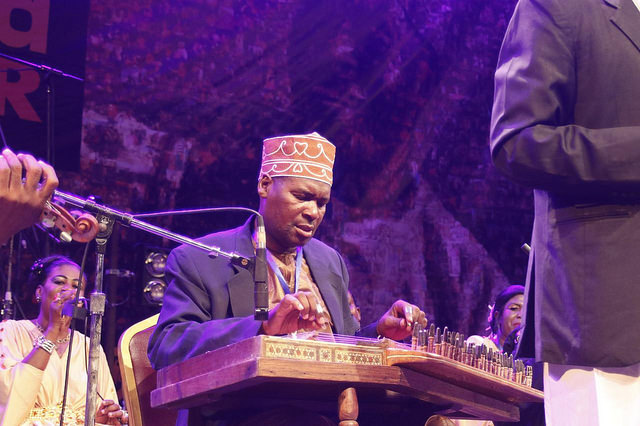
It was a precursor to the lively and energetic performances that were to be showcased at the festival over the next four days, and which were a blend of diverse cultures carefully selected from all over Africa and the Diaspora. A total of forty performances were showcased, all of them performed live. And they did not disappoint. From the high-octave act of Ihhashi Elimhlophe from South Africa to the mellow taarab tunes of the island’s age-old Culture Music al Club, the shows were unique and distinct. You hardly knew what to expect next. And the crowd loved it, packing the venue ground to a man, dancing along as they sampled the various Tanzanian refreshments at the bar.
With all the partying going on it was strange to imagine that at some point in history, the huge walled-in Old Fort yard accommodated prisoners in leg irons, watched over by guards carrying muskets patrolling on the ramparts ringing the thick walls above. I was reminded of this when I felt something poking my toe in the fawn-coloured grass. On closer examination it turned out to be the remains of a rusty four-inch nail that had been dug up by the sound crew when they were laying the power cables. There was a strange feeling holding that nail, almost like a gory souvenir from a forgotten age. Could it have been shrapnel from a bomb that had been fired over the wall during a siege on the great fort? Could it have been used to torture one of the prisoners? There was no way of telling, but it sure brought to mind the true purpose of the fort.
The crowd at the festival over the four days was a mix of all nationalities, from the native Swahili and Arabs to Latinos, Chinese and Italians. Simply put, it was a tower of babel. Walking around with a hand-held recorder eavesdropping in on conversations would have thrown the equipment’s translation software into a spin. Practically every nationality was represented. And, like in all busy port cities, there was this unique group of mixed-blood people who looked neither black nor white, Arab nor Portuguese. They were of a sizeable number, predominantly sporting dreadlocks. They reminded me of my last visit to Cape Town. I always think of them as the true global citizens, and who give a city the cosmopolitan tag.
Zanzibar’s famous pint-sized legend, Bi Kidude’s shadow loomed large over the festival. On the first day there was a screening of a documentary on her last days titled I Shot Bi Kidude by Andy Jones, and which was a follow-up on his earlier film, As Old as My Tongue. The film focused on the fast-talking, chain-smoking rebel-rocker’s last days and her alleged 2012 kidnapping before her death.
It is a contested twist in the controversial singer’s life that some of the locals dispute, claiming it was introduced by the British film-maker to make it more captivating. According to some locals I spoke to, there was no such thing, and that Bi Kidude passed on at her home on the island due to old age.
This year’s festival lived up to its billing as the friendliest festival on earth. There were hardly any incidences to report, and the atmosphere was just that: friendly. The crowd kept up their energy right up to the last day, jamming to the sounds of the electrifying reggae band from Algeria, Djimawi Africa. It certainly was worth a second visit.


Most popular

Call for applications: ACCES 2026 Emerging Artist Spotlight Competition
01 Oct 2026

Top amapiano songs of 2026
16 Feb 2026

Top Naija songs of 2026
31 Mar 2026

Top Afrobeats songs of 2026
19 Mar 2026
Open call: 2026 Gender@Work music industry training in Johannesburg
03 Oct 2026

AFRIMA 2026: All the winners
12 Jan 2026
Disclaimer: Music In Africa provides a platform for musicians and contributors to embed music and videos solely for promotional purposes. If any track or video embedded on this platform violates any copyrights please inform us immediately and we will take it down. Please read our Terms of Use for more.

Subscribe to our monthly Newsletter
Follow us on social media


Please log in to post a comment.