
NEFCISA
NEFCISA

The Music In Africa Foundation (MIAF) is proud of its partnership with the Industrial Development Corporation (IDC) as a Strategic Implementing Partner (SIP) for its Social Employment Fund (SEF). Through this collaboration, MIAF is running a national programme that is creating jobs, addressing skills gaps, and strengthening South Africa's creative industries — in line with the SEF's overarching goal to generate work for the common good and build community value through employment, social contribution, and inclusive economic participation. Operating under the banner NEFCISA (National Employment Facility for Creative Industries in South Africa), the initiative is recruiting and training participants, matching them with host organisations, and has already placed 1 500 workers across the country — surpassing its original target of 1 000. NEFCISA is delivered through a network of 20 host organisations spanning five provinces, who are actively hosting participants and contributing to work for the common good across South Africa's creative and cultural industries. Key Objectives: Support employment and entrepreneurship in the creative industries. Offer skills development and training programmes. Foster partnerships between public and private creative sectors. Promote South African creativity at both provincial and national levels Foster community development through social contribution.

ACCES
ACCES

ACCES Conference and Showcase Festival is Africa's leading music industry gathering, bringing together the people shaping the future of the continent's music business. Artists, entrepreneurs, executives, investors, policymakers and cultural leaders from across Africa and around the world come to ACCES to build partnerships, exchange ideas, discover talent and create new business opportunities. Since its launch in 2017, ACCES has become the continent's premier platform for professional exchange and music market development. Combining a high-level conference with a curated showcase festival, networking, exhibitions and industry programmes, ACCES offers a unique space where creativity meets business and where African music connects with the global industry.

Gender@Work
Gender@Work

Music In Africa Gender @ Work is a three-year training programme aimed at upskilling and increasing the participation of female professionals in the African music sector. Launched by the Music In Africa Foundation (MIAF) in April 2019, the programme is connected to the MIAF’s ACCES music conference – a pan-African event held in a different African country every year. This connection enables the programme to reach new participants in a different African country every year. The programme marks the beginning of a more concerted effort by the Foundation to support the participation and inclusion of women in all facets of its programmes and the music sector in Africa as a whole. Over the three years, the programme will aim to address gender imbalances in the sector through training, lobbying, facilitating knowledge exchange and dialogues that foster the interest of women. The broader objectives of the programme are to: Provide industry training for women on critical music industry skills, focusing on: Stage management Electronic music production and recording Music business management Technical knowledge Provide an opportunity for both professional and aspiring women to benefit from the Music In Africa network and its broad range of activities in 2019, 2020 and 2021. Provide a solution-based platform in the form of a round table at ACCES with a view to identify challenges, discuss opportunities and lobby for the interests of female practitioners. Offer participants the opportunity to benefit from programmes offered by MIAF’s partners. Increase access to educational materials. Integrate participants in the broader ACCES programme to maximise experience and exposure to the industry. Record and present training materials on the www.musicinafrica.net, including but not limited to tutorials, templates and other best-practice materials. Communicate women-based themes that support the initiatives and messages of the programme. MAIN TRAINING ACTIVITIES Training in first country (Ghana): In the first year, participants will be trained on all aspects of stage management by a team of experienced stage managers from 10 to 17 November 2019. The programme will offer robust classroom training as well as practical, hands-on training in which participants will also be given the opportunity to manage various aspects of the ACCES performance programme. Training in second country: The second training iteration will take place at ACCES 2020 when the programme will diversify its course to include music production lessons and training on other music business topics. A round-table platform will also be introduced to coincide with the ACCES programme. Training in third country: The third training iteration will take place at ACCES 2021 in a different country, offering an advanced course. HOW DO YOU GET INVOLVED?  As a participant, facilitator or trainer: The programme enrolls up to 12 trainees every year. All opportunities are advertised publicly on this website, and will be added to this page. Please keep checking this page for new calls (below under UPDATES & CURRENT OPPORTUNITIES). As a partner Please contact Claire Metais at [email protected]. APPLY The call for applications for 2020 will be announced soon. The Music In Africa Gender @ Work programme is made possible with the support of the Prince Claus Fund, Siemens Stiftung and Goethe-Institut.

Sound Connects Fund
Sound Connects Fund

For cultural and creative practitioners and organisations operating in southern Africa, access to funding remains a major challenge. The COVID-19 pandemic has also had a massive impact on government policy, spending and the economy in general, and has seen spending on culture being moved further down the list of priorities. Further, the cultural and creative industries repeatedly cite four main areas where investment is needed for growth, which are increased visibility, mobility including access to new markets, finance and support structures.

Instrument Building And Repair Project

Experience the Vibrations African Instruments Exhibition online in 3D

Features

Shut up and play the kora

17 Jun 2015 - 10:03

cc-img flag-img

It must be difficult lugging the kora around. The thought, to the uninitiated, is this: why bother? And yet, that thought is first thing to flee the mind once the instrument, in the hands of gifted player, yields its music.

On Thursday 11 June the kora brought forth its music at the Centre for Contemporary Art (CCA) in Lagos, an art space neither funded enough nor big enough for what it provides artists looking to showcase work. The event, tagged Truth & Art, featured a couple: English filmmaker Sunara Begum and musician Tunde Jegede.
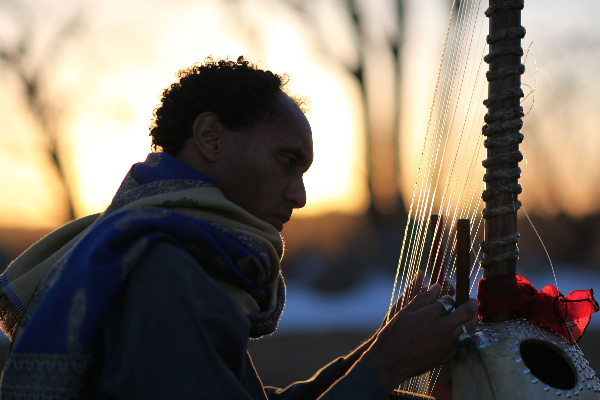
Tunde Jegede

Jegede, Artistic Director Music Society of Nigeria (MUSON), brought a number of his students; his students brought a number of music instruments. And the audience brought curiosity. CCA had advertised film, music and art. How would it all play out?

Simple enough. When you walked into the second floor of the building, you encountered the installation; the film plays when you sit down; afterwards Jegede and his boys—call them Jegede and the Joys—play music. This order comes in hindsight. It wasn’t announced. And good, too. The newbie is ambushed by beauty. The initiated is pacified by same.

At first, and perhaps becomes it is encountered first, the weakest bit of the three components, it must be said, are the three short films making up the 'Truth & Art' series. Each is dedicated to a music artist: singer and flautist Diana Baroni, kora player and cellist Tunde Jegede, and guitarist and folklorist Derek Johnson.

Directed by Begum, who is of Bangladeshi descent, the short, often confounding films are a measure of spousal support. You get the feeling that if the director could she’d include her partner in every shot. Filmed against the light or with the full glare of blessed sun rays, Jegede’s image attains a superhuman substance. Light isn’t around him as much as pouring forth from him. He illuminates the film. The romantic may take a leap off-screen: he illuminates her life. So that when a talking head in the series suggests that Jegede is an ancient spirit, stopping short of uttering reincarnation, it is not hard to imagine.

Begum’s exquisite cinematography makes it so we are liable to accepting this quasi-blasphemy. And by the time those words turn up in the film, Begum has made the point repeatedly with the camera. Sitting and watching this with the couple inches away gives a heightened effect of voyeurism. It recalls a line from TS Eliot to his wife: “But this dedication is for others to read: These are private words addressed to you in public.”

The somewhat experimental form of the trio of short films means nary a consideration is given to narration. Talking heads talk, the centrepiece of the collection, named after titular character Tunde Jegede, features the hero’s clarification of his art. A clarification which only adds to the befuddlement of the viewer. Art is essentially unknowable, and in the case of Jegede, his wife presents that mystery as currency. Pity then that that currency is unserviceable for viewers yet to see Jegede perform. That was corrected at the end of event when Jegede’s fingers happened on the kora’s strings.

Before Jegede’s performance, the audience rose for chatter and Begum’s installation. The installation comprised small calabashes suspended from the ceiling half-filled with earth. Within these vessels were 2-sided black and white photos. Artists, activists, writers, politicians, Malcolm X, Frida Kahlo, Sankara et al adorned these photos. Name of the installation? 'Floating Icons'. Tunde Jegede’s face peeped out of one of these photos.

Combined with the films, particularly one on Derek Johnson, discussing his book on the roots of African-American classical music, ‘Floating Icons’ is a homage and static celebration of some of humankind’s finest people, a literal representation of sons and daughters of the soil. Humans of the salt-of-the-earth variety. Asked why a portion of the screened films were devoted to the USA, Jegede responded, “It is difficult not to acknowledge American when you are looking at music.”

Chattering over, the audience resettled for Jegede’s performance. He started off with 'Sahel’s Call', a piece inspired by Malian music. Excellent music; yet it wasn’t until ‘Evocations’, played in tandem with his students, that audible gasps could be heard from the audience. “They played it very well,” he said of his students afterwards. The same could be said of Jegede himself. In fact, as he played the music, one began to understand Begum’s lens’s obsessive fascination with the man. There is a kind of brilliance doused by intimacy. Jegede’s brilliance with the kora is not that kind.

Please log in to post a comment.

Most popular

Disclaimer: Music In Africa provides a platform for musicians and contributors to embed music and videos solely for promotional purposes. If any track or video embedded on this platform violates any copyrights please inform us immediately and we will take it down. Please read our Terms of Use for more.

newsletter banner

Subscribe to our monthly Newsletter

Follow us on social media