































































Renowned Kenyan singer, multi-instrumentalist, poet, composer and bandleader Zein l’Abdin Ahmed Alamoody was a valuable repository of cultural knowledge.
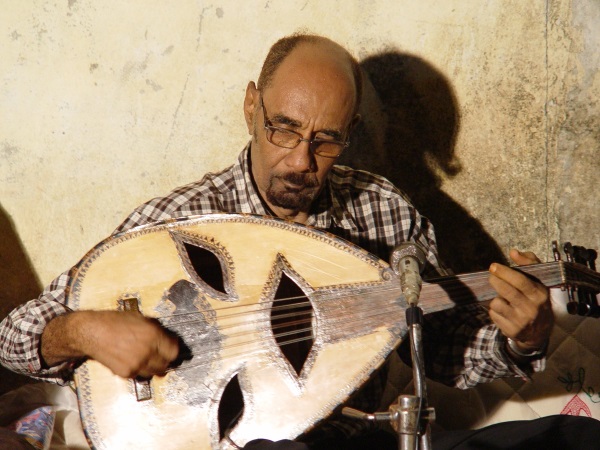
Referred to locally with the honorific Ustadh, Zein was a central figure in the genre of sung Swahili poetry known as taarab for more than six decades. He passed away on the morning of 27 June at his home in the Old Town neighborhood of Mombasa, Kenya.
My year and a half as a regular at Zein’s evening maskani was part of my dissertation fieldwork [i]. That research included many interviews, conversations and musical interactions with Zein, all of which inform this tribute to one of Kenya’s longest-serving musical icons.
The Arabic (kiarabu) style of taarab that Zein cultivated since the 1970s drew from earlier creative adaptations of Arab music throughout the history of the genre, including the work of the legendary Zanzibari taarab artist Siti Binti Saad, East Africa’s first music recording artist[ii]. Most famously, perhaps, Zein was a virtuoso of the Arabic oud (lute), an instrument with a long history in Swahili music that has nonetheless become scarce on the Swahili coast in recent decades."Zein’s approach to this instrument—and, by extension, to musical composition and improvisation—was broadly “Egyptian”. His approach was shaped by immersion in 20th century music and musical films from Cairo. He also borrowed creatively from Kuwaiti and other Gulf styles.
Something similar could probably be said of all highly accomplished Swahili oud players since the 1930s, but Zein’s stylistic synthesis was beautifully idiosyncratic, a product of a lifetime of passionate engagement with musical sounds that moved within the transnational and cosmopolitan circuits of the Arab and Indian Ocean worlds.
Education of a Swahili musician
Zein was born in 1939 on the northern Kenyan island of Lamu, in a village just south of the historic Swahili port town of the same name. Though already in decline, Lamu was still an active trading centre during Zein’s early childhood. Ships would arrive at port with fish in their holds and leave with boriti (mangrove poles used in construction) destined for locations in the Arabian Gulf. Sometimes they would also carry a different sort of cargo: musicians.
Among the local hosts for these musicians was Zein’s father. Though he made his living as a clerk at the port, Zein’s father was an amateur oud player and a music patron who would host musical gatherings in his sitting room, under a wall-mounted kibangala (a 19th century Swahili string instrument similar to, and presumably derived from, the Yemeni gambus). Among the guest musicians at these gatherings were Zein’s maternal uncle, Ali Baskuta, Lamu’s finest oud player of the time, and Kuwaiti musicians brought in by a local shipping magnate Zein’s father had gotten to know through his work.
Zein’s early exposure to his father’s musical gatherings instilled in him a desire to play the oud, and a life-long love of the rhythmically exciting style of Kuwait song. Just as formative, however, was his exposure to radio broadcasts and recordings of Egyptian music by the likes of Umm Kulthum and Mohammed Abdel Wahab, as well as early Swahili taarab recordings that his father had collected.
After his father’s death in 1951, Zein came to Mombasa to live with an uncle, where he attended school until 1954. As a result of family disagreements, Zein returned to Lamu briefly before coming back to Mombasa, where he would take up a job as a clerk at the port. It was during this time that he began learning to play the oud.
“Zein was never formally taught by anyone,” ethnomusicologist and record producer Werner Graebner writes in his liner notes[iii] for Zein’s 1989 Globestyle recording Mtindo wa Mombasa. “He learned by seeing, listening to and asking other oud players questions. He often went to the home of the tailor, Omar Awadh Ban, a well-known oud player of the time (who recorded for the Jambo label in the late 40s), and stayed whole nights playing and discussing music.”
Zein also learned by studying recordings. The advent of consumer magnetic tape recorders in the 1960s enabled him to create a reference library for his studies which included BBC Arabic music broadcasts, according to Graebner’s notes. Zein’s most essential reference recordings were oud improvisations by Farid el-Atrash and Riad Al Sunbati, two giants of the 20th century Cairo scene. From listening to and copying these masters, Zein internalized the workings of the Arab Maqam system of melodic modes, as well as idiomatic phrasing and ornamentation on the oud. The virtuosic playing of Farid el-Atrash was especially influential, and inspirational, for Zein. Zein called Farid his “mwalimu” (teacher) and kept a picture of him—tattered and aging by the time I first saw it in 2004—on his wall. It seemed to me that Zein even modeled himself personally on Farid, channeling the star’s suave demeanor in performance and everyday life.
Beginnings in Mombasa
At the time when Zein first picked up the oud in Mombasa, the town's music scene was dominated by sharply dressed, all-male taarab orchestras. These groups would perform at local weddings, social events and on radio shows. The groups would sometimes record for the Mzuri label owned by Assanand and Sons Records. In 1956, Zein joined the famed Jauhar Orchestra, which had developed a fascinating Swahili style redolent with Arab and Latin (and a touch of Indian) sounds. Zein’s tenure with the club was short: after the orchestra’s leaders declined to include him in an historic performance for the Sultan of Zanzibar, he resigned.
Zein next worked with Lamu poet and musician Ali wa Lela, who had learned to play the oud at Zein's father's house in the 1940s. But Ali wa Lela soon left Kenya, chasing a job opportunity in the UAE. Left on his own, Zein slowly grew into the role of an independent artist.
Graebner traces Zein’s development as a recording artist and star of the wedding circuit from the 1960s: “After a first recording with the Arrow label in the early 1960s, Zein joined Mzuri Records, Mombasa's main taarab outlet at the time. He recorded a host of singles up to the mid-1970s, occasionally featuring other singers with his band, at weddings and on records. Maulidi Juma and Zuhura are among those who sang with his group. In the second half of the 1970s, Zein recorded for Mbwana, a thriving cassette store in Mombasa's old town.”
Evolution of 'Arabic Taarab'
Early on in his solo career, Zein followed the trend of the day by working in an 'Indian' style, setting his Swahili poetry to the melodies of popular Hindi film songs. However, he realized that this was not going to be a path to success. As Zein put it decades later, he came to believe that people appreciate music more when it is anchored on the performer’s own culture.
Zein’s turn toward cultural authenticity - if that is how he truly saw it at the time - involved a recreation of “utungaji wa zamani,” the old style of composition. This meant the style employed by Siti binti Saad and her contemporaries. While binti Saad’s music was stylistically eclectic, it bore a strong Egyptian influence.
Zein’s version of Arabic taarab found a waiting audience in Mombasa in the 1970s consequently launching him to taarab stardom. His success was also due to a general expansion of the local audience for taarab as well as the influx of Hadhramis (Arabs from Hadhramaut, in southern Yemen) to East Africa in the 1960s to escape violence and instability back home. The large number of Hadhrami-Swahili weddings created natural opportunities for music sung in Swahili (and therefore accessible to all) but performed kiarabu, in an Arab style.
Some newly arrived Hadhramis preferred to hear only Yemeni popular music at their wedding celebrations. Seizing the opportunity, Zein got this repertoire under his belt as well.
As it happened, Zein traced his paternal lineage to Hadhramaut. But his forefathers arrived in Kenya many generations ago. His Swahili identity and accent made it difficult to compete with local Hadhrami musicians like oud-singer Ahmed Bin Brek, but his remarkable oud skills won him many Hadhrami fans. Indeed, when the Saudi-based Hadhrami luminary Abu Bakar Salim Bilfageeh[iv] visited Mombasa in the late-1970s courtesy of a wealthy Hadhrami family, it was Zein who was tapped to perform with him.
Throughout the 1970s, Zein worked to develop his Arabic taarab repertoire into something that would set him apart from other local taarab musicians, 'Arab' and 'non-Arab' alike. Toward this end, he collaborated with Swahili poet and scholar Ahmed Sheikh Nabhany[v], a native of Lamu based in Mombasa. Zein and Nabhany worked together to set their own poems to music and revive poems from early-20th century Lamu. The resulting repertoire arguably includes some of the finest examples of Swahili expressive culture.
Most of Zein’s commercial recordings - dozens of “volumes” on cassette - are only available in Mombasa, from Mbwana Radio Services or until his death, from Zein himself. But a good sampling of Zein’s most popular songs have been released internationally on two full-length albums, Mtindo wa Mombasa[vi] (1989, Globestyle) and The Swahili Songbook[vii] (2000, Dizim Records) and a smattering of compilations (including John Storm Robert’s classic Songs the Swahili Sing[viii], first released in 1980).
In the last few decades of his life, Zein continued to make part of his living from wedding gigs and cassette sales, but came to rely more and more on occasional performances at beach hotels, special events and festivals. He also had a few engagements abroad, in Europe[ix] (courtesy of Werner Graebner) and the Gulf.


Most popular

Ghana: Mr Eazi and MOLIY’s ‘Comfort’ earns Urban Music Awards nomination
21 Oct 2026

Top Naija songs of 2026
31 Mar 2026

Top Afrobeats songs of 2026
19 Mar 2026

Top amapiano songs of 2026
16 Feb 2026

Open call: CANEX Music Business Lab and Songwriting Camp
15 Oct 2026
Nigeria: CANEX WKND unveils 2026 programme
21 Oct 2026
Disclaimer: Music In Africa provides a platform for musicians and contributors to embed music and videos solely for promotional purposes. If any track or video embedded on this platform violates any copyrights please inform us immediately and we will take it down. Please read our Terms of Use for more.

Subscribe to our monthly Newsletter
Follow us on social media


Please log in to post a comment.