





























































If your uncle who was in a '60s band gifts you his Fender Stratocaster, think twice before you pass it on again: it could be worth over R200 000 ($12 000). Why is old gear still in demand and so valuable? There’s something about it that the new stuff just hasn’t got, and that’s why people are prepared to pay a lot for it. But you have to know what to look for – and more particularly, what to listen for.
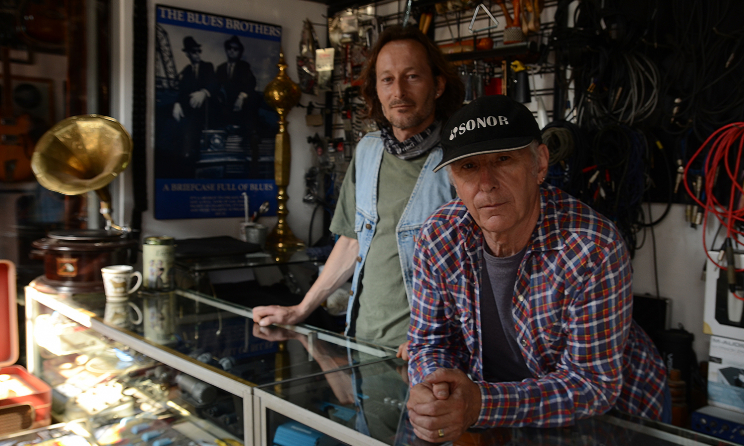
Ronnie Milne, who has been buying and selling second-hand musical instruments for more than 30 years, has fine-tuned his ear and eye to know where a good bargain lies. He’s a drummer who also plays guitar, so his speciality is in these instruments, but you can also find amplifiers, microphones and most of what you need to project your sound out to an audience effectively in his shop in Linden, Johannesburg. He started off "wheeling and dealing" in Hillbrow "because I didn’t fancy getting a job", and then moved to Melville, then sold second-hand gear from his flat near Cresta before opening his own shop, appropriately named Allbang & Strumit. It's lined with gear from floor to ceiling, and he knows the story behind every item on display.
He makes most of his money from selling good quality second-hand gear and says that "the vintage gear that fetches top price is the cherry on top." Second-hand instruments devalue fast in South Africa, as buyers want the latest modell; the UK is where old gear is valued most. The majority of top music equipment comes from the US but most people can’t afford it, so cheaper copies are made in the East. Some of this stuff is pretty good but it’s in that 10% of extra quality where the magic lies, and that’s what the aficionados are looking for. "When it sounds good, when you’re playing in a band, that’s why you’re there, and you want to be there for the rest of your life. It’s better than drugs," Ronnie says.
The music scene has changed drastically in Ronnie’s lifetime, and so has the demand for certain kinds of musical equipment. Bands have shrunk: "I used to sell 10 drum kits a month, now I can barely sell 10 kits a year," Ronnie says. These days, people buy and play with computers or loop stations, and venues want DJs or one-man acts.
In the '80s, there were huge gigs with crowds of over a thousand people at hotel venues like Southern Sun and Gold Reef City. The bands played mostly covers, often for six nights a week. This "drew in the girls, which of course then drew in the boys." The venues made so much money from selling alcohol that very few of them charged at the door.
Ronnie, who hails from Scotland, says that when he arrived in Johannesburg “I’d never seen so many working musicians in my life." Back then there was a culture of networking among musicians, who went out nearly every night to watch what the other bands were doing. You would play with different acts, both for fun and to learn. There was a pecking order: every time you improved as a musician and “went up” into the next bracket, you got paid more. But people don’t go out until one or two in the morning any more. It’s too expensive, and it can be dangerous. "We used to travel right across town to go watch a band. Now, we don’t even want to stop at a robot [traffic light] at night anymore,” he reminisces.
Most of Ronnie’s customer base now comprises amateurs: his typical customer is a guy sitting at home with a guitar and a computer. The COVID-19 pandemic has pushed the demand for acoustic guitars – it’s easy to get the lyrics and chords for songs off Google and entertain yourself in your own lounge. Often the choice of instrument for an amateur is "artist-driven" – if Bruce Springsteen plays a Fender Telecaster, for instance, then that’s the guitar the amateur sitting at home wants too.
Another side-line Ronnie benefits from is hiring out musical props for movies and adverts. As he’s been in the game for so long, he knows what instruments go with what era. "There’s nothing worse than seeing something on TV and it’s supposed to be the '60s and the guy is playing an '80s Strat.” There are also drum and guitar teachers in a small studio attached to the shop, and, since Ronnie moved to Linden, there’s a tiny coffee shop and music venue called the Vintage Café. His son Jos helps to keep the business afloat.
What’s the most valuable equipment? In guitars, its Fender, Gibson and Gretsch; for drum kits it's Gretsch, Rogers, Ludwig and Slingerland. There’s also demand for some electronic equipment, such as Moog and Oberheim synthesisers, though it’s usually the studios that buy them. Some of the old gear just has a particular sound "that cannot be emulated, or it’s too expensive to emulate" and that’s what the specialists want. Ronnie used to hunt around for rare pieces, and still owns a few, “but by now, there’s very few '60s Strats left in Joburg."
Back in the '60s, he explains, the good guitars were made in factories, but they were assembled by hand, so they have imperfections. This means that some sound amazing, and some sound terrible. "Not every L-series Strat (1963-65) sounds great, you know." Because he’s been in the business so long, Ronnie knows what models and makes are the most valuable and will fetch the best prices, and, just as a wine specialist knows which wines taste best, he knows what the “classic sound” is.
"I’m the last of a breed. I know that period, but 50 years from now, people might really value some of today’s equipment that I know nothing about. There are so many variations in musical equipment and in people. In this game, the rules make themselves up," Ronnie says.


Most popular

Call for applications: ACCES 2026 Emerging Artist Spotlight Competition
01 Oct 2026

Top amapiano songs of 2026
16 Feb 2026

Top Naija songs of 2026
31 Mar 2026

Open call: 2026 Gender@Work music industry training in Johannesburg
03 Oct 2026

Top Afrobeats songs of 2026
19 Mar 2026

AFRIMA 2026: All the winners
12 Jan 2026
Disclaimer: Music In Africa provides a platform for musicians and contributors to embed music and videos solely for promotional purposes. If any track or video embedded on this platform violates any copyrights please inform us immediately and we will take it down. Please read our Terms of Use for more.

Subscribe to our monthly Newsletter
Follow us on social media


Please log in to post a comment.