






















































This text provides an overview of traditional music in Ghana.
The festivals
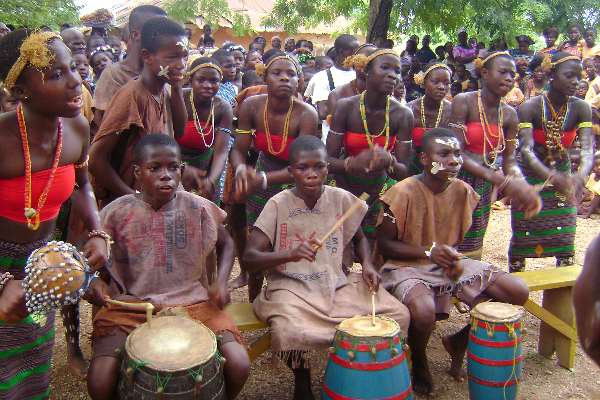
The seat of the Ashanti kingdom, Manhyia Palace, is one of the few places where traditional Ghanaian music can be experienced first-hand in recent times aside annual traditional festivals like Bakatue in Elmina celebrated by the Fanti, Ga Homowo in Accra, Nzema Kundum, Effutu Aboakyer, Anlo Hogbetsotso, Ho Yam festival, Krobo Ngmayem, Dagomba Bugum Chugu, Gonja Beng and others
Social relevance
For artistic intent, there’s a wide range of vocal tones with respect to traditional music. The Akans use a less intense tone as compared to the Frafra, while a near or true falsetto can be noticed from several other ethnic groups. Even the “dirty” tones are not distortions but intentional in both vocal and instrumental sounds to project acoustics as natural as possible. The percussive rhythm of hand clapping could be as important as drums. In the social space, Akans have a traditional song aimed to cure enuresis as well as specific drums played to shame a thief while he is paraded through town with whatever he stole in his hands.
Spirituality
Since the colonial era, Christian churches have been purveyors of European culture which preaches against African cultural practices and poses a popular inimical treatment to traditional music while promoting western cultural values and usages.
The dwindling traditional religious settings tend to apply innovative methods or efforts in choosing the most inviting traditional music sounds to attract new members to the shrine. Sometimes, possession of spirits results in body contortions following the sound of fontomfrom and mpintin drums accompanied by specific chanting sounds.
Traditional Ewe music performed by the Anlo-Ewe of the Yeve shrine uses a set of seven principal dance-songs in worship: Nusago (preludial), Afovu, Sogbadzi, Savu, Adavu, Agovu and Avlevu. Avlevu is used to return a spirit-possessed person back to normal.
Performative experience
The absence of mounted ‘stages' boosts the intimate connection between dancers of Adowa or Kete and the musical rhythms from bands playing interchangeably or sometimes simultaneously. In some settings, the main band is embedded like a toe nail in front of the audience in the middle of the space opposite the seating corridor of the king and sub kings and is composed of eight muscular fontomfrom and atumpan drumming kinsmen. Their drums are draped in kente sheathing adinkra symbols carved into the wood.
Two other bands led by women singers are positioned at the flanks away from the kinsmen band. Traditional instruments such as the six-stringed lute; seprewa and bass lute; pentenkyriwa, are central to these bands. The maracas, dawuru (double bell), atoke (single bell) and atumpan talking drums are beaten to praise the stool head and make pertinent announcements. One interesting thing is the use of public address systems by these two bands, making the connection of western technology influence on traditional music. Adinkra symbols on walls and drums, fans made from animal hide, brass sceptres, gold ornaments and beads are metaphoric and compliment the music and dance.
The Ntahera ensemble uses carved ivory horns for surrogate speech to echo noble deeds and characteristics of the stool head. Most Ashantis understand instrument speech due to a cultural socialization process and as such respond to this language. As Africa's premier musicologist, the renowned Kwabena Nketia puts it; “instruments use a surrogate speech with the same fluency as the court linguist- tone substituting for words.”
Pioneers
Ephraim Amu, who is regarded as the father of contemporary Ghanaian Art Music played the seprewa, atentenben and the Akan drums; atumpan and fontomfrom, with complex contrapuntal treatment notably in polyrhythmic and polyphonic textures. Ghanaian languages in his work add instrumental textures—sounds like kon kon kon and pete pete pete copy the gong and drum. The Ghana National Orchestra is one of the existing tributes to Amu's successful musical career.
After Amu, we find the next generation of musicologists, J.H.K. Nketia, Entsua-Mensah, Ata Annan Mensah, Otto-Boateng, Kwesi Baiden, A. Amissah, Gyimah Larbi, Eric Nyarko, Kenneth Kafui, N. Z. Nayo, Willie Anku and Emmanuel Boamah investing in compositions with a strong sense of academic interest in music without deviating from the essence of tradition.
Acquaye Saka experimented with pre-electric urban sounds as a teacher, performer and playwright while Onipa Nua started off as a blind street child musician playing the kalimba(thumb piano) with artsy musical vision. Mustapha Tettey Addy was born into a Ga traditional drumming family and became dadeafolakye(head of ritual drummers) and Obo Addy joined Nkrumah’s state bands which toured the country to educate farmers, performing with traditional instruments exclusively.
The highly respected J. H. K. Nketia on the other hand builds works “culturally relevant to Africa with a view to understanding the principles of African music.” He currently heads the International Centre for African Music and Dance, Legon.
Influence on modern music
Ghanaian choral music and Northern Ewe recreational music make use of traditional musical styles like call and response as well as improvisations. In 'Roots of Highlife,' documented at Faisal Helwani’s studio in Accra, the Edikanfo Band and the National Folkloric Company of the Arts Council of Ghana use Ewe Borborbor, Dagomba Bamaya, Ga Kpanlogo, Brong Bosoe, Kasisina Nagla, Ewe Agbadza, Ashanti Adowa, Fanti Ompeh and Akwamu Asafo rhythms.
Traditional Ghanaian music birthed highlife music, which has heavily influenced African. Currently, Ghanaian traditional music bands play at cultural festivals as well as special occasions all over the country. Since 1973, the Ga Wulomei has been known as a folk revival band. Onyame Akwan band led by Kaakyire Badu plays at Manhyia palace.
Away from Ghanaian players, the percussionist Royal Hartigan, who performs the music of Asia, Africa, Europe, West Asia, and the Americas, including indigenous West African drumming, has had the opportunity to play with one of the royal bands as part of an Akwasidae gathering. Akwasidae is an Ashanti durbar held every six weeks based on the Akan calendar in honour of the ancestors, the golden stool and the Ashanti king, now Otumfuo Osei Tutu II.
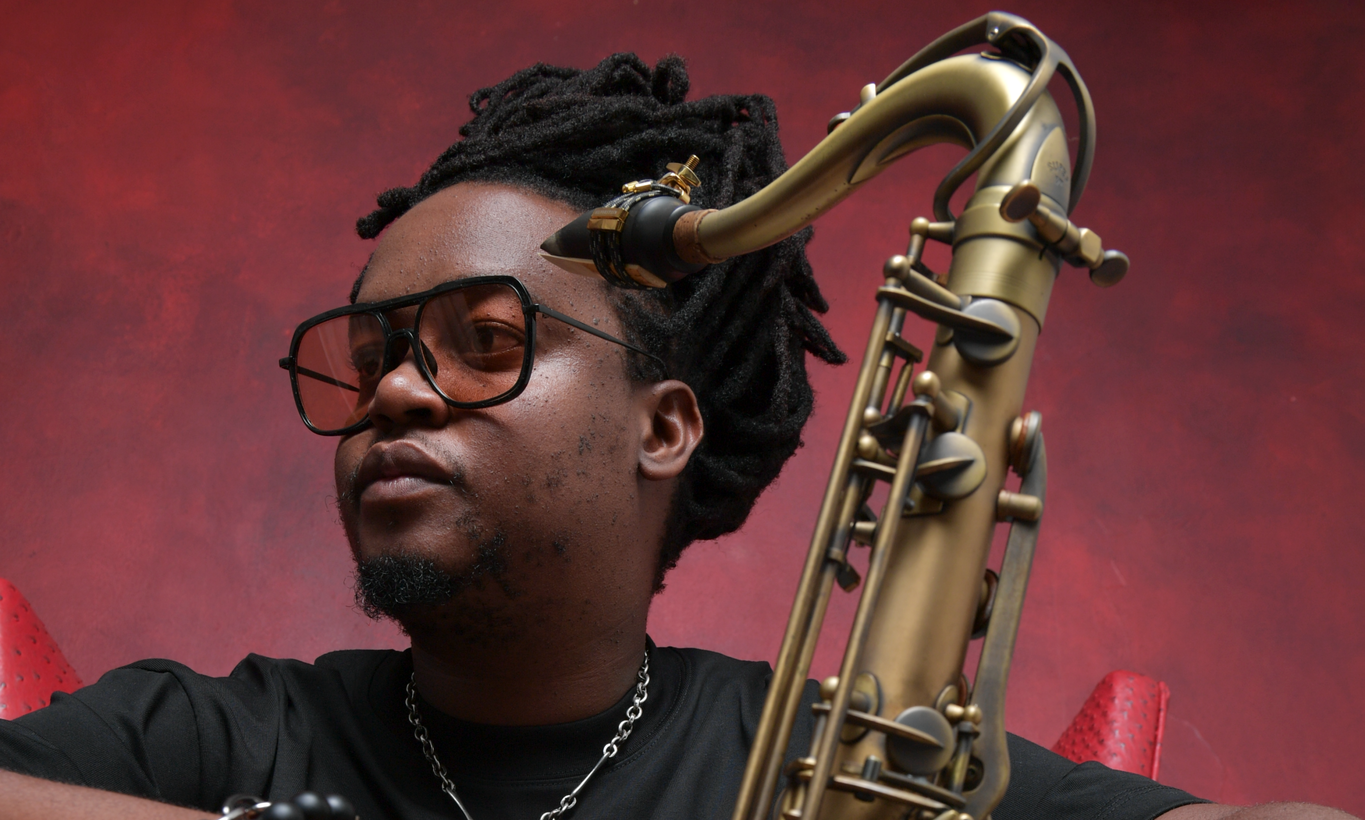
In Accra's entertainment circles, palmwine music, an appendage of Ghana's traditional music preserved by the likes of Agya Koo Nimo and Tumi Ansah, can be found in the music of the younger generation like Kyekyeku who adds a contemporary touch to the art. Aside percussion-based bands, string instruments like the kologo is used by King Ayisoba and Stevo Atimbire while Osei Kwame Korankye spreads the good news about the seperewa.
- Nigerian Art Music: With an Introductory Study of Ghanaian Art Music, by Omojola Bode, Institut français de recherche en Afrique, ©1995 https://books.google.fr/books?id=iRsfCwAAQBAJ&pg=PT1&lpg=PT1&dq=Art+Music+in+Ghana:+An+Introduction+by+Omojola,+Bode
- The soul of Mbira- Music and Traditions of the Shona People of Zimbabwe. Paul F. Berliner. University of Carlifornia Press, Berkeley Los Angeles, London ©1978, Copyright. The Regents of the University of Carlifornia, USA.
- Africa O-Ye! A Celebration of African Music by Grene Ewens, with an Introduction by Manu Dibango. ©1991. Guinness Publishing Ltd. 1991. 33 London Road, Enfield, Middlesex
- The World of African Music, Written and edited by Ronnie Graham, Stern's Guide to Contemporary African Music Vol 2. First published in ©1992 by Pluto press. 345 Archway Rd. London, N6 5AA
- More than Drumming, Essays on African & Afro-Latin American Music & Musicians, Edited by Irene V. Jackson, ©1985, Greenwood Press, USA. Center for Ethnic Music, Howard University.


Most popular

Call For Applications : ACCES seeks a UK-based performer
10 Sep 2026

Top amapiano songs of 2026
16 Feb 2026

Top Afrobeats songs of 2026
19 Mar 2026
Open call: Goethe-Institut grants for Southern African creatives
08 Sep 2026

AFRIMA 2026: All the winners
12 Jan 2026
Open call: FAME Week Africa, Pressure Cooker Studios songwriting camp
09 Sep 2026

Open call: Ernst von Siemens Music Foundation 2026 funding programmes
04 Sep 2026
Disclaimer: Music In Africa provides a platform for musicians and contributors to embed music and videos solely for promotional purposes. If any track or video embedded on this platform violates any copyrights please inform us immediately and we will take it down. Please read our Terms of Use for more.

Subscribe to our monthly Newsletter
Follow us on social media


Please log in to post a comment.