
















































This text provides an overview of the Eritrean media, particularly as it relates to the local music industry.
Background
Eritrea’s achievements are extensive in many fields, yet little is mentioned of the country’s rich arts and culture. With nine different ethnic languages in the country, the music of each ethnic group was historically confined to its respective region. It is only with the advent of media technology, however, that the various styles of Eritrean music started spreading to the rest of the country, the region and the world.
During Ethiopia’s occupation of Eritrea (1961-91), Eritreans were actively discouraged from listening to music in their indigenous languages and were banned from following the popular radio broadcast, Voice of the Broad Masses of Eritrea, which aired from the 'liberated' area of the country. Despite the ban, music remained a lifeline between the public and Eritrean liberation fighters. People listened and the music helped drive many youth to join the liberation struggle.
After Eritrea’s independence in 1991, music continued to be used for political reasons - but this time, by Eritrea's government against its own people. Various bands worked directly under the party’s organs and the army, producing a disproportionate number of songs for the many national holidays that fill up the Eritrean calendar. Only songs produced in this fashion received substantial media airplay. This tradition has resulted in an "echo chamber" in which Eritrean artists produce music that they know the state-controlled media want - despite the songs' obvious lack of quality, integrity or creativity. Singers are rewarded according to how well their songs are received in the state media and how much airtime they receive. This sort of "success" opens further opportunities for these artists to tour outside the country.
While the state media heavily promotes music that fulfills their own agenda, this does not necessarily improve the quality of productions. With the almost constant playing of patriotic songs on national radio and TV, it's difficult to gauge how the music is really being received. The public's continuous exposure to mediocre music results in a limited ability to discern what good-quality music actually is. There's little or no objective standard for quality music in Eritrea – no knowledgeable music critics, very little musical scholarship and little access to decent, freely-made music from outside the country.
Elias Weldegebriel, director of the Asmara Music School[i] in Eritrea, explains the problem: In the post-independence era, because of lack of arts institutions and national interest, there was no one who could authoritatively write, teach, critique and research the musical performance practices, although these performance practices were and are abundant. It has been difficult for musicians and audiences to discern the ‘good’ music. The problem manifests itself in the few workshops and seminars conducted. Participants are typically divided as two whether Eritrean music shows positive change, what positive change might be and how to actually bring about the potential change or enrichment[ii].
Today the Eritrean government maintains a monopoly over domestic radio and television. The few privately-owned newspapers were all closed in 2001 as part of a crackdown on the opposition. The state media strongly backs the government, while accusing the opposition and the West (especially the USA) of undermining the country and of supporting its main enemy, Ethiopia. The government controls all media in Eritrea, including a newspaper published in three languages, a television station and three radio stations. A permit is required to print a publication or to distribute a foreign publication, restricting any opposing views.
Television
The state-run TV station, Eri-TV, began in 1993 with very limited coverage in the capital. Over time the station has significantly increased its range and coverage. Currently, the TV broadcasts in six languages (Tigrinya, Tigre, Arabic, Amharic, Oromo and English) and is broadcast to all corners of the country and the world via satellite. Each broadcast language of the TV has its own music slot and tradition calls for songs to provide the transition between programs. This practice has helped popularize local music tremendously, though the programs also broadcast international music.
In recent years, most Christian and Muslim religious holidays have been celebrated with extended state TV coverage of popular Eritrean artists, particularly singers. The singers will be interviewed, perform in studio and answer questions from the audience. Although this trend might not actually contribute to the quality of local music, it certainly enhances the popularity of the featured singers and their music.
The state broadcaster also runs a second channel, Eri-TV 2, which broadcasts only within the country. It is considered the entertainment channel and broadcasts mainly live football games of European clubs, various soap operas (mostly Turkish dubbed in Arabic) and national and international music. Unlike the main channel, the second channel tends to create opportunities for budding singers. It also encouraged many young Eritrean talents to produce their own music videos.
Radio
Eritrea has three state-owned radio stations: the national Voice of the Broad Masses of Eritrea and two FM stations, Zara FM and Radio Numa. While Voice of the Masses mainly focuses on development journalism and includes music in various programs and transitions, the two FM stations devote more of their time to music and other entertainment. Zara FM is mainly devoted to local and international music programming with little time for news, while Radio Numa cover a variety of content, including sports, interviews and other entertainment.
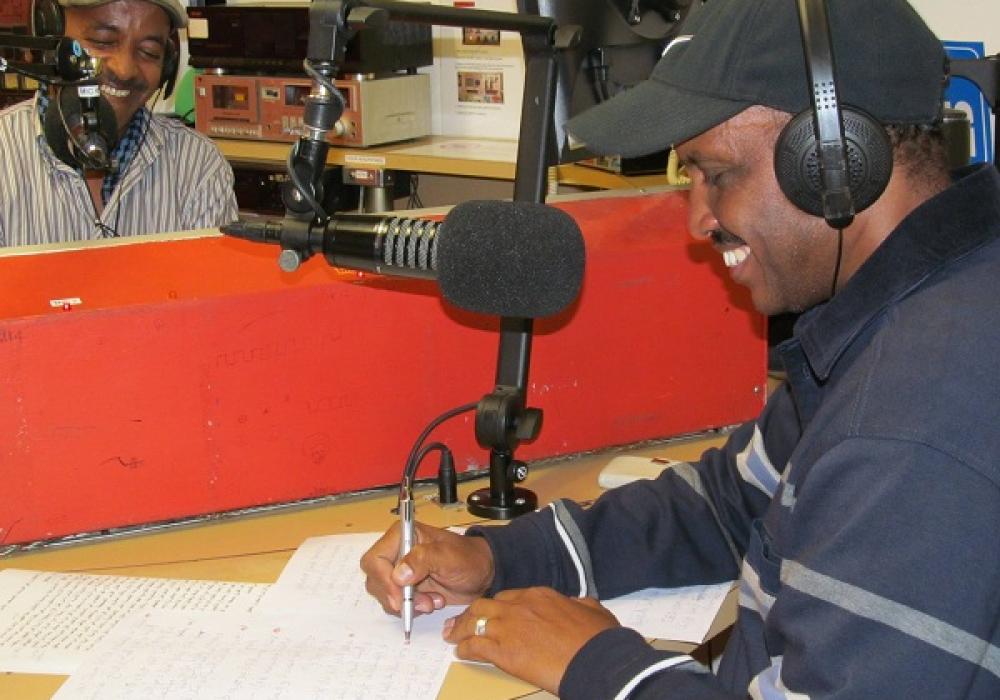
Several radio stations run by Eritreans abroad are attempting to reach listeners in Eritrea. These include Radio Erena[iii], which broadcasts via satellite and over the radio from Paris, France. Radio Erena features discussions of many issues of crucial importance to Eritreans. Probably for this reason, the station is very popular and is considered one of the only credible news sources available to the people of Eritrea. Satellite dishes have become very popular in recent years in Eritrea, which has enhanced the station's reach. Nevertheless, Radio Erena's signal has been repeatedly jammed by authorities in recent years.
One of the most popular programs on the station that is followed by many Eritreans (including those living outside the country) is a music program called ‘Shekortetina’. This two-hour show is broadcast on Sundays and hosted by singer Yonathan Habte. It is highly entertaining both due to its music selection and its presentation style that engages closely with listeners. Besides the host offering entertaining comments on many issues, listeners have the rare opportunity to choose their favorite songs.
Besides Radio Erena there were also various other opposition-aligned stations broadcasting from Ethiopia and the UK. Founded in 2008 Ethiopia based radio station named Wegahta (Tigrigna translation- dawn) used to air programs twice a day, for 3 hours beginning 6 am in the morning and for seven hours from 5PM. However the station stopped its transmission in 2013. Another station was the UK based ‘Radio Asena[iv]‘. The station was opposed to the Eritrean government. In February 2015 Radio Asena unplugged itself and stopped its broadcast for what its founder and Editor Amanuel Eyasu announced that the unpopular satellite radio broadcasting was discontinued due to chronic lack of funding.
There is only one newspaper published in Eritrea, and that is the official portal of the Ministry of Information. "Haddas Ertra" in Tigrinya is published in three languages: Tigrinya, English and Arabic. Although the newspaper gives extensive coverage to music – often through interviews with singers, for example - it doesn’t employ music critics to discuss or assess the content.
Another print medium – run by the party organ, the National Union of Eritrean Youth and Students – is the quarterly magazine Menisey. Among this magazine’s most-read content are its interviews with popular entertainers, mainly singers and actors.
Online
Internet penetration in Eritrea remains relatively poor, with statistics suggesting that the country has around 67 000 internet users- roughly1% of the population[v]. Nevertheless, today internet cafes in major cities and towns in Eritrea have been transformed into meeting places for the exchange of music, music videos and movies. This is mainly facilitated through the use of portable flash (USB) disks.
Eritreans living outside the country often use YouTube to access Eritrean music. In fact, some YouTube channels have emerged to cater to these demands, which are chipping away at the centralization of music in Eritrea. Halenga Eritrea[vi] is such a channel where one can discover Eritrean Music. The channel publishes Eritrean music videos every week. Halenga Eritrea was started with the mission to help emerging and established Eritrean Musicians promote and sell their work. The Eritrean Music[vii] is yet another channel that shares Eritrean music. LYE Musica[viii] is another channel that shares Eritrean music online.
QieNit[ix] is another platform that used to share information about the music of Eritrea. The platform also had a TV programme called the QieNit TV Talk Show, which focused on Eritrea’s legendary musicians.
Eritrea's media landscape is severely restricted by government interference. However, music does have an important place in Eritrean radio, TV, print and online media. Apart from the music industry’s role in sustaining the Eritrean media, the media largely depends on the music industry to convey the state’s messages.


Most popular

Top Naija songs of 2026
31 Mar 2026

Top amapiano songs of 2026
16 Feb 2026

Top Afrobeats songs of 2026
19 Mar 2026

AFRIMA 2026: All the winners
12 Jan 2026
Open call: CANEX Creative Pitch for African creative enterprises
29 Sep 2026

Goethe-Institut Kenya brings Ghanaian and Kenyan artists together for MobiArts concert
05 Oct 2026
Disclaimer: Music In Africa provides a platform for musicians and contributors to embed music and videos solely for promotional purposes. If any track or video embedded on this platform violates any copyrights please inform us immediately and we will take it down. Please read our Terms of Use for more.

Subscribe to our monthly Newsletter
Follow us on social media


Please log in to post a comment.