
















































By Malle Hanzi
Hip-hop has enjoyed a loyal following in Tanzania since the early 1980s and has evolved from its American-influenced origins into numerous local variations. This text provides an overview of the genre in the East African nation.
Origins
Hip-hop culture arrived in Tanzania in the early 1980s. According to cultural activist and historian Mejah Mbuya, it first arrived in the form of dance, though the culture’s various elements were publicly shown in 1984 during Sabasaba Day in Dar es Salaam. During that anniversary, the 1983 American hip-hop movie Wild Style was played in public to make people aware of the new culture’s arrival. That year was called mwakawamabreka (break dance year) by some observers. More generally, hip-hop arrived in Tanzania during the policy transformation from socialism to liberalism in the mid-1980s (Gesthuizen and Haas, 2000). The pioneer groups and artists include Kwanza Unit (KU), Saleh Jabir, Hard Blasters Crew (HBC), WagumuWeusi Asilia (WWA), De-plow-matz, MrII and Hasheem Dogo, among others(J4, 2009). Promoters like Joe Kusaga and Abdulhakim Magomero hosted events such as Yo! Rap Bonanza and Coco Beach Bottle parties “to give chances to those who had rap skills” (Mhagama, 2008).
Until the end of the 1980s, many MCs were not able to record their music due to the absence of studios. The turning point came when rappers started to rhyme in the Swahili language to localize the genre. One of the earliest rappers to record using Swahili was Saleh Jabir who incorporated American beats such as samplings of the songs such as ‘OPP’, ‘Ice Ice Baby’ and ‘Now that we Found Love’[i] rendered in Swahili in the early 1990s. His landmark album Swahili Rap was released in 1991 (Gesthuizen, 2001). The use of Swahili lyrics was also emphasized by Mr II (aka 2 Proud or Sugu) and Wagumu Weusi Asilia (WWA), who became the first Tanzania rap group to record an album in a real studio(J4, 2009).The opening of Don Bosco Studio under Marlon Linje (in 1992) and Mawingu Studio under DJ Bonny Luv (in 1994) paved the way for hits such as ‘Msela’[ii] by Mawingu in 1995. The track is considered ‘one of the first Swahili rap tracks to hit the charts’(J4, 2009). The emergence of Master Jay and P Funky led to a change in the game due to their competition to release new music.
Initially, hip-hop artists copied lyrics from American rappers. Some even tried to imitate their lifestyles and even their names. Mwanjoka (2011) said that at first: “The pioneer groups resembled American groups in appearance. Kwanza was like Mobb Deep, GWM was like Naughty By Nature, Hard Blastaz was like Fu-Schnickens Crew, Diplomatz was like Dogg Pound and 2 Proud was like 2Pac”. In time, however, local hip-hop culture grew Africanized and Swahilized (Suriano, 2006). Today lyrics by Tanzanian rappers are typically in Swahili and most often in the variety called ‘Kiswahili cha mitaani’ (street Swahili). Rappers frequently switch between or borrow from English and other local languages (Englert, 2003).
Schools of hip-hop in Tanzania
Today, hip-hop in Tanzania can be categorized according to two features. The first distinction is between old school and new school hip-hop,while the second is between mainstream and underground artists. Old school hip-hop includes pioneers of the genre in Tanzania, some of them have been mentioned by J4 (2009). Old school hip-hop ranged between the 1980s and 1990s, while the new school hip-hop is believed to have started in 2000 up to date.
While in other countries, the term ‘underground usually refers to conscious, positive, anti-commercial artists who are either unsigned or signed to independent labels, in Tanzania underground artists are those artists who have not yet become successful or well-known (Omary, 2011). In other words, underground“is used to denote the large majority of rappers who have not made it (yet) - those who are only known in the part of town where they come from or not known at all” (Englert, 2003).
Whereas underground emcees are said to keep the ‘real’ hip-hop alive, mainstream artists are accused of destroying the culture by accepting exploitative media systems and recording unconscious lyrics. Nikki Wa Pili, a member of a mainstream group, defends himself in his song ‘Bei ya Mkaa’[iii](2013) by rapping:
Inabidi wakahonge promo (they have to bribe for promotion) Naka ligihaka sindio somo (in this game, we are the icon) Wanawivu mpaka umevuka ukomo (they’ve got excessive jealousy) Dhidi ya,weusi wale niwatu wa media (against Weusi, the mainstream artists) Indeed, muziki naofanya hii niligi yao(Indeed, my music is their complaint) Mainstream niubepari cheki lead yao (mainstream is capitalism, that’s their lead)
Hip-Hop and Bongo Flava
Since the mid-1990s Tanzania has witnessed the rapid rise of the genre known as bonga flava, which continues to dominate the local pop scene. However, whether Tanzanian hip-hop is equated to Bongo Flava or the two are totally different entities is still a source of much debate and disagreement.Suriano (2006) argues that “The early meaning of the term ‘bongo flavour’ was ‘hip-hop’”,while Quade et al (2008) define Bongo Flava as “music that combines rap, hip-hop, RnB and traditional Tanzanian beats”.
Many scholars and hip-hop heads consider hip-hop and Bongo Flava to be two separate genres. However, the two labels are still often used synonymously (Englert, 2003; Kibona, 2013). Many hip-hop purists argue that Tanzanian hip-hop is no longer part of the bongo flava genre. Some rappers have distanced themselves from the bongo flava label on the grounds that hip-hop is supposedly still committed to telling the truth, respecting the original function of this style, whereas many bongo flava songs focus purely on entertainment (Suriano, 2006).
Impact on social changes
Some hip-hop emcees have been trying to educate listeners about the need to eliminate social problems such as drugs, prostitution, robbery, etc. Some emcees challenge authorities about political issues and other matters relating to the music industry. For example, Nash MC’s track ‘Kaka Suma’(2013) is currently banned by the Tanzania Communication Regulatory Authority (TCRA). According to the authority, the lyrics contain falsehoods that incite citizens against the Surface and Marine Transport Regulatory Authority (SUMATRA) (Nash, 2014).The track talks about the increase of bus fares from Tsh.300 to 400:
Hamtaki tuwejuu (They don’t want us to be better) Mnataka tuwe chini nawauliza kwanini? (They want us to be poor; I’m asking them, why?) Kwetu hali sinzuri (Our situation is not good) Msosi hatuli mnapandisha nauli (we can’t afford the meals, they increase the bus fare) Hamtuonei huruma (they lack sympathy for us) Viongozi dhuruma nchi hii haki hakuna (Unjust leaders, there is no justice in this country) Mabomu ya machozi namaji ya kuwashawasha (Tear gas and itching water) Iposiku yatafyata (Will end one day)
Live events and media coverage
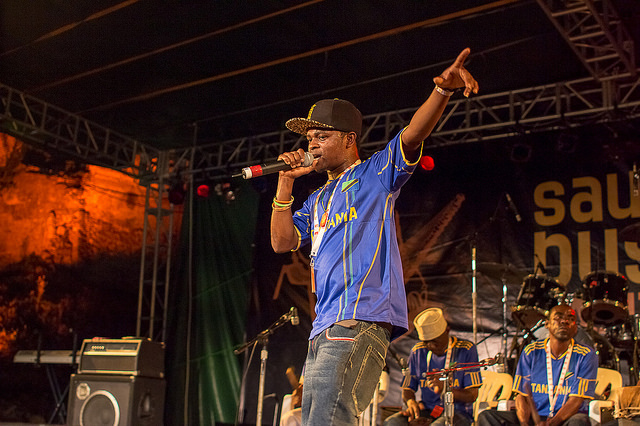
There are currently two major hip-hop events in Tanzania: Kilinge[iv] (Cypher) in Dar es Salaam and S.U.A (Saving Underground Artist)[v] in Arusha. While popular, these events do not draw huge audiences, arguably because these events are mostly promoted on the internet, whereas most Tanzanians depend on radio and television to get their news and adverts.
Media houses in Tanzania seem to favour genres other than hip-hop, due to both economic and political factors. The main reason is because media houses believe that hip-hop has lower sales compared to other kinds of music, such as Taarab, dance, Bongo Flava or gospel. This belief is summed up in the track ‘Hip-Hop Haiuzi’[vi] (‘Hip-hop has no sales’) by Madee (2007). Some of his lyrics are:“Hip-hop haiuzi, hip-hop hailipi; hip-hop kibongo bongo, ni bora uuze pipi”(Hip-hop has no sales, hip-hop has no pay; it is better to retail peppermint than do hip-hop in Tanzania).These days, you cannot find hip-hop on well-known radio and television stations. As a result, many Tanzanian MCs currently supply their music through the internet rather than depend on radio airplay.
From the end of 1980s until the early 2000s, hip-hop was the most popular youth music in Tanzania. Though many artists were famous, they did not earn decent pay. The same could be said of most artists of other genres, although local promoters, retailers and media seemed to ignore hip-hop specifically. Kibona (2013) suggests that “the international market could be a platform from which Tanzanian emcees could find some reward, as the ‘survival of the fittest’ environment of the international market will separate the mediocre from the talented. Finding success abroad would increase the value of Tanzanian hip-hop emcees in the Tanzanian music scene as well”. While financial security and international success have so far remained elusive for most Tanzanian hip-hop artists, the genre nevertheless remains an important part of the country’s musical landscape.
References
- Englert B. (2003). “Bongo Flava (still) hidden: ‘Underground’ rap from Morogoro, Tanzania”. Stichproben (Wiener Zeitschrift für kritische Afrikastudien), 5 (3), 73-93. Retreived from <http://stichproben.univie.ac.at/fileadmin/user_upload/p_stichproben/Artikel/Nummer05/Nr5_Englert.pdf>
- Gesthuizen T. (2001).“Saleh J - Tanzanian Pioneer”. Retrieved from<http://archive.africanhiphop.com/index.php?module=subjects&func=printpage&pageid=34&scope=all>
- Gesthuizen T.and P.J. Haas (2000).“Ndaniya Bongo: Kiswahili rap keepingitreal”.Mashindano! Competitive Music Performance in East Africa.Dar es Salaam: MkukinaNyotaPublishers.
- J4 (2009).“Tanzanian Hip Hop: The Old School (1991-1999)”. Retrieved from <http://archive.africanhiphop.com/index.php?module=subjects&func=viewpage&pageid=100>
- Mhagama M. (2008).“Chimbuko La MuzikiWaKizaziKipya Tanzania Na MaanaHalisiYaNeno Bongo Flava”. Retrieved from <www.bongocelebrity.wordpress.com>
- Kibona M. (2013).“The Struggle for Hip Hop Authenticity and Against Commercialization in Tanzania”.The Journal of Pan African Studies 6(3).
- Mwanjoka, G. (2011).Harakati za Bongo Fleva, 1st Ed. Dodoma, Kama Kawa.
- Nash M. (2014).“Nash Mc Atoa Taarifa Kwa Umma: Kuhusu Sanaa Nchini Na Hali Halisi ya Mapokeo ya Kibao ‘Kaka Suma’”. Retrieved from
- <http://nashemcee.blogspot.com/2014/03/nash-mc-atoa-taarifa-kwa-umma-kuhusu.html?m=1>
- Omary(2011).“Call Me ‘Top In Dar’1: The Role of Pseudonyms In Bongo FlevaMusic”. Swahili Forum 18.pp. 69-86.Retrieved from <www.jpanafrican.com>
- Quade, B., L. Martin& O. Ondego (2008).“The rise and rise of Tanzanian Bongo Flava music”.ArtMatters.Info: Flaunting Arts and Culture in Africa. Retrieved from <http://artmatters.info/?p=1049>
- Suriano M. (2006).“Hip Hop and Bongo Flavour music in Contemporary Tanzania: Youths’ Experiences, Agency, Aspirations and Contradictions”. Paper submitted for the conference Youth and the Global South: Religion, Politics and the Making of Youth in Africa, Asia and the Middle East, Dakar, Senegal, 13–15 October 2006.Retrieved from <http://www.ascleiden.nl/Pdf/youthconfsuriano1.pdf>
[i]http://m.youtube.com/watch?v=NTuvvGNCvEc [ii]http://m.youtube.com/watch?v=RuFKDEkcjH0 [iii]http://m.youtube.com/watch?v=QeH5myY4vp0 [iv]http://m.youtube.com/watch?v=GeqAiuGMQdQ [v]http://m.youtube.com/watch?v=9SxbSbJww28 [vi]http://m.youtube.com/watch?v=twrVXARmwkQ


Most popular

Top Naija songs of 2026
31 Mar 2026

Top Afrobeats songs of 2026
19 Mar 2026
Ghana: Mr Eazi and MOLIY’s ‘Comfort’ earns Urban Music Awards nomination
21 Oct 2026

Top amapiano songs of 2026
16 Feb 2026
Open call: CANEX Music Business Lab and Songwriting Camp
15 Oct 2026
Nigeria: CANEX WKND unveils 2026 programme
21 Oct 2026
Disclaimer: Music In Africa provides a platform for musicians and contributors to embed music and videos solely for promotional purposes. If any track or video embedded on this platform violates any copyrights please inform us immediately and we will take it down. Please read our Terms of Use for more.

Subscribe to our monthly Newsletter
Follow us on social media


Please log in to post a comment.