




























































By Uchenna Ikonne
This text provides an overview of the origins, growth and status of Highlife music in West Africa.
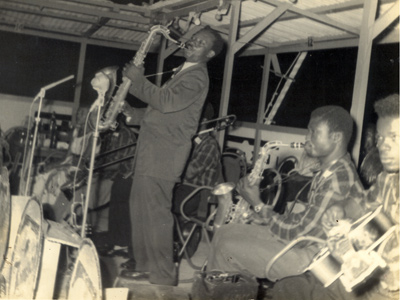
The origins of highlife
It’s difficult to identify the essence that defines highlife music, mostly because the sound, function and overall configuration of highlife have changed so frequently in the sixty years of the music’s existence. Or perhaps it’s been closer to 75 years that highlife’s been around? A century? Maybe even more than that? That’s the other thing: It’s even harder to definitively establish when—and where—highlife actually originated.
Did it come from Nigeria? Ghana? Sierra Leone? Did it sprout spontaneously in various points across the West African coast? Or did it arrive there from further beyond, over the Atlantic, somewhere in the Caribbean?
While the roots of highlife extend across West Africa, the Gold Coast—the country today known as Ghana—is typically recognized as the crux point at which all the streams coalesced. The Gold Coast had hosted a progressive music tradition starting with adaha, an Africanized brass band style dating back to the mid-nineteenth century when His Majesty’s West India Regiment of Jamaica was stationed in the Cape Coast region, bringing drum & fife and brass band military marches, and Caribbean melodies.
While the popularity of adaha spread across the country, its performance was dependent upon the possession of very expensive brass instruments, so in less elite circles, down-market versions of the music emerged such as osibisaaba—which was built upon percussion effects and melodies played on more accessible instruments such as the guitar and accordion.
The guitar was originally popularized by sailors from the Kru coast of Liberia. By the early twentieth century, as they traversed the ports of West Africa, they spread a basic, cross-fingered playing style as they sang tunes influenced by English sea chanteys and West Indian airs.
As the style filtered into Sierra Leone, it became known as maringa or more colloquially, “palm wine music”—it was typically played at bars where the locally fermented beverage was served. In Ghana, the innovative guitarist Jacob Sam modified the palm wine sound, supplementing the guitar with indigenous rhythm accompaniment from his Kumasi Trio, and sometime around 1919, composed “Yaa Amponsah,” the song that is today viewed as the prototype for a new genre, “highlife.”
But why “highlife”? It is believed that the name arose as a reflection of the more glamourous profile given to the music by the high-society orchestras that played at formal dances organized by the emerging Ghanaian elite. While these orchestras and their audiences took pride in their flawless rendition of Western ballroom music, by the early 1920s, they were peppering their repertoire with the occasional big-band arrangement of a palm wine tune.
These numbers were usually received joyously by the audience, who welcomed the opportunity to break from the rigid, copiously rehearsed steps of the waltz, fox trot, quickstep, tango and quadrille, and lose themselves in the unchoreographed, hip-rolling movements of the familiar local rhythms. These balls were swanky affairs open only to those who could afford the accouterments of upward mobility required for admission, but the proletariat were allowed to lurk outside, peering through the windows to observe the exuberant proceedings within.
“The term ‘highlife’ was created by people who gathered around the dancing clubs,” remembers orchestra musician Yebuah Mensah, “to watch and listen to the couples enjoying themselves. Highlife started as a catch-name for the indigenous songs played at these clubs by such early bands as the Jazz Kings, the Cape Coast Sugar Babies, the Sekondi Nanshamang, and later the Accra Orchestra.
The people outside called it highlife as they did not reach the class of the couples going inside, who not only had to pay high entrance fee of 7s. 6d., but also had to wear full evening dress including top hats.”
The evolution and growth of Highlife: The E.T.Mensah legacy
The man who would be responsible for taking the highlife out of the exclusive ballrooms and bringing it to the people outside was Yebuah Mensah’s younger brother, Emmanuel Tetteh Mensah (1919-1996). E.T. Mensah started out playing in the large ballroom orchestras, but as American soldiers stationed in Ghana after the Second World War popularized jazz and swing dancing, Mensah achieved prominence with the Tempos, a smaller, swing-style combo that played new styles such calypso as well as a jazz-accented version of highlife.
E.T. Mensah and the Tempos created a sensation when they toured Nigeria in 1953; Nigerian radio stations started playing nothing but E.T. Mensah records and Nigerian bands had to start playing Mensah’s numbers to satisfy the dancing public’s boundless appetite for the new Ghanaian sound. Bobby Benson (1921-1983)—whose Jam Session Orchestra typically specialized in jazz, blues, calypso and mambo—was the first Nigerian bandleader to take a tentative stab at emulating Mensah.
However, Nigeria’s first true highlife superstar was Victor Olaiya (b. 1931) who by the late nineteen fifties had started filling his entire sets with nothing but songs by Mensah (as well as by the Black Beats, the Red Spots, the Rhythm Aces and the other new Ghanaian dance bands that had sprouted in the wake of the Mensah phenomenon) translated into local Nigerian languages.
Mensah toured extensively across West Africa, going to Dahomey (present-day Republic of Benin), Cameroon, Liberia, Sierra Leone, Guinea and Togo, establishing his highlife as the most stylishly modern of African sounds, an African music of the future, emblematic of a continent that was steadily marching towards independence from colonialism.
In fact, not long after Ghana achieved independence in 1957, President Kwame Nkrumah declared highlife as the official music of the new nation. Nigerian musicians such as Roy Chicago (1931?-1989) actively worked to detach highlife from its Ghanaian associations by infusing it with local elements such as the Yoruba talking drum.
Growth of Highlife across the West Afrcian Coast 1960- present day
The bandleader who was celebrated more than any other for investing a distinctly Nigerian character to highlife was Rex Jim Lawson (1937-1971), who drew from the rhythms of ashiko and other indigenous pre-highlife social music from his native Niger Delta region. After Nigeria’s independence in 1960, it too was laying claim to highlife as its own national music.
Meanwhile in Sierra Leone, Mensah’s music was widely enjoyed, but the Tempos-style dance band concept never took root locally, and the old palm-wine guitar band style remained dominant, particularly as practiced by Ebenezer Calendar (1912-1985) and his Maringer Band, S.E. Rogie (1926-1994) and Famous Scrubbs.
However, highlife’s status as Nigeria’s national music was torpedoed by the civil war of 1967 to 1970. As the country splintered along ethnic and political lines, so did its music preference. Most highlife musicians hailed from the eastern region of the country, which was attempting to secede from the union.
As they deserted the then-national capital of Lagos to return to their homelands, the Yoruba-centric juju style expanded to fill the void. Highlife would never again be the universally beloved, multiethnic voice of a unified Nigeria, but it would continue to thrive in eastern and midwestern Nigeria, undergoing even more permutations.
Stephen Osita Osadebe (1936-2007) and Celestine Ukwu (1940-1977) transformed the dance band tradition by drawing increasingly from Igbo folklore and toning down the brassy bombast with languid, low-simmering Afro-Cuban rhythms. Victor Uwaifo similarly drew on Cuban music and the folklore of his native Edo land as well as rock n’ roll to develop his own highlife variant called akwassa. The Igbo ensemble Oriental Brothers ditched the dance bands’ emphasis on horn sections and universalized a flashy new guitar band model influenced more by the sizzling, interlocking electric guitar solos of the soukous and rumba music from Congo and Cameroon than by “Yaa Amponsah.”
The new guitar highlife also took hold in Ghana, where the old dance band style had lost ground to imported styles like soul and reggae, spawning new stars like the African Brothers, Alex Konadu’s Band, the City Boys and K. Gyasi’s Noble Kings. But in the end, the political and economic instability of the 1980’s brought highlife’s contemporary cultural currency to an effective halt.
Conclusion
Highlife’s spirit has never been quenched completely, though—it’s just gone undercover. Highlife, in its time, enshrined itself as the fundamental musical lingua franca of Anglophone (and parts of Francophone) West Africa and its rhythmic and melodic concepts are the DNA that has continued to animate a range of regional sounds that have emerged in the years since its heyday.
“Every music in Nigeria borrows one thing or the other from highlife,” says Victor Olaiya, still actively keeping the highlife flame alight in his eighties. “Name it: fuji, juju, afro juju, afro anything; they all take or or two things from highlife.”
If you listen carefully, you can even hear highlife’s off-beat rhythm whispering at the edges of the globally fashionable “Naija” hip-hop. The Ghanaian variant of this modern style is even more upfront about drawing the connection in its name: “hiplife.”
So while the days of self-consciously cultured Africans in evening gowns, top hats and tails expressing their Africanity to native rhythms played by Western-oriented ballroom orchestras may be a fading memory, West Africa is still living the highlife.


Most popular

Top Naija songs of 2026
31 Mar 2026

Top Afrobeats songs of 2026
19 Mar 2026

Ghana: Mr Eazi and MOLIY’s ‘Comfort’ earns Urban Music Awards nomination
21 Oct 2026

Top amapiano songs of 2026
16 Feb 2026

Open call: CANEX Music Business Lab and Songwriting Camp
15 Oct 2026

Nigeria: CANEX WKND unveils 2026 programme
21 Oct 2026
Disclaimer: Music In Africa provides a platform for musicians and contributors to embed music and videos solely for promotional purposes. If any track or video embedded on this platform violates any copyrights please inform us immediately and we will take it down. Please read our Terms of Use for more.

Subscribe to our monthly Newsletter
Follow us on social media


Please log in to post a comment.