






























































By Problem Masau
Music is a universal language that unites a people and as such Zimbabwe’s music landscape has continuously evolved over the years. From the days of Chimurenga to the advent of a new genre that has taken over at the moment, Zim-Dancehall, one thing remains - the power of music has shaped the nation. There are many genres, but these are the most popular.
Chimurenga
This was the famous prior to independence and just after independence. Chimurenga is a Shona word which means a struggle. Zimbabwe’s wars against the settler regime are called Chimurenga. Prior to independence Chimurenga was sung as a morale booster to the liberation fighters. Following independence, Chimurenga music usually delves on the social injustices perpetrated by the government. The music was pioneered by Thomas Mapfumo who now stays in United States of America. Thomas Mapfumo remains one of the best protest singers to ever come out of Zimbabwe. Some of Thomas Mpapfumo’s album has been banned on government radio stations. These are Toi Toi (2004), Rise Up (2006), The Long Walk (2007) and Exile (2010). Thomas Mapfumo has never returned to Zimbabwe since he relocated to United States of America more than a decade ago though he has performed in neighbouring South Africa a couple of times.
Other musicians to follow in Thomas Mapfumo’s footsteps are the late Pio Farai Macheka and human rights activist Raymond Majongwe. Unfortunatley, Raymond Majongwe’s music has been banned on all radio stations[i]. Another musician who is currently doing well singing the Chimurenga genre is Jairos Chabvonga. Chabvonga who fronts the group Ngorimba Afro Fusion is slowly finding his footing attracting sizeable crowd at his shows[ii].
Neo-traditional music
Zimbabwe’s traditional music is diverse depending on the region of the country. The mbira is synomous with Zimbabwean traditional music and many popular contemporary acts have drawn inspiration from it to forge new sounds. One of the first to do so was Mbuya Stella Chiweshe, who found international success since the early 1980s, touring throughout Europe and Asia. The well-travelled singer is now based in Germany but occasionally returns to perform in Zimbabwe.
Another famous artist to find international success with the mbira was the late Chiwoniso Maraire, the US-born daughter of musician Dumisani Maraire. Though she was young, her deep knowledge of Shona culture and intricate skills of playing the mbira went endeared her to many fans. She passed away in 2013 at the age of 37. Chiwoniso was also the former wife of the late Andy Brown, another influential and revered figure in Zimbabwean popular music whose work since the 1980s with groups such as Ilanga and later The Storm bridged many different styles and genres.
Continuing the legacy of Chiweshe and Maraire, Hope Masike is arguably the “next big thing” to play the same genre[iii]. A talented mbira player, singer and dancer, she has performed in countries such as Denmark, Italy and Sweden, among others. Her 2012 album Mbira, Love and Chocolate was recorded in Norway and Zimbabwe with renowned Zimbabwean producer and session guitarist Clive 'Mono' Mukundu. Masike’s 'Mbiracentric’ concerts see her fuse mbira sounds with various bands of other music genres, such as hip-hop, jazz and sungura.
Jiti
During the 1980s, a popular style of guitar-driven dance music emerged known as Jiti (aka Jit or Jit-Jive). The dance revolved on the fast drum beat fused with the sound of a guitar. It’s influences include local Chimurenga and Sungura music, as well as Congolese rumba and even Tanzanian guitar styles.
Some of the musicians who popularised the genre included the late Biggie Tembo, who fronted the Bhundu Boys, and Mike Mopo & Zinawa of ‘Ndati huya titambe’ fame. Mopo has since retired from music to become a successful businessman. The Bhundu Boys enjoyed huge success during their heydays. They were the first Zimbabwean group to make it big in United Kingdom. They temporarily relocated to England and shared stages with global stars like Madonna. However, disagreements in the group forced the band to dismantle, with the lead vocalist Biggie Tembo returning to Zimbabwe in a huff.
Biggie Tembo Junior, the son of the legendary Bhundu Boys frontman, has since tried to revive his father’s legacy, albeit with little success. To date, he has released two albums which have not been warmly welcomed[iv]. However, Potiphar, son of Mike Mopo, is currently doing well with his song ‘Makandiberekereiko’. Another popular band associated with Jiti who found international success in the 1980s was The Four Brothers.
Sungura & Dendera
Sungura is a mixture of the bass guitar, rhythm guitar and lead guitar sounds fused with a fast paced rhumba and the East African Kanindo beat. The sound relies heavily on bass guitar baseline and drums. The sungura genre became popular in 1980s with musicians such as Ephraim Joe, John Chibadura, Michael Jambo, System Tazvida (Chazezesa Challengers), Nicholas Zakaria, among others coming on board. The late Leonard Dembo was the probably the best sungura artist to ever come out of Zimbabwe and his song ‘Chitekete’ was used as a backtrack in 1994 at Miss World beauty pageant held in Namibia[v].
After the death of most of the sungura pioneers, Alick Macheso naturally assumed the throne of the most successful musician. His albums Simbaradzo (2000) and Zvakanaka Zvakadaro (2002) went platinum[vi].
Labels associated with this genre include Diamond Studios, Zimbabwe Music Corporation (ZMC) and the now-defunct Last Power Records, owned by Alick Macheso.
Dendera music is a different type of sungura music in that though there all three guitars (bass, rhythm and lead guitars) used to produce the sungura sound, more emphasis is put on the hornbill sound. Dendera is a Shona word which means Hornbill bird. The genre was pioneered by the Chimbetu Brothers, Simon, Naison and Allan, while their sons Suluman, Douglas and Tryson have continued with the legacy. Suluman has enjoyed success over his peers and the commercial world seem to have faith in him[vii]. He has won several endorsements over the years he is the Zimbabwe National Traffic Revenue Authority brand ambassador, Vaseline Blue Seal local ambassador, Population Service International ambassador among others[viii].
Gospel
Gospel music was generally unpopular in Zimbabwe because recording companies usually did not want to record gospel musicians. They were only a few notable gospel artists during the 1980s and 1990s, such as Jordan Chataika and Mechanic Manyeruke. This changed at the turn of the millennium, arguably because economic hardships faced by the country led many people to turn to worship as the panacea of their problem. This saw the rise of musicians such as Charles Charamba, Fungisai Mashavave, Blessing Shumba, Mathias Mhere and Sabastian Magacha, among others. The musicians usually ride on popular hymns in church. Most of the singers fused different type of genres such as sungura and jazz. Most of the singers usually use their native languages, though lately some are now singing in English.
With a career that spans close to two decades, Charles Charamba is one of the most recognised faces in Zimbabwean gospel music. Contemporary gospel musicians such as Pastor G and Mudiwa Mtandwa have imported western beats in their music. Pastor G has introduced soul music influences, while Mudiwa Mtandwa has adopted hip-hop. Local labels and studios associated with gospel include Metro Sounds, Gospel Train and Ngaavongwe Records.
Urban Grooves
In 2002, Zimbabwe’s government introduced 100% local content quota on all radio stations. This quickly gave rise to a new genre, christened Urban Grooves[ix]. Young musicians embraced western hip-hop and fused it with the local flair. The music genre saw the rise of musicians such as Alexio Kawara, Maskiri, Rockford Josphats and Extra Large among other musicians. However, the genre is under serious threat from Zim Dancehall.
Rockford Josphats, who is simply known as Roki, is one of the artists credited for pioneering and shaping the genre. He is a former Big Brother contestant. The genre came to life with assistance from banker Gilbert Muvavarirwa, who formed Shamiso Productions working with Delani Makhalima, a former presenter on South Africa’s Metro FM. These two recruited untapped talent in the form of David Chifunyise, Roki, Alexio Kawara and their first compilation shall forever remain the ‘roots’ of urban grooves. As time progressed, more studios sprouted and the genre grew. Labels associated with Urban Grooves include Umsindo Records, Hesh Mfeshi, Eternity Records and This is Records.
Zim Dancehall
This is probably the new kid on the block in Zimbabwe entertainment. The genre is so popular to the extent that most sungura artistes are now performing in rural areas. Some of the musicians who are popular are Winky D, Sniper Storm and Killer T among others. Winky D has remained on top of his game and continues to release chart topping music[x].
What made Zim Dancehall so popular is that it is sung by ghetto youths who express their daily tribulations in songs. The musicians ride on a certain “riddim” (sound) produced in backyard studios. The musicians try to outwit each other with lyrical prowess and rhyming skills. The only difference with Jamaican dancehall is that the ‘riddim’ is produced localy and musicians usually sing in local language. Some labels associated with Zim Dancehall artists are Chill Spot Records, Vigilance Music and Sunshine Studios.
Other contemporary genres
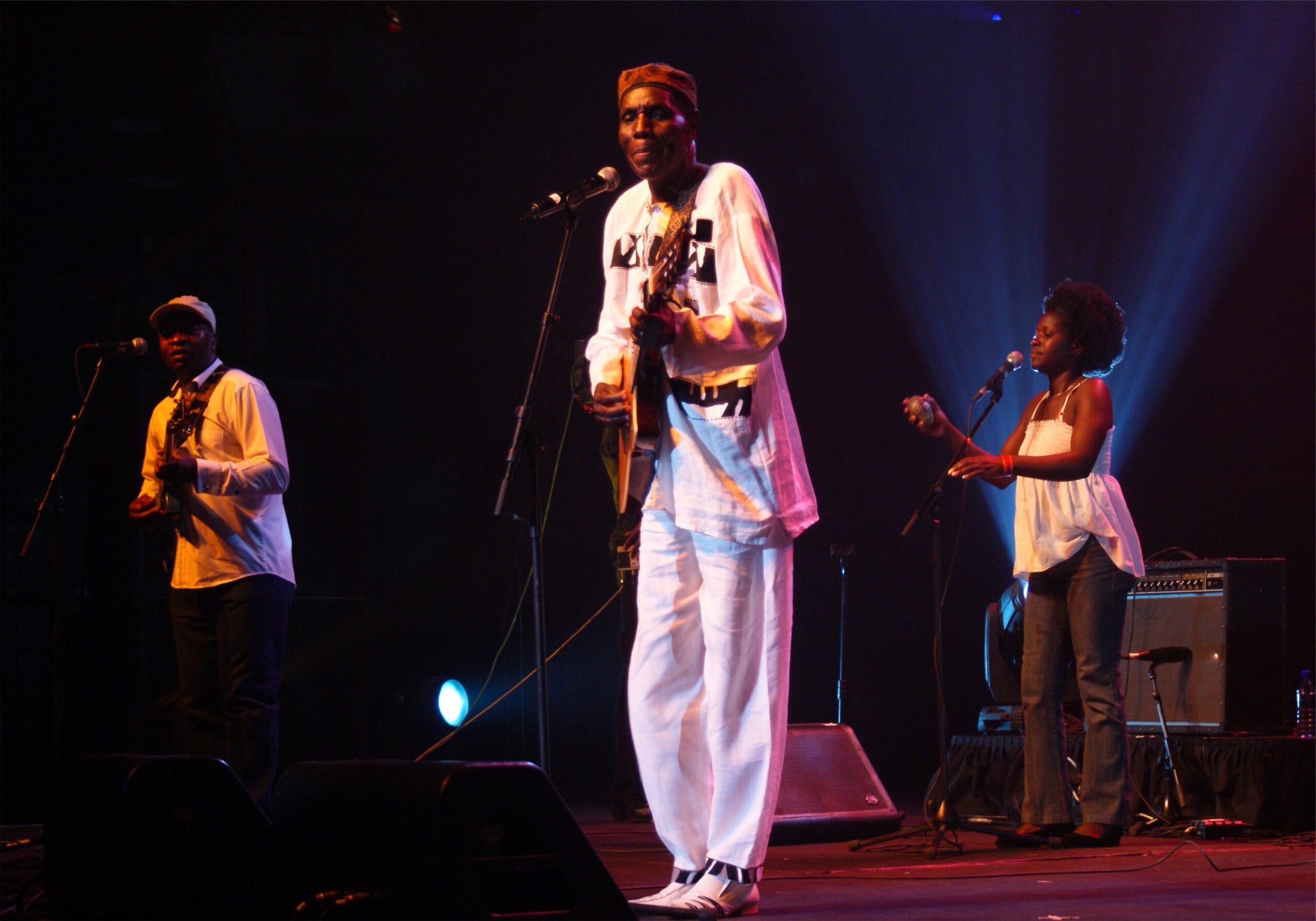
Oliver Mtukudzi remains the most successful musician in Zimbabwe. He has more than 60 albums under his belt. In 2014, he spent the first three months of the year touring Europe and America. He is also a member of the Southern African group Amahube. His fans call his music Tuku Music because he has his own sound that cannot be categorised in other genres. Tuku has trained other musicians like Munya Mataruse[xi] who is a product of his Pakare Paye Arts Centre in Norton. He was also grooming his son the late Sam Mtukudzi to take over from him. His daughter, Selmor has diverted from her father’s music genre and prefers to sing jazz or house music. Tuku reportedly does not see eye to eye with his daughter[xii].
Other styles of popular Zimbabwean music have not been categorised and are instead loosely labeled contemporary music. Big-selling performer Jah Prayzah has admitted that he is failing to name his music[xiii]. Comrade Chinx (aka Dickson Chingaira) is another popular artist, best known for his political songs supporting the ruling party, and as such is often labelled ‘revolutionary music’ or ‘liberation songs’. Mokoomba and Bongo Love similarly resort to vague labels such as ‘Afro-fusion’ and ‘Afrocoustics’ respectively. Both of these bands got their break by winning the Music Crossroads Interregional Festival and have since gone on to find more success abroad than at home, and thus sometimes simply define their sound as ‘world music’[xiv]15. The success of these and other musicians underlines the futility of pigeonholing artists according to genres, particularly in Zimbabwe’s rich and varied musical landscape.
Conclusion
Zimbabwe’s music continues to evolve. Though Zim Dancehall is currently enjoying widespread success, it has been referred to as ‘bubblegum’ music that may be enjoyed for many years to come, not unlike Urban Grooves before it. Older, more established genres like Chimurenga and Sungura, on the other hand, have stood the test of time and will likely be listened to for generations to come. Fans of these genres eagerly await new releases from big artistes such Alick Macheso, Nicholas Zakaria and others released albums, the music landscape is going to change.


Most popular

Top Naija songs of 2026
31 Mar 2026

Top Afrobeats songs of 2026
19 Mar 2026

Ghana: Mr Eazi and MOLIY’s ‘Comfort’ earns Urban Music Awards nomination
21 Oct 2026

Top amapiano songs of 2026
16 Feb 2026

Open call: CANEX Music Business Lab and Songwriting Camp
15 Oct 2026

Nigeria: CANEX WKND unveils 2026 programme
21 Oct 2026
Disclaimer: Music In Africa provides a platform for musicians and contributors to embed music and videos solely for promotional purposes. If any track or video embedded on this platform violates any copyrights please inform us immediately and we will take it down. Please read our Terms of Use for more.

Subscribe to our monthly Newsletter
Follow us on social media


Please log in to post a comment.